

52
M. Haumann
homogeneous transition metal catalyst was able to overcome this drawback of ionic
liquid and catalyst leaching [10].
A sulfoxantphos (sxp, see Fig. 3.2) modified Rh complex was dissolved in
[C 4 C 1 im][PF 6 ] and [C 4 C 1 im][n-C 8 H 17 OSO 3 ]. Commercially available porous silica gel was used as support material, providing a large internal surface area around
300 m
2 g
−1 . The activity was low with TOF values of only 18 h
−1 but could be
maintained for at least 4 h. In a follow-up study, the reaction was conducted in a
mini-plant setup that allowed higher conversion levels, yielding initial TOF values
around 70 h
−1 [11]. Hydroformylation of propylene was found to be first order in
substrate partial pressure, slightly positive order in hydrogen, and negative order
in carbon monoxide. These data are in accordance with the established Wilkinson
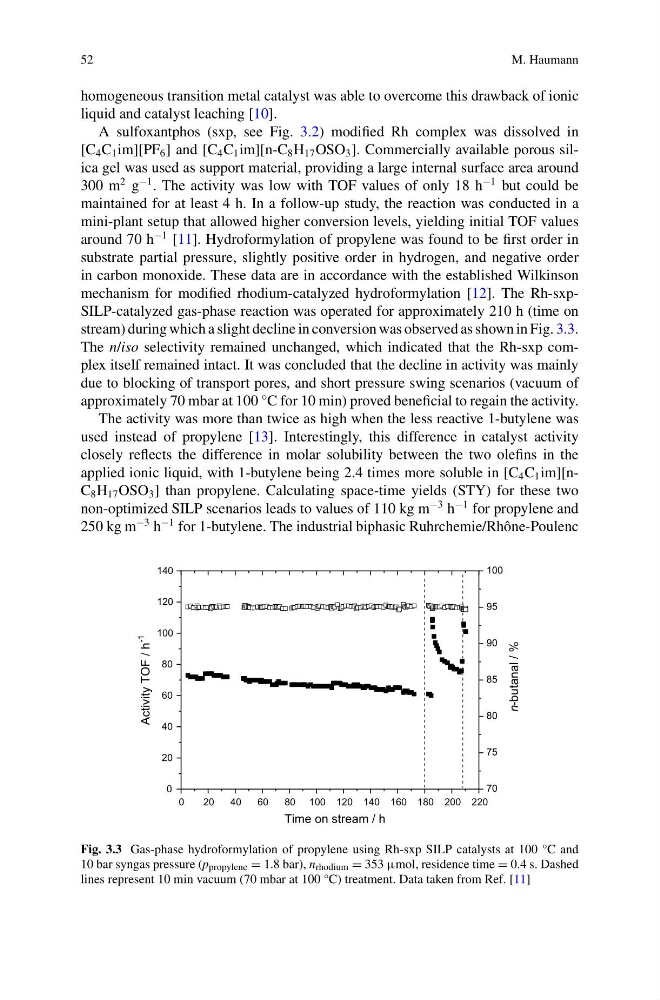
mechanism for modified rhodium-catalyzed hydroformylation [12]. The Rh-sxpSILP-catalyzed gas-phase reaction was operated for approximately 210 h (time on
stream) during which a slight decline in conversion was observed as shown in Fig. 3.3.
The n/iso selectivity remained unchanged, which indicated that the Rh-sxp complex itself remained intact. It was concluded that the decline in activity was mainly
due to blocking of transport pores, and short pressure swing scenarios (vacuum of
approximately 70 mbar at 100 °C for 10 min) proved beneficial to regain the activity.
The activity was more than twice as high when the less reactive 1-butylene was
used instead of propylene [13]. Interestingly, this difference in catalyst activity
closely reflects the difference in molar solubility between the two olefins in the
applied ionic liquid, with 1-butylene being 2.4 times more soluble in [C 4 C 1 im][nC 8 H 17 OSO 3 ] than propylene. Calculating space-time yields (STY) for these two
non-optimized SILP scenarios leads to values of 110 kg m
−3 h
−1 for propylene and
250 kg m
−3 h
−1 for 1-butylene. The industrial biphasic Ruhrchemie/Rhône-Poulenc
0
20
40
60
80 100 120 140 160 180 200 220
0
20
40
60
80
100
120
140
Time on stream / h
Activity TOF / h
-1
70
75
80
85
90
95
100
n-butanal / %
Fig. 3.3 Gas-phase hydroformylation of propylene using Rh-sxp SILP catalysts at 100 °C and
10 bar syngas pressure (p propylene = 1.8 bar), n rhodium = 353 µmol, residence time = 0.4 s. Dashed
lines represent 10 min vacuum (70 mbar at 100 °C) treatment. Data taken from Ref. [11]
M. Haumann
homogeneous transition metal catalyst was able to overcome this drawback of ionic
liquid and catalyst leaching [10].
A sulfoxantphos (sxp, see Fig. 3.2) modified Rh complex was dissolved in
[C 4 C 1 im][PF 6 ] and [C 4 C 1 im][n-C 8 H 17 OSO 3 ]. Commercially available porous silica gel was used as support material, providing a large internal surface area around
300 m
2 g
−1 . The activity was low with TOF values of only 18 h
−1 but could be
maintained for at least 4 h. In a follow-up study, the reaction was conducted in a
mini-plant setup that allowed higher conversion levels, yielding initial TOF values
around 70 h
−1 [11]. Hydroformylation of propylene was found to be first order in
substrate partial pressure, slightly positive order in hydrogen, and negative order
in carbon monoxide. These data are in accordance with the established Wilkinson
mechanism for modified rhodium-catalyzed hydroformylation [12]. The Rh-sxpSILP-catalyzed gas-phase reaction was operated for approximately 210 h (time on
stream) during which a slight decline in conversion was observed as shown in Fig. 3.3.
The n/iso selectivity remained unchanged, which indicated that the Rh-sxp complex itself remained intact. It was concluded that the decline in activity was mainly
due to blocking of transport pores, and short pressure swing scenarios (vacuum of
approximately 70 mbar at 100 °C for 10 min) proved beneficial to regain the activity.
The activity was more than twice as high when the less reactive 1-butylene was
used instead of propylene [13]. Interestingly, this difference in catalyst activity
closely reflects the difference in molar solubility between the two olefins in the
applied ionic liquid, with 1-butylene being 2.4 times more soluble in [C 4 C 1 im][nC 8 H 17 OSO 3 ] than propylene. Calculating space-time yields (STY) for these two
non-optimized SILP scenarios leads to values of 110 kg m
−3 h
−1 for propylene and
250 kg m
−3 h
−1 for 1-butylene. The industrial biphasic Ruhrchemie/Rhône-Poulenc
0
20
40
60
80 100 120 140 160 180 200 220
0
20
40
60
80
100
120
140
Time on stream / h
Activity TOF / h
-1
70
75
80
85
90
95
100
n-butanal / %
Fig. 3.3 Gas-phase hydroformylation of propylene using Rh-sxp SILP catalysts at 100 °C and
10 bar syngas pressure (p propylene = 1.8 bar), n rhodium = 353 µmol, residence time = 0.4 s. Dashed
lines represent 10 min vacuum (70 mbar at 100 °C) treatment. Data taken from Ref. [11]