

10 Development of New Cellulosic Fibers and Composites …
251
more promising results with PAN-based CF. However, today, cellulose-based CF
precursors have again evoked interest [94, 155, 162–164].
Naturally grown cellulose fibers are not suitable for the production of CFs due
to fiber morphology inhomogeneities and impurities, like proteins and lignin. The
porous structure leads to high brittleness after carbonization [94]. Well-defined filament fiber dimensions and high-purity cellulosic fibers can be produced by the viscose
or Lyocell process and by IL-technology processes. When processed as continuous
multi-filaments, they are considered and used as promising precursors. However, during carbonization, the total mass loss might be up to 90% due to degradation reactions
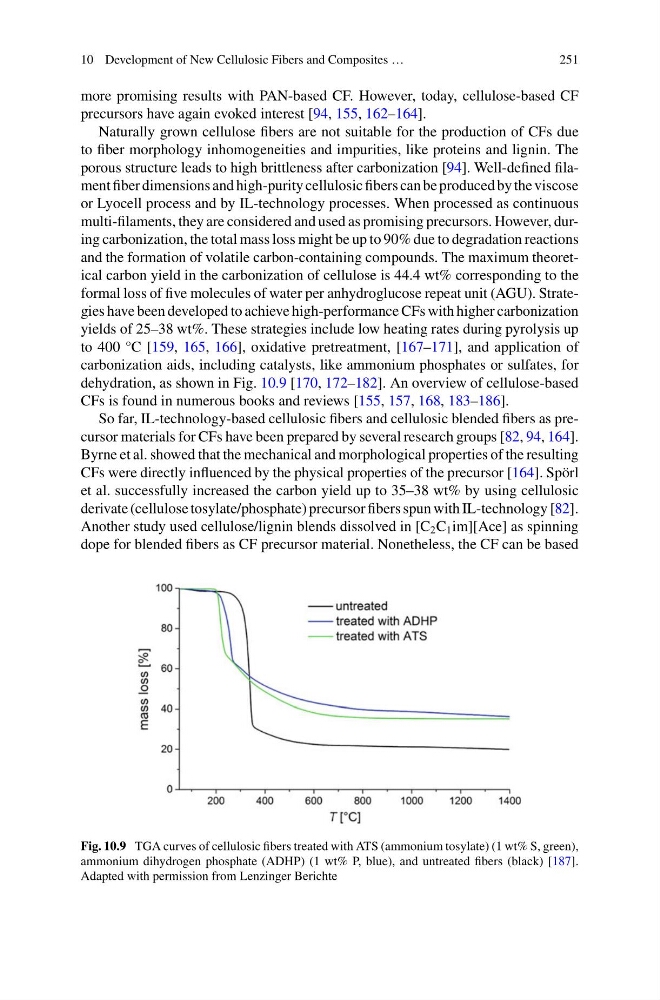
and the formation of volatile carbon-containing compounds. The maximum theoretical carbon yield in the carbonization of cellulose is 44.4 wt% corresponding to the
formal loss of five molecules of water per anhydroglucose repeat unit (AGU). Strategies have been developed to achieve high-performance CFs with higher carbonization
yields of 25–38 wt%. These strategies include low heating rates during pyrolysis up
to 400 °C [159, 165, 166], oxidative pretreatment, [167–171], and application of
carbonization aids, including catalysts, like ammonium phosphates or sulfates, for
dehydration, as shown in Fig. 10.9 [170, 172–182]. An overview of cellulose-based
CFs is found in numerous books and reviews [155, 157, 168, 183–186].
So far, IL-technology-based cellulosic fibers and cellulosic blended fibers as precursor materials for CFs have been prepared by several research groups [82, 94, 164].
Byrne et al. showed that the mechanical and morphological properties of the resulting
CFs were directly influenced by the physical properties of the precursor [164]. Spörl
et al. successfully increased the carbon yield up to 35–38 wt% by using cellulosic
derivate (cellulose tosylate/phosphate) precursor fibers spun with IL-technology [82].
Another study used cellulose/lignin blends dissolved in [C 2 C 1 im][Ace] as spinning
dope for blended fibers as CF precursor material. Nonetheless, the CF can be based
Fig. 10.9 TGA curves of cellulosic fibers treated with ATS (ammonium tosylate) (1 wt% S, green),
ammonium dihydrogen phosphate (ADHP) (1 wt% P, blue), and untreated fibers (black) [187].
Adapted with permission from Lenzinger Berichte
251
more promising results with PAN-based CF. However, today, cellulose-based CF
precursors have again evoked interest [94, 155, 162–164].
Naturally grown cellulose fibers are not suitable for the production of CFs due
to fiber morphology inhomogeneities and impurities, like proteins and lignin. The
porous structure leads to high brittleness after carbonization [94]. Well-defined filament fiber dimensions and high-purity cellulosic fibers can be produced by the viscose
or Lyocell process and by IL-technology processes. When processed as continuous
multi-filaments, they are considered and used as promising precursors. However, during carbonization, the total mass loss might be up to 90% due to degradation reactions
and the formation of volatile carbon-containing compounds. The maximum theoretical carbon yield in the carbonization of cellulose is 44.4 wt% corresponding to the
formal loss of five molecules of water per anhydroglucose repeat unit (AGU). Strategies have been developed to achieve high-performance CFs with higher carbonization
yields of 25–38 wt%. These strategies include low heating rates during pyrolysis up
to 400 °C [159, 165, 166], oxidative pretreatment, [167–171], and application of
carbonization aids, including catalysts, like ammonium phosphates or sulfates, for
dehydration, as shown in Fig. 10.9 [170, 172–182]. An overview of cellulose-based
CFs is found in numerous books and reviews [155, 157, 168, 183–186].
So far, IL-technology-based cellulosic fibers and cellulosic blended fibers as precursor materials for CFs have been prepared by several research groups [82, 94, 164].
Byrne et al. showed that the mechanical and morphological properties of the resulting
CFs were directly influenced by the physical properties of the precursor [164]. Spörl
et al. successfully increased the carbon yield up to 35–38 wt% by using cellulosic
derivate (cellulose tosylate/phosphate) precursor fibers spun with IL-technology [82].
Another study used cellulose/lignin blends dissolved in [C 2 C 1 im][Ace] as spinning
dope for blended fibers as CF precursor material. Nonetheless, the CF can be based
Fig. 10.9 TGA curves of cellulosic fibers treated with ATS (ammonium tosylate) (1 wt% S, green),
ammonium dihydrogen phosphate (ADHP) (1 wt% P, blue), and untreated fibers (black) [187].
Adapted with permission from Lenzinger Berichte