

248
F. Hermanutz et al.
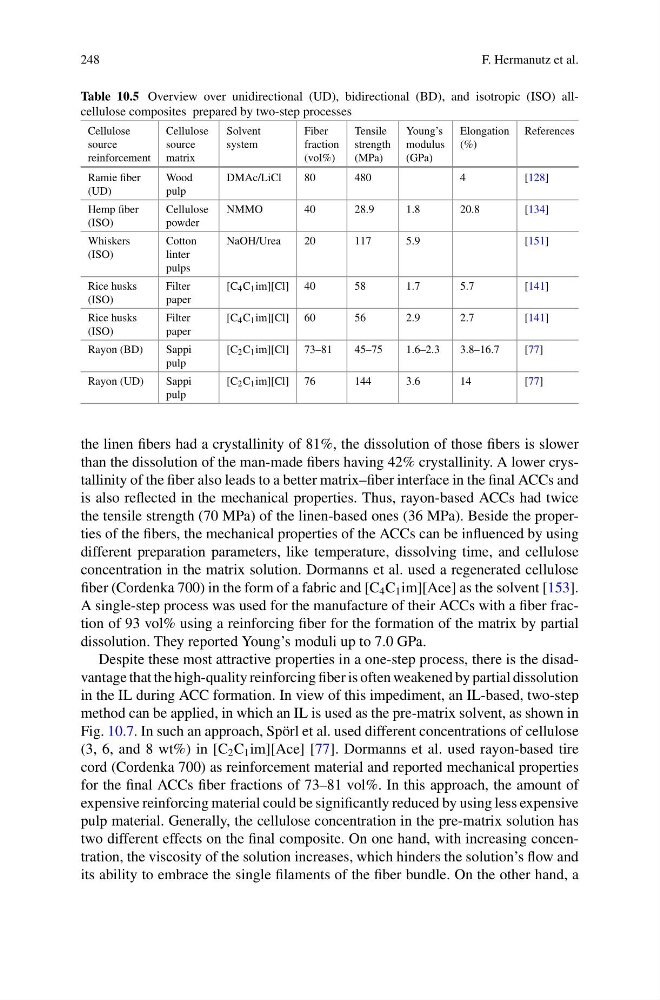
Table 10.5 Overview over unidirectional (UD), bidirectional (BD), and isotropic (ISO) allcellulose composites prepared by two-step processes
Cellulose
source
reinforcement
Cellulose
source
matrix
Solvent
system
Fiber
fraction
(vol%)
Tensile
strength
(MPa)
Young’s
modulus
(GPa)
Elongation
(%)
References
Ramie fiber
(UD)
Wood
pulp
DMAc/LiCl
80
480
4
[128]
Hemp fiber
(ISO)
Cellulose
powder
NMMO
40
28.9
1.8
20.8
[134]
Whiskers
(ISO)
Cotton
linter
pulps
NaOH/Urea
20
117
5.9
[151]
Rice husks
(ISO)
Filter
paper
[C 4 C 1 im][Cl] 40
58
1.7
5.7
[141]
Rice husks
(ISO)
Filter
paper
[C 4 C 1 im][Cl] 60
56
2.9
2.7
[141]
Rayon (BD)
Sappi
pulp
[C 2 C 1 im][Cl] 73–81
45–75
1.6–2.3
3.8–16.7
[77]
Rayon (UD)
Sappi
pulp
[C 2 C 1 im][Cl] 76
144
3.6
14
[77]
the linen fibers had a crystallinity of 81%, the dissolution of those fibers is slower
than the dissolution of the man-made fibers having 42% crystallinity. A lower crystallinity of the fiber also leads to a better matrix–fiber interface in the final ACCs and
is also reflected in the mechanical properties. Thus, rayon-based ACCs had twice
the tensile strength (70 MPa) of the linen-based ones (36 MPa). Beside the properties of the fibers, the mechanical properties of the ACCs can be influenced by using
different preparation parameters, like temperature, dissolving time, and cellulose
concentration in the matrix solution. Dormanns et al. used a regenerated cellulose
fiber (Cordenka 700) in the form of a fabric and [C 4 C 1 im][Ace] as the solvent [153].
A single-step process was used for the manufacture of their ACCs with a fiber fraction of 93 vol% using a reinforcing fiber for the formation of the matrix by partial
dissolution. They reported Young’s moduli up to 7.0 GPa.
Despite these most attractive properties in a one-step process, there is the disadvantage that the high-quality reinforcing fiber is often weakened by partial dissolution
in the IL during ACC formation. In view of this impediment, an IL-based, two-step
method can be applied, in which an IL is used as the pre-matrix solvent, as shown in
Fig. 10.7. In such an approach, Spörl et al. used different concentrations of cellulose
(3, 6, and 8 wt%) in [C 2 C 1 im][Ace] [77]. Dormanns et al. used rayon-based tire
cord (Cordenka 700) as reinforcement material and reported mechanical properties
for the final ACCs fiber fractions of 73–81 vol%. In this approach, the amount of
expensive reinforcing material could be significantly reduced by using less expensive
pulp material. Generally, the cellulose concentration in the pre-matrix solution has
two different effects on the final composite. On one hand, with increasing concentration, the viscosity of the solution increases, which hinders the solution’s flow and
its ability to embrace the single filaments of the fiber bundle. On the other hand, a
F. Hermanutz et al.
Table 10.5 Overview over unidirectional (UD), bidirectional (BD), and isotropic (ISO) allcellulose composites prepared by two-step processes
Cellulose
source
reinforcement
Cellulose
source
matrix
Solvent
system
Fiber
fraction
(vol%)
Tensile
strength
(MPa)
Young’s
modulus
(GPa)
Elongation
(%)
References
Ramie fiber
(UD)
Wood
pulp
DMAc/LiCl
80
480
4
[128]
Hemp fiber
(ISO)
Cellulose
powder
NMMO
40
28.9
1.8
20.8
[134]
Whiskers
(ISO)
Cotton
linter
pulps
NaOH/Urea
20
117
5.9
[151]
Rice husks
(ISO)
Filter
paper
[C 4 C 1 im][Cl] 40
58
1.7
5.7
[141]
Rice husks
(ISO)
Filter
paper
[C 4 C 1 im][Cl] 60
56
2.9
2.7
[141]
Rayon (BD)
Sappi
pulp
[C 2 C 1 im][Cl] 73–81
45–75
1.6–2.3
3.8–16.7
[77]
Rayon (UD)
Sappi
pulp
[C 2 C 1 im][Cl] 76
144
3.6
14
[77]
the linen fibers had a crystallinity of 81%, the dissolution of those fibers is slower
than the dissolution of the man-made fibers having 42% crystallinity. A lower crystallinity of the fiber also leads to a better matrix–fiber interface in the final ACCs and
is also reflected in the mechanical properties. Thus, rayon-based ACCs had twice
the tensile strength (70 MPa) of the linen-based ones (36 MPa). Beside the properties of the fibers, the mechanical properties of the ACCs can be influenced by using
different preparation parameters, like temperature, dissolving time, and cellulose
concentration in the matrix solution. Dormanns et al. used a regenerated cellulose
fiber (Cordenka 700) in the form of a fabric and [C 4 C 1 im][Ace] as the solvent [153].
A single-step process was used for the manufacture of their ACCs with a fiber fraction of 93 vol% using a reinforcing fiber for the formation of the matrix by partial
dissolution. They reported Young’s moduli up to 7.0 GPa.
Despite these most attractive properties in a one-step process, there is the disadvantage that the high-quality reinforcing fiber is often weakened by partial dissolution
in the IL during ACC formation. In view of this impediment, an IL-based, two-step
method can be applied, in which an IL is used as the pre-matrix solvent, as shown in
Fig. 10.7. In such an approach, Spörl et al. used different concentrations of cellulose
(3, 6, and 8 wt%) in [C 2 C 1 im][Ace] [77]. Dormanns et al. used rayon-based tire
cord (Cordenka 700) as reinforcement material and reported mechanical properties
for the final ACCs fiber fractions of 73–81 vol%. In this approach, the amount of
expensive reinforcing material could be significantly reduced by using less expensive
pulp material. Generally, the cellulose concentration in the pre-matrix solution has
two different effects on the final composite. On one hand, with increasing concentration, the viscosity of the solution increases, which hinders the solution’s flow and
its ability to embrace the single filaments of the fiber bundle. On the other hand, a