

10 Development of New Cellulosic Fibers and Composites …
247
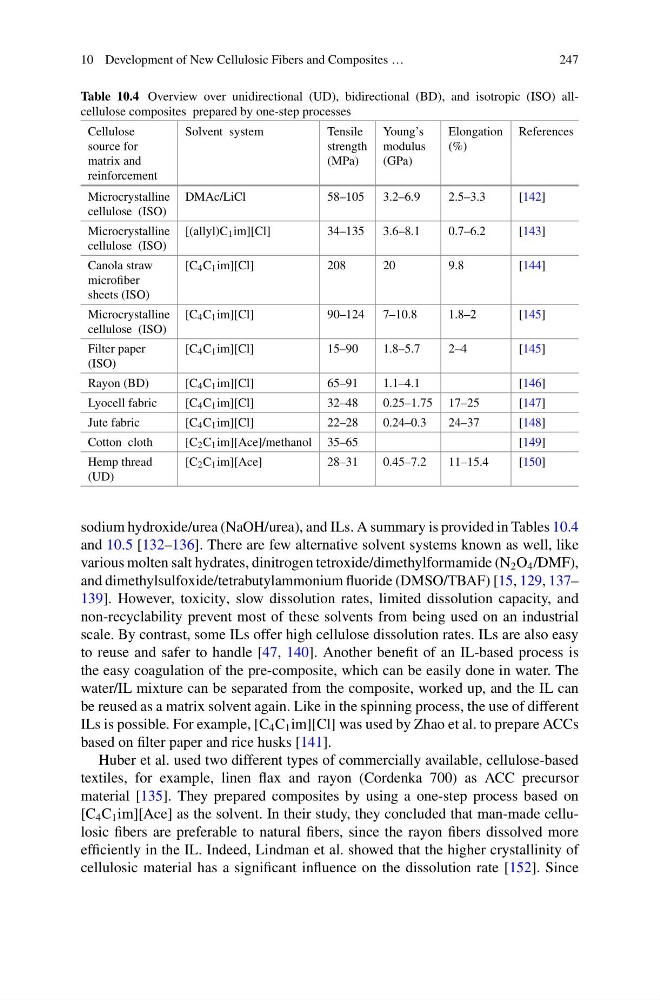
Table 10.4 Overview over unidirectional (UD), bidirectional (BD), and isotropic (ISO) allcellulose composites prepared by one-step processes
Cellulose
source for
matrix and
reinforcement
Solvent system
Tensile
strength
(MPa)
Young’s
modulus
(GPa)
Elongation
(%)
References
Microcrystalline
cellulose (ISO)
DMAc/LiCl
58–105 3.2–6.9
2.5–3.3
[142]
Microcrystalline
cellulose (ISO)
[(allyl)C 1 im][Cl]
34–135 3.6–8.1
0.7–6.2
[143]
Canola straw
microfiber
sheets (ISO)
[C 4 C 1 im][Cl]
208
20
9.8
[144]
Microcrystalline
cellulose (ISO)
[C 4 C 1 im][Cl]
90–124 7–10.8
1.8–2
[145]
Filter paper
(ISO)
[C 4 C 1 im][Cl]
15–90
1.8–5.7
2–4
[145]
Rayon (BD)
[C 4 C 1 im][Cl]
65–91
1.1–4.1
[146]
Lyocell fabric
[C 4 C 1 im][Cl]
32–48
0.25–1.75 17–25
[147]
Jute fabric
[C 4 C 1 im][Cl]
22–28
0.24–0.3
24–37
[148]
Cotton cloth
[C 2 C 1 im][Ace]/methanol 35–65
[149]
Hemp thread
(UD)
[C 2 C 1 im][Ace]
28–31
0.45–7.2
11–15.4
[150]
sodium hydroxide/urea (NaOH/urea), and ILs. A summary is provided in Tables 10.4
and 10.5 [132–136]. There are few alternative solvent systems known as well, like
various molten salt hydrates, dinitrogen tetroxide/dimethylformamide (N 2 O 4 /DMF),
and dimethylsulfoxide/tetrabutylammonium fluoride (DMSO/TBAF) [15, 129, 137–
139]. However, toxicity, slow dissolution rates, limited dissolution capacity, and
non-recyclability prevent most of these solvents from being used on an industrial
scale. By contrast, some ILs offer high cellulose dissolution rates. ILs are also easy
to reuse and safer to handle [47, 140]. Another benefit of an IL-based process is
the easy coagulation of the pre-composite, which can be easily done in water. The
water/IL mixture can be separated from the composite, worked up, and the IL can
be reused as a matrix solvent again. Like in the spinning process, the use of different
ILs is possible. For example, [C 4 C 1 im][Cl] was used by Zhao et al. to prepare ACCs
based on filter paper and rice husks [141].
Huber et al. used two different types of commercially available, cellulose-based
textiles, for example, linen flax and rayon (Cordenka 700) as ACC precursor
material [135]. They prepared composites by using a one-step process based on
[C 4 C 1 im][Ace] as the solvent. In their study, they concluded that man-made cellulosic fibers are preferable to natural fibers, since the rayon fibers dissolved more
efficiently in the IL. Indeed, Lindman et al. showed that the higher crystallinity of
cellulosic material has a significant influence on the dissolution rate [152]. Since
247
Table 10.4 Overview over unidirectional (UD), bidirectional (BD), and isotropic (ISO) allcellulose composites prepared by one-step processes
Cellulose
source for
matrix and
reinforcement
Solvent system
Tensile
strength
(MPa)
Young’s
modulus
(GPa)
Elongation
(%)
References
Microcrystalline
cellulose (ISO)
DMAc/LiCl
58–105 3.2–6.9
2.5–3.3
[142]
Microcrystalline
cellulose (ISO)
[(allyl)C 1 im][Cl]
34–135 3.6–8.1
0.7–6.2
[143]
Canola straw
microfiber
sheets (ISO)
[C 4 C 1 im][Cl]
208
20
9.8
[144]
Microcrystalline
cellulose (ISO)
[C 4 C 1 im][Cl]
90–124 7–10.8
1.8–2
[145]
Filter paper
(ISO)
[C 4 C 1 im][Cl]
15–90
1.8–5.7
2–4
[145]
Rayon (BD)
[C 4 C 1 im][Cl]
65–91
1.1–4.1
[146]
Lyocell fabric
[C 4 C 1 im][Cl]
32–48
0.25–1.75 17–25
[147]
Jute fabric
[C 4 C 1 im][Cl]
22–28
0.24–0.3
24–37
[148]
Cotton cloth
[C 2 C 1 im][Ace]/methanol 35–65
[149]
Hemp thread
(UD)
[C 2 C 1 im][Ace]
28–31
0.45–7.2
11–15.4
[150]
sodium hydroxide/urea (NaOH/urea), and ILs. A summary is provided in Tables 10.4
and 10.5 [132–136]. There are few alternative solvent systems known as well, like
various molten salt hydrates, dinitrogen tetroxide/dimethylformamide (N 2 O 4 /DMF),
and dimethylsulfoxide/tetrabutylammonium fluoride (DMSO/TBAF) [15, 129, 137–
139]. However, toxicity, slow dissolution rates, limited dissolution capacity, and
non-recyclability prevent most of these solvents from being used on an industrial
scale. By contrast, some ILs offer high cellulose dissolution rates. ILs are also easy
to reuse and safer to handle [47, 140]. Another benefit of an IL-based process is
the easy coagulation of the pre-composite, which can be easily done in water. The
water/IL mixture can be separated from the composite, worked up, and the IL can
be reused as a matrix solvent again. Like in the spinning process, the use of different
ILs is possible. For example, [C 4 C 1 im][Cl] was used by Zhao et al. to prepare ACCs
based on filter paper and rice husks [141].
Huber et al. used two different types of commercially available, cellulose-based
textiles, for example, linen flax and rayon (Cordenka 700) as ACC precursor
material [135]. They prepared composites by using a one-step process based on
[C 4 C 1 im][Ace] as the solvent. In their study, they concluded that man-made cellulosic fibers are preferable to natural fibers, since the rayon fibers dissolved more
efficiently in the IL. Indeed, Lindman et al. showed that the higher crystallinity of
cellulosic material has a significant influence on the dissolution rate [152]. Since