

246
F. Hermanutz et al.
10.4 Preparation of All-Cellulose Composites Using
IL-Technology
Fiber-reinforced plastics (FRPs) are important materials for lightweight construction and are progressively replacing traditional materials. The properties of composites [9] depend on the matrix, the reinforcing fiber, and the matrix–fiber interface
[123]. The matrix provides partial mechanical strength and works as a binder for the
reinforcing fibrous phase. Due to their good mechanical properties and availability,
cellulose fibers are intensively used in bio-composites and natural fiber-reinforced
plastics (NFRPs) [124–126]. Several duroplastic or thermoplastic polymers, including poly(vinyl chloride), poly(ethylene), epoxides, and polyurethanes, have been
used as matrices. Flax, hemp, cotton, among others are used as reinforcing fibers
[124, 127]. Generally, the adhesion at the interface between a hydrophobic polymer
matrix and a hydrophilic natural fiber is very weak [77, 127]. As a consequence,
mechanical strength, stiffness, and impact strength of the respective composites are
low, and the reinforcement potential of the fiber, for example, cellulose is only used
to a small extent. To overcome this drawback, all-cellulose composites (ACCs) were
first discussed as easily recyclable and biodegradable composites in 2004 [128, 129].
Due to an increased environmental awareness and increasingly restrictive legislative rules, the demand for recyclable and sustainable composites strongly increased
over the last few years [130]. Nishino et al. used a 3 wt% solution of cellulose in
N,N-dimethylacetamide (DMAc) containing 8 wt% LiCl as a matrix solution [128].
Ramie fibers were aligned parallel and impregnated with the cellulose solution under
reduced pressure. After 12 h, the fiber-reinforced cellulose gel was washed with
methanol to extract LiCl and DMAc to form the final composite. This manufacturing
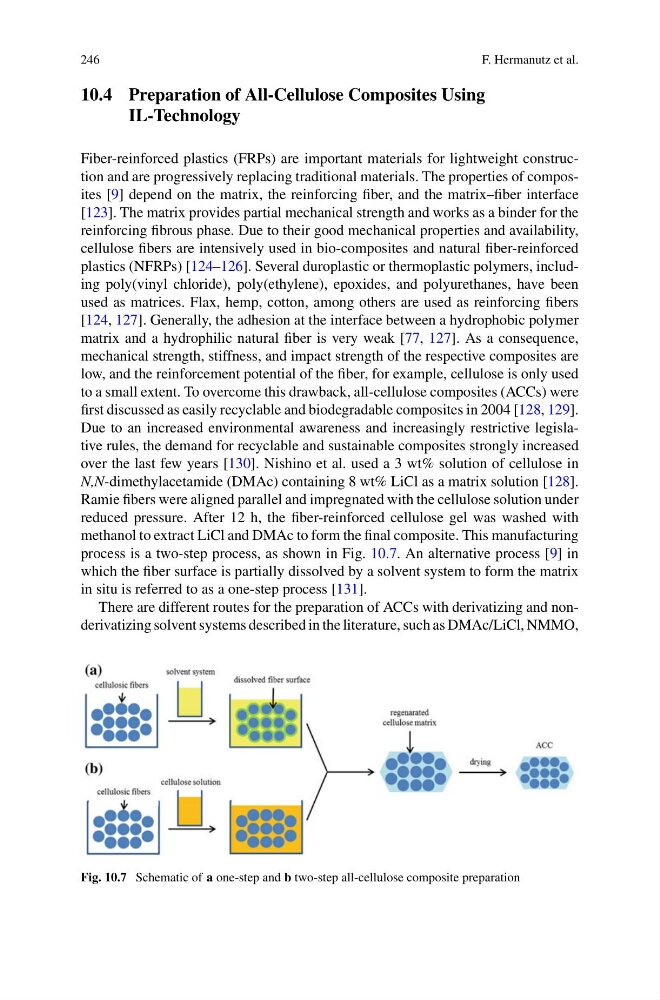
process is a two-step process, as shown in Fig. 10.7. An alternative process [9] in
which the fiber surface is partially dissolved by a solvent system to form the matrix
in situ is referred to as a one-step process [131].
There are different routes for the preparation of ACCs with derivatizing and nonderivatizing solvent systems described in the literature, such as DMAc/LiCl, NMMO,
Fig. 10.7 Schematic of a one-step and b two-step all-cellulose composite preparation
F. Hermanutz et al.
10.4 Preparation of All-Cellulose Composites Using
IL-Technology
Fiber-reinforced plastics (FRPs) are important materials for lightweight construction and are progressively replacing traditional materials. The properties of composites [9] depend on the matrix, the reinforcing fiber, and the matrix–fiber interface
[123]. The matrix provides partial mechanical strength and works as a binder for the
reinforcing fibrous phase. Due to their good mechanical properties and availability,
cellulose fibers are intensively used in bio-composites and natural fiber-reinforced
plastics (NFRPs) [124–126]. Several duroplastic or thermoplastic polymers, including poly(vinyl chloride), poly(ethylene), epoxides, and polyurethanes, have been
used as matrices. Flax, hemp, cotton, among others are used as reinforcing fibers
[124, 127]. Generally, the adhesion at the interface between a hydrophobic polymer
matrix and a hydrophilic natural fiber is very weak [77, 127]. As a consequence,
mechanical strength, stiffness, and impact strength of the respective composites are
low, and the reinforcement potential of the fiber, for example, cellulose is only used
to a small extent. To overcome this drawback, all-cellulose composites (ACCs) were
first discussed as easily recyclable and biodegradable composites in 2004 [128, 129].
Due to an increased environmental awareness and increasingly restrictive legislative rules, the demand for recyclable and sustainable composites strongly increased
over the last few years [130]. Nishino et al. used a 3 wt% solution of cellulose in
N,N-dimethylacetamide (DMAc) containing 8 wt% LiCl as a matrix solution [128].
Ramie fibers were aligned parallel and impregnated with the cellulose solution under
reduced pressure. After 12 h, the fiber-reinforced cellulose gel was washed with
methanol to extract LiCl and DMAc to form the final composite. This manufacturing
process is a two-step process, as shown in Fig. 10.7. An alternative process [9] in
which the fiber surface is partially dissolved by a solvent system to form the matrix
in situ is referred to as a one-step process [131].
There are different routes for the preparation of ACCs with derivatizing and nonderivatizing solvent systems described in the literature, such as DMAc/LiCl, NMMO,
Fig. 10.7 Schematic of a one-step and b two-step all-cellulose composite preparation