

10 Development of New Cellulosic Fibers and Composites …
245
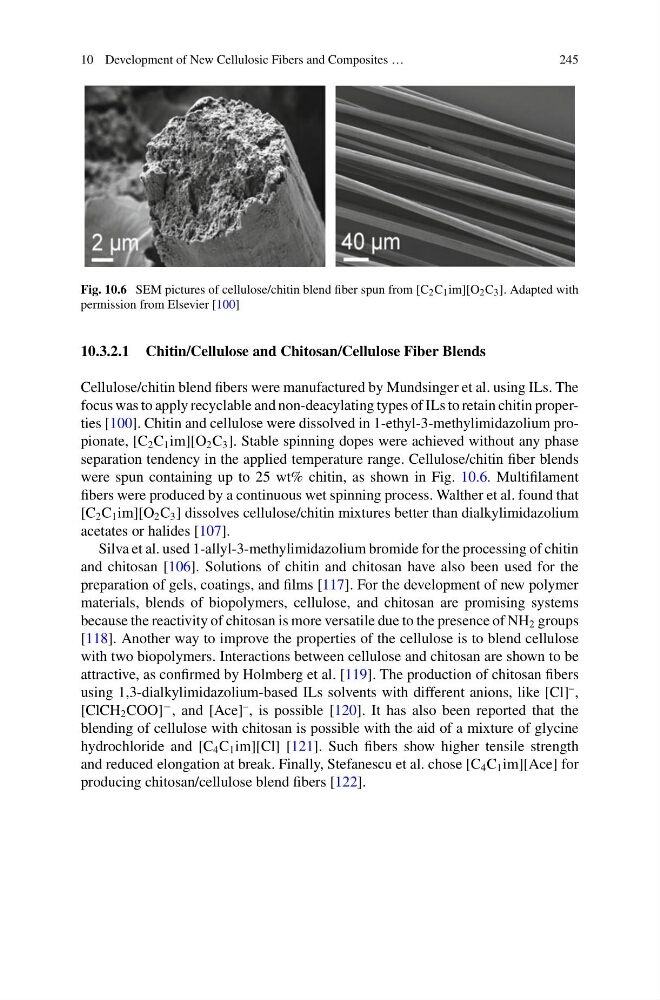
Fig. 10.6 SEM pictures of cellulose/chitin blend fiber spun from [C 2 C 1 im][O 2 C 3 ]. Adapted with
permission from Elsevier [100]
10.3.2.1 Chitin/Cellulose and Chitosan/Cellulose Fiber Blends
Cellulose/chitin blend fibers were manufactured by Mundsinger et al. using ILs. The
focus was to apply recyclable and non-deacylating types of ILs to retain chitin properties [100]. Chitin and cellulose were dissolved in 1-ethyl-3-methylimidazolium propionate, [C 2 C 1 im][O 2 C 3 ]. Stable spinning dopes were achieved without any phase
separation tendency in the applied temperature range. Cellulose/chitin fiber blends
were spun containing up to 25 wt% chitin, as shown in Fig. 10.6. Multifilament
fibers were produced by a continuous wet spinning process. Walther et al. found that
[C 2 C 1 im][O 2 C 3 ] dissolves cellulose/chitin mixtures better than dialkylimidazolium
acetates or halides [107].
Silva et al. used 1-allyl-3-methylimidazolium bromide for the processing of chitin
and chitosan [106]. Solutions of chitin and chitosan have also been used for the
preparation of gels, coatings, and films [117]. For the development of new polymer
materials, blends of biopolymers, cellulose, and chitosan are promising systems
because the reactivity of chitosan is more versatile due to the presence of NH 2 groups
[118]. Another way to improve the properties of the cellulose is to blend cellulose
with two biopolymers. Interactions between cellulose and chitosan are shown to be
attractive, as confirmed by Holmberg et al. [119]. The production of chitosan fibers
using 1,3-dialkylimidazolium-based ILs solvents with different anions, like [Cl]
– ,
[ClCH 2 COO]
− , and [Ace]
– , is possible [120]. It has also been reported that the
blending of cellulose with chitosan is possible with the aid of a mixture of glycine
hydrochloride and [C 4 C 1 im][Cl] [121]. Such fibers show higher tensile strength
and reduced elongation at break. Finally, Stefanescu et al. chose [C 4 C 1 im][Ace] for
producing chitosan/cellulose blend fibers [122].
245
Fig. 10.6 SEM pictures of cellulose/chitin blend fiber spun from [C 2 C 1 im][O 2 C 3 ]. Adapted with
permission from Elsevier [100]
10.3.2.1 Chitin/Cellulose and Chitosan/Cellulose Fiber Blends
Cellulose/chitin blend fibers were manufactured by Mundsinger et al. using ILs. The
focus was to apply recyclable and non-deacylating types of ILs to retain chitin properties [100]. Chitin and cellulose were dissolved in 1-ethyl-3-methylimidazolium propionate, [C 2 C 1 im][O 2 C 3 ]. Stable spinning dopes were achieved without any phase
separation tendency in the applied temperature range. Cellulose/chitin fiber blends
were spun containing up to 25 wt% chitin, as shown in Fig. 10.6. Multifilament
fibers were produced by a continuous wet spinning process. Walther et al. found that
[C 2 C 1 im][O 2 C 3 ] dissolves cellulose/chitin mixtures better than dialkylimidazolium
acetates or halides [107].
Silva et al. used 1-allyl-3-methylimidazolium bromide for the processing of chitin
and chitosan [106]. Solutions of chitin and chitosan have also been used for the
preparation of gels, coatings, and films [117]. For the development of new polymer
materials, blends of biopolymers, cellulose, and chitosan are promising systems
because the reactivity of chitosan is more versatile due to the presence of NH 2 groups
[118]. Another way to improve the properties of the cellulose is to blend cellulose
with two biopolymers. Interactions between cellulose and chitosan are shown to be
attractive, as confirmed by Holmberg et al. [119]. The production of chitosan fibers
using 1,3-dialkylimidazolium-based ILs solvents with different anions, like [Cl]
– ,
[ClCH 2 COO]
− , and [Ace]
– , is possible [120]. It has also been reported that the
blending of cellulose with chitosan is possible with the aid of a mixture of glycine
hydrochloride and [C 4 C 1 im][Cl] [121]. Such fibers show higher tensile strength
and reduced elongation at break. Finally, Stefanescu et al. chose [C 4 C 1 im][Ace] for
producing chitosan/cellulose blend fibers [122].