

242
F. Hermanutz et al.
newly developed spinnerets with hole diameters down to 20 μm. These new kinds
of spinnerets were manufactured using laser drilling technology. Laser-drilled spinnerets with up to 1500 holes have been realized [97]. Different hole geometries were
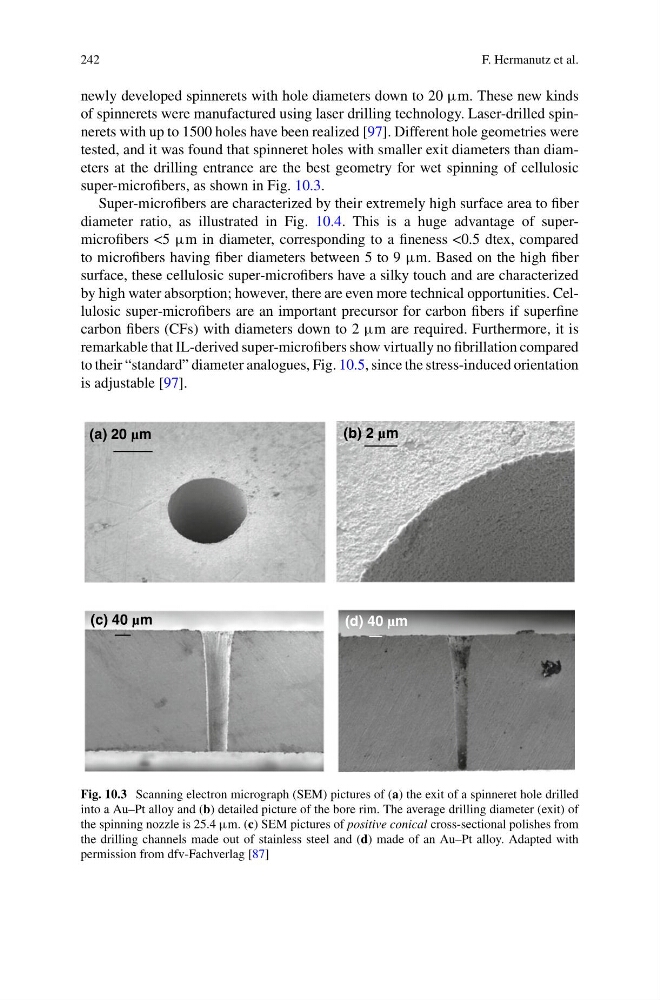
tested, and it was found that spinneret holes with smaller exit diameters than diameters at the drilling entrance are the best geometry for wet spinning of cellulosic
super-microfibers, as shown in Fig. 10.3.
Super-microfibers are characterized by their extremely high surface area to fiber
diameter ratio, as illustrated in Fig. 10.4. This is a huge advantage of supermicrofibers <5 μm in diameter, corresponding to a fineness <0.5 dtex, compared
to microfibers having fiber diameters between 5 to 9 μm. Based on the high fiber
surface, these cellulosic super-microfibers have a silky touch and are characterized
by high water absorption; however, there are even more technical opportunities. Cellulosic super-microfibers are an important precursor for carbon fibers if superfine
carbon fibers (CFs) with diameters down to 2 μm are required. Furthermore, it is
remarkable that IL-derived super-microfibers show virtually no fibrillation compared
to their “standard” diameter analogues, Fig. 10.5, since the stress-induced orientation
is adjustable [97].
(b) 2 µm
(a) 20 µm
(d) 40 µm
(c) 40 µm
Fig. 10.3 Scanning electron micrograph (SEM) pictures of (a) the exit of a spinneret hole drilled
into a Au–Pt alloy and (b) detailed picture of the bore rim. The average drilling diameter (exit) of
the spinning nozzle is 25.4 μm. (c) SEM pictures of positive conical cross-sectional polishes from
the drilling channels made out of stainless steel and (d) made of an Au–Pt alloy. Adapted with
permission from dfv-Fachverlag [87]
F. Hermanutz et al.
newly developed spinnerets with hole diameters down to 20 μm. These new kinds
of spinnerets were manufactured using laser drilling technology. Laser-drilled spinnerets with up to 1500 holes have been realized [97]. Different hole geometries were
tested, and it was found that spinneret holes with smaller exit diameters than diameters at the drilling entrance are the best geometry for wet spinning of cellulosic
super-microfibers, as shown in Fig. 10.3.
Super-microfibers are characterized by their extremely high surface area to fiber
diameter ratio, as illustrated in Fig. 10.4. This is a huge advantage of supermicrofibers <5 μm in diameter, corresponding to a fineness <0.5 dtex, compared
to microfibers having fiber diameters between 5 to 9 μm. Based on the high fiber
surface, these cellulosic super-microfibers have a silky touch and are characterized
by high water absorption; however, there are even more technical opportunities. Cellulosic super-microfibers are an important precursor for carbon fibers if superfine
carbon fibers (CFs) with diameters down to 2 μm are required. Furthermore, it is
remarkable that IL-derived super-microfibers show virtually no fibrillation compared
to their “standard” diameter analogues, Fig. 10.5, since the stress-induced orientation
is adjustable [97].
(b) 2 µm
(a) 20 µm
(d) 40 µm
(c) 40 µm
Fig. 10.3 Scanning electron micrograph (SEM) pictures of (a) the exit of a spinneret hole drilled
into a Au–Pt alloy and (b) detailed picture of the bore rim. The average drilling diameter (exit) of
the spinning nozzle is 25.4 μm. (c) SEM pictures of positive conical cross-sectional polishes from
the drilling channels made out of stainless steel and (d) made of an Au–Pt alloy. Adapted with
permission from dfv-Fachverlag [87]