

10 Development of New Cellulosic Fibers and Composites …
243
cellulose2.5-acetate fiber
cellulose fiber
supermicrofibers microfibers natural fibers
3.5
3.0
0.5
1.0
1.5
2.0
2.5
8.0
10.0
0.0
2.0
4.0
6.0
12.0
14.0
16.0
fiber diameter [µm]
sureface area [m
2
/g]
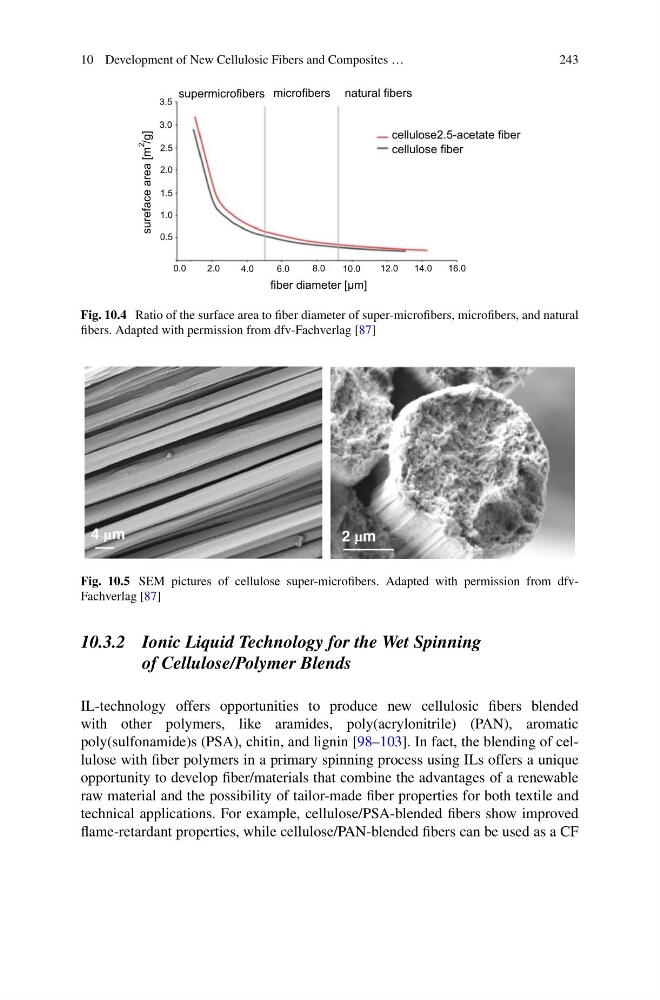
Fig. 10.4 Ratio of the surface area to fiber diameter of super-microfibers, microfibers, and natural
fibers. Adapted with permission from dfv-Fachverlag [87]
4 µm
2 µm
Fig. 10.5 SEM pictures of cellulose super-microfibers. Adapted with permission from dfvFachverlag [87]
10.3.2 Ionic Liquid Technology for the Wet Spinning
of Cellulose/Polymer Blends
IL-technology offers opportunities to produce new cellulosic fibers blended
with other polymers, like aramides, poly(acrylonitrile) (PAN), aromatic
poly(sulfonamide)s (PSA), chitin, and lignin [98–103]. In fact, the blending of cellulose with fiber polymers in a primary spinning process using ILs offers a unique
opportunity to develop fiber/materials that combine the advantages of a renewable
raw material and the possibility of tailor-made fiber properties for both textile and
technical applications. For example, cellulose/PSA-blended fibers show improved
flame-retardant properties, while cellulose/PAN-blended fibers can be used as a CF
243
cellulose2.5-acetate fiber
cellulose fiber
supermicrofibers microfibers natural fibers
3.5
3.0
0.5
1.0
1.5
2.0
2.5
8.0
10.0
0.0
2.0
4.0
6.0
12.0
14.0
16.0
fiber diameter [µm]
sureface area [m
2
/g]
Fig. 10.4 Ratio of the surface area to fiber diameter of super-microfibers, microfibers, and natural
fibers. Adapted with permission from dfv-Fachverlag [87]
4 µm
2 µm
Fig. 10.5 SEM pictures of cellulose super-microfibers. Adapted with permission from dfvFachverlag [87]
10.3.2 Ionic Liquid Technology for the Wet Spinning
of Cellulose/Polymer Blends
IL-technology offers opportunities to produce new cellulosic fibers blended
with other polymers, like aramides, poly(acrylonitrile) (PAN), aromatic
poly(sulfonamide)s (PSA), chitin, and lignin [98–103]. In fact, the blending of cellulose with fiber polymers in a primary spinning process using ILs offers a unique
opportunity to develop fiber/materials that combine the advantages of a renewable
raw material and the possibility of tailor-made fiber properties for both textile and
technical applications. For example, cellulose/PSA-blended fibers show improved
flame-retardant properties, while cellulose/PAN-blended fibers can be used as a CF