

9 Natural Fiber Welding
221
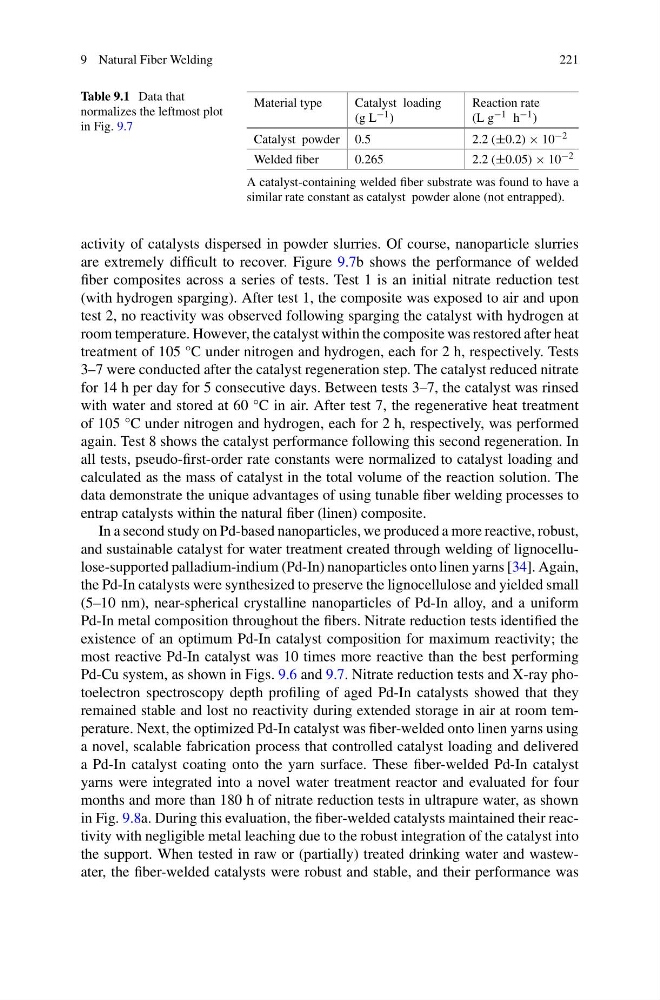
Table 9.1 Data that
normalizes the leftmost plot
in Fig. 9.7
Material type
Catalyst loading
(g L −1 )
Reaction rate
(L g −1 h −1 )
Catalyst powder 0.5
2.2 (±0.2) × 10 −2
Welded fiber
0.265
2.2 (±0.05) × 10 −2
A catalyst-containing welded fiber substrate was found to have a
similar rate constant as catalyst powder alone (not entrapped).
activity of catalysts dispersed in powder slurries. Of course, nanoparticle slurries
are extremely difficult to recover. Figure 9.7b shows the performance of welded
fiber composites across a series of tests. Test 1 is an initial nitrate reduction test
(with hydrogen sparging). After test 1, the composite was exposed to air and upon
test 2, no reactivity was observed following sparging the catalyst with hydrogen at
room temperature. However, the catalyst within the composite was restored after heat
treatment of 105 °C under nitrogen and hydrogen, each for 2 h, respectively. Tests
3–7 were conducted after the catalyst regeneration step. The catalyst reduced nitrate
for 14 h per day for 5 consecutive days. Between tests 3–7, the catalyst was rinsed
with water and stored at 60 °C in air. After test 7, the regenerative heat treatment
of 105 °C under nitrogen and hydrogen, each for 2 h, respectively, was performed
again. Test 8 shows the catalyst performance following this second regeneration. In
all tests, pseudo-first-order rate constants were normalized to catalyst loading and
calculated as the mass of catalyst in the total volume of the reaction solution. The
data demonstrate the unique advantages of using tunable fiber welding processes to
entrap catalysts within the natural fiber (linen) composite.
In a second study on Pd-based nanoparticles, we produced a more reactive, robust,
and sustainable catalyst for water treatment created through welding of lignocellulose-supported palladium-indium (Pd-In) nanoparticles onto linen yarns [34]. Again,
the Pd-In catalysts were synthesized to preserve the lignocellulose and yielded small
(5–10 nm), near-spherical crystalline nanoparticles of Pd-In alloy, and a uniform
Pd-In metal composition throughout the fibers. Nitrate reduction tests identified the
existence of an optimum Pd-In catalyst composition for maximum reactivity; the
most reactive Pd-In catalyst was 10 times more reactive than the best performing
Pd-Cu system, as shown in Figs. 9.6 and 9.7. Nitrate reduction tests and X-ray photoelectron spectroscopy depth profiling of aged Pd-In catalysts showed that they
remained stable and lost no reactivity during extended storage in air at room temperature. Next, the optimized Pd-In catalyst was fiber-welded onto linen yarns using
a novel, scalable fabrication process that controlled catalyst loading and delivered
a Pd-In catalyst coating onto the yarn surface. These fiber-welded Pd-In catalyst
yarns were integrated into a novel water treatment reactor and evaluated for four
months and more than 180 h of nitrate reduction tests in ultrapure water, as shown
in Fig. 9.8a. During this evaluation, the fiber-welded catalysts maintained their reactivity with negligible metal leaching due to the robust integration of the catalyst into
the support. When tested in raw or (partially) treated drinking water and wastewater, the fiber-welded catalysts were robust and stable, and their performance was
221
Table 9.1 Data that
normalizes the leftmost plot
in Fig. 9.7
Material type
Catalyst loading
(g L −1 )
Reaction rate
(L g −1 h −1 )
Catalyst powder 0.5
2.2 (±0.2) × 10 −2
Welded fiber
0.265
2.2 (±0.05) × 10 −2
A catalyst-containing welded fiber substrate was found to have a
similar rate constant as catalyst powder alone (not entrapped).
activity of catalysts dispersed in powder slurries. Of course, nanoparticle slurries
are extremely difficult to recover. Figure 9.7b shows the performance of welded
fiber composites across a series of tests. Test 1 is an initial nitrate reduction test
(with hydrogen sparging). After test 1, the composite was exposed to air and upon
test 2, no reactivity was observed following sparging the catalyst with hydrogen at
room temperature. However, the catalyst within the composite was restored after heat
treatment of 105 °C under nitrogen and hydrogen, each for 2 h, respectively. Tests
3–7 were conducted after the catalyst regeneration step. The catalyst reduced nitrate
for 14 h per day for 5 consecutive days. Between tests 3–7, the catalyst was rinsed
with water and stored at 60 °C in air. After test 7, the regenerative heat treatment
of 105 °C under nitrogen and hydrogen, each for 2 h, respectively, was performed
again. Test 8 shows the catalyst performance following this second regeneration. In
all tests, pseudo-first-order rate constants were normalized to catalyst loading and
calculated as the mass of catalyst in the total volume of the reaction solution. The
data demonstrate the unique advantages of using tunable fiber welding processes to
entrap catalysts within the natural fiber (linen) composite.
In a second study on Pd-based nanoparticles, we produced a more reactive, robust,
and sustainable catalyst for water treatment created through welding of lignocellulose-supported palladium-indium (Pd-In) nanoparticles onto linen yarns [34]. Again,
the Pd-In catalysts were synthesized to preserve the lignocellulose and yielded small
(5–10 nm), near-spherical crystalline nanoparticles of Pd-In alloy, and a uniform
Pd-In metal composition throughout the fibers. Nitrate reduction tests identified the
existence of an optimum Pd-In catalyst composition for maximum reactivity; the
most reactive Pd-In catalyst was 10 times more reactive than the best performing
Pd-Cu system, as shown in Figs. 9.6 and 9.7. Nitrate reduction tests and X-ray photoelectron spectroscopy depth profiling of aged Pd-In catalysts showed that they
remained stable and lost no reactivity during extended storage in air at room temperature. Next, the optimized Pd-In catalyst was fiber-welded onto linen yarns using
a novel, scalable fabrication process that controlled catalyst loading and delivered
a Pd-In catalyst coating onto the yarn surface. These fiber-welded Pd-In catalyst
yarns were integrated into a novel water treatment reactor and evaluated for four
months and more than 180 h of nitrate reduction tests in ultrapure water, as shown
in Fig. 9.8a. During this evaluation, the fiber-welded catalysts maintained their reactivity with negligible metal leaching due to the robust integration of the catalyst into
the support. When tested in raw or (partially) treated drinking water and wastewater, the fiber-welded catalysts were robust and stable, and their performance was