

220
L. M. Haverhals et al.
9.4.3 Catalytic Wastewater Treatment
In addition to entrapping sub-nanometer dye molecules, fabrication processes have
also been demonstrated that incorporate nanometer-sized functional materials [34,
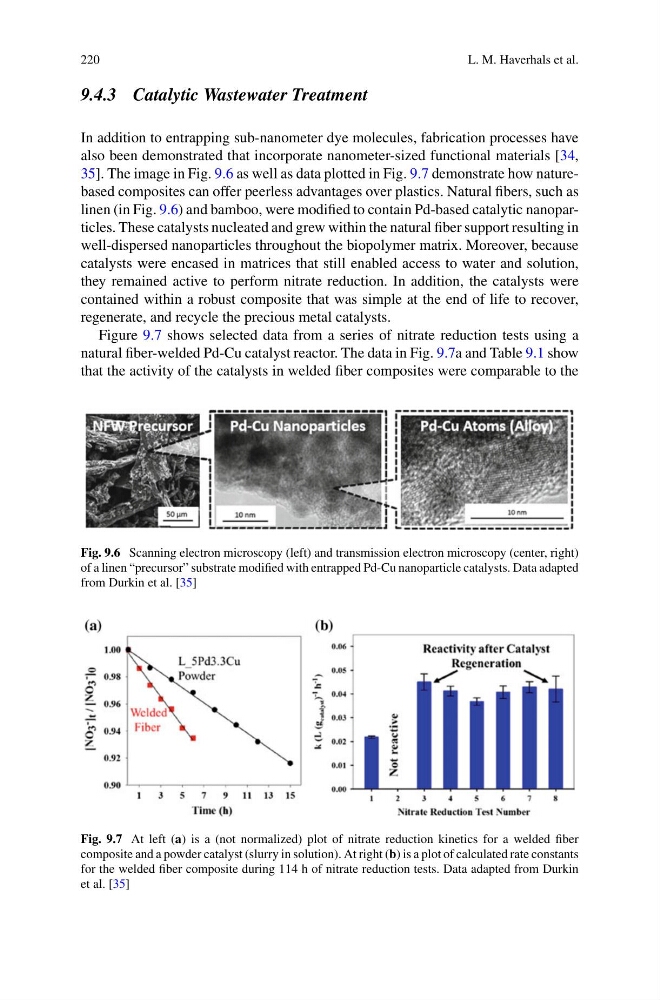
35]. The image in Fig. 9.6 as well as data plotted in Fig. 9.7 demonstrate how naturebased composites can offer peerless advantages over plastics. Natural fibers, such as
linen (in Fig. 9.6) and bamboo, were modified to contain Pd-based catalytic nanoparticles. These catalysts nucleated and grew within the natural fiber support resulting in
well-dispersed nanoparticles throughout the biopolymer matrix. Moreover, because
catalysts were encased in matrices that still enabled access to water and solution,
they remained active to perform nitrate reduction. In addition, the catalysts were
contained within a robust composite that was simple at the end of life to recover,
regenerate, and recycle the precious metal catalysts.
Figure 9.7 shows selected data from a series of nitrate reduction tests using a
natural fiber-welded Pd-Cu catalyst reactor. The data in Fig. 9.7a and Table 9.1 show
that the activity of the catalysts in welded fiber composites were comparable to the
Fig. 9.6 Scanning electron microscopy (left) and transmission electron microscopy (center, right)
of a linen “precursor” substrate modified with entrapped Pd-Cu nanoparticle catalysts. Data adapted
from Durkin et al. [35]
Fig. 9.7 At left (a) is a (not normalized) plot of nitrate reduction kinetics for a welded fiber
composite and a powder catalyst (slurry in solution). At right (b) is a plot of calculated rate constants
for the welded fiber composite during 114 h of nitrate reduction tests. Data adapted from Durkin
et al. [35]
L. M. Haverhals et al.
9.4.3 Catalytic Wastewater Treatment
In addition to entrapping sub-nanometer dye molecules, fabrication processes have
also been demonstrated that incorporate nanometer-sized functional materials [34,
35]. The image in Fig. 9.6 as well as data plotted in Fig. 9.7 demonstrate how naturebased composites can offer peerless advantages over plastics. Natural fibers, such as
linen (in Fig. 9.6) and bamboo, were modified to contain Pd-based catalytic nanoparticles. These catalysts nucleated and grew within the natural fiber support resulting in
well-dispersed nanoparticles throughout the biopolymer matrix. Moreover, because
catalysts were encased in matrices that still enabled access to water and solution,
they remained active to perform nitrate reduction. In addition, the catalysts were
contained within a robust composite that was simple at the end of life to recover,
regenerate, and recycle the precious metal catalysts.
Figure 9.7 shows selected data from a series of nitrate reduction tests using a
natural fiber-welded Pd-Cu catalyst reactor. The data in Fig. 9.7a and Table 9.1 show
that the activity of the catalysts in welded fiber composites were comparable to the
Fig. 9.6 Scanning electron microscopy (left) and transmission electron microscopy (center, right)
of a linen “precursor” substrate modified with entrapped Pd-Cu nanoparticle catalysts. Data adapted
from Durkin et al. [35]
Fig. 9.7 At left (a) is a (not normalized) plot of nitrate reduction kinetics for a welded fiber
composite and a powder catalyst (slurry in solution). At right (b) is a plot of calculated rate constants
for the welded fiber composite during 114 h of nitrate reduction tests. Data adapted from Durkin
et al. [35]