

222
L. M. Haverhals et al.
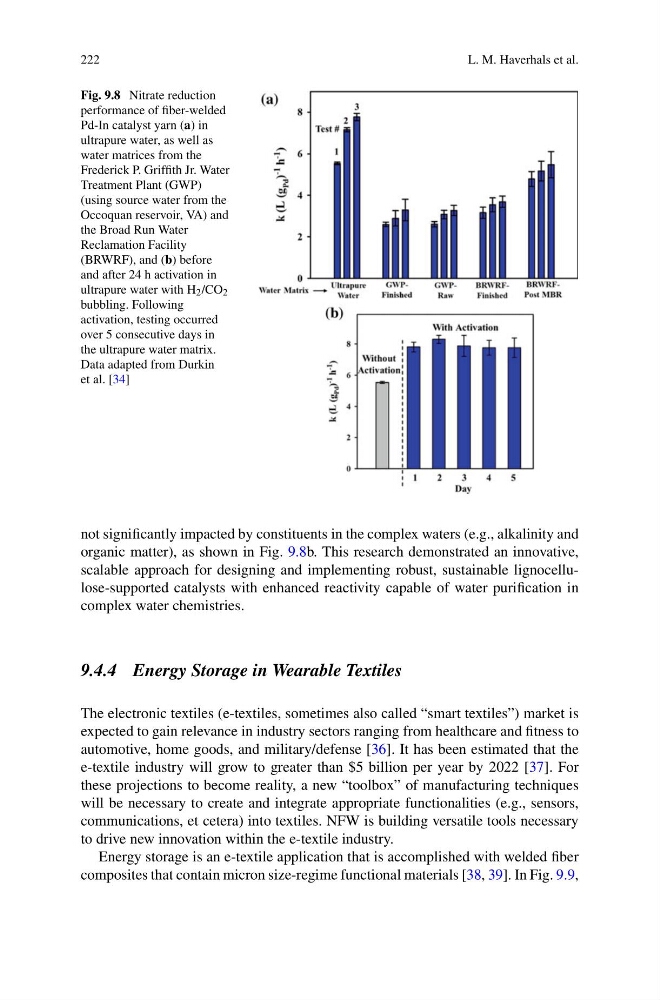
Fig. 9.8 Nitrate reduction
performance of fiber-welded
Pd-In catalyst yarn (a) in
ultrapure water, as well as
water matrices from the
Frederick P. Griffith Jr. Water
Treatment Plant (GWP)
(using source water from the
Occoquan reservoir, VA) and
the Broad Run Water
Reclamation Facility
(BRWRF), and (b) before
and after 24 h activation in
ultrapure water with H 2 /CO 2
bubbling. Following
activation, testing occurred
over 5 consecutive days in
the ultrapure water matrix.
Data adapted from Durkin
et al. [34]
not significantly impacted by constituents in the complex waters (e.g., alkalinity and
organic matter), as shown in Fig. 9.8b. This research demonstrated an innovative,
scalable approach for designing and implementing robust, sustainable lignocellulose-supported catalysts with enhanced reactivity capable of water purification in
complex water chemistries.
9.4.4 Energy Storage in Wearable Textiles
The electronic textiles (e-textiles, sometimes also called “smart textiles”) market is
expected to gain relevance in industry sectors ranging from healthcare and fitness to
automotive, home goods, and military/defense [36]. It has been estimated that the
e-textile industry will grow to greater than $5 billion per year by 2022 [37]. For
these projections to become reality, a new “toolbox” of manufacturing techniques
will be necessary to create and integrate appropriate functionalities (e.g., sensors,
communications, et cetera) into textiles. NFW is building versatile tools necessary
to drive new innovation within the e-textile industry.
Energy storage is an e-textile application that is accomplished with welded fiber
composites that contain micron size-regime functional materials [38, 39]. In Fig. 9.9,
L. M. Haverhals et al.
Fig. 9.8 Nitrate reduction
performance of fiber-welded
Pd-In catalyst yarn (a) in
ultrapure water, as well as
water matrices from the
Frederick P. Griffith Jr. Water
Treatment Plant (GWP)
(using source water from the
Occoquan reservoir, VA) and
the Broad Run Water
Reclamation Facility
(BRWRF), and (b) before
and after 24 h activation in
ultrapure water with H 2 /CO 2
bubbling. Following
activation, testing occurred
over 5 consecutive days in
the ultrapure water matrix.
Data adapted from Durkin
et al. [34]
not significantly impacted by constituents in the complex waters (e.g., alkalinity and
organic matter), as shown in Fig. 9.8b. This research demonstrated an innovative,
scalable approach for designing and implementing robust, sustainable lignocellulose-supported catalysts with enhanced reactivity capable of water purification in
complex water chemistries.
9.4.4 Energy Storage in Wearable Textiles
The electronic textiles (e-textiles, sometimes also called “smart textiles”) market is
expected to gain relevance in industry sectors ranging from healthcare and fitness to
automotive, home goods, and military/defense [36]. It has been estimated that the
e-textile industry will grow to greater than $5 billion per year by 2022 [37]. For
these projections to become reality, a new “toolbox” of manufacturing techniques
will be necessary to create and integrate appropriate functionalities (e.g., sensors,
communications, et cetera) into textiles. NFW is building versatile tools necessary
to drive new innovation within the e-textile industry.
Energy storage is an e-textile application that is accomplished with welded fiber
composites that contain micron size-regime functional materials [38, 39]. In Fig. 9.9,