

9 Natural Fiber Welding
217
9.4 Functional “Welded” Composites
Previous research publications have detailed some of the basic operating principles
for “vanilla” welding processes. (Here we use “vanilla” to describe processes that
impart beneficial morphological modifications to natural fiber substrates.) For the
past few years, NFW has been further inventing, refining, and scaling platforms that
will have global impacts across large markets. NFW is particularly focused on the
ways in which fabrication processes can be extended and do more for the textile
industry. For example, NFW has developed and patented “indigo flavors” of welding
processes that not only increase the utility of short cotton fibers by accessing new
morphologies, but indigo dyeing can be simultaneously accomplished with a zerowaste closed-loop operation [8]. The remainder of this chapter will be devoted to
detailing several examples that show platform breadth and diversity of applications.
9.4.1 Furniture from Waste Textiles
Billions of pounds of textiles are discarded annually. Much of this waste goes to
landfills, and, unfortunately, too often textile waste is improperly disposed of and
compounds the problems of the release of nonbiodegradable plastic microfibers into
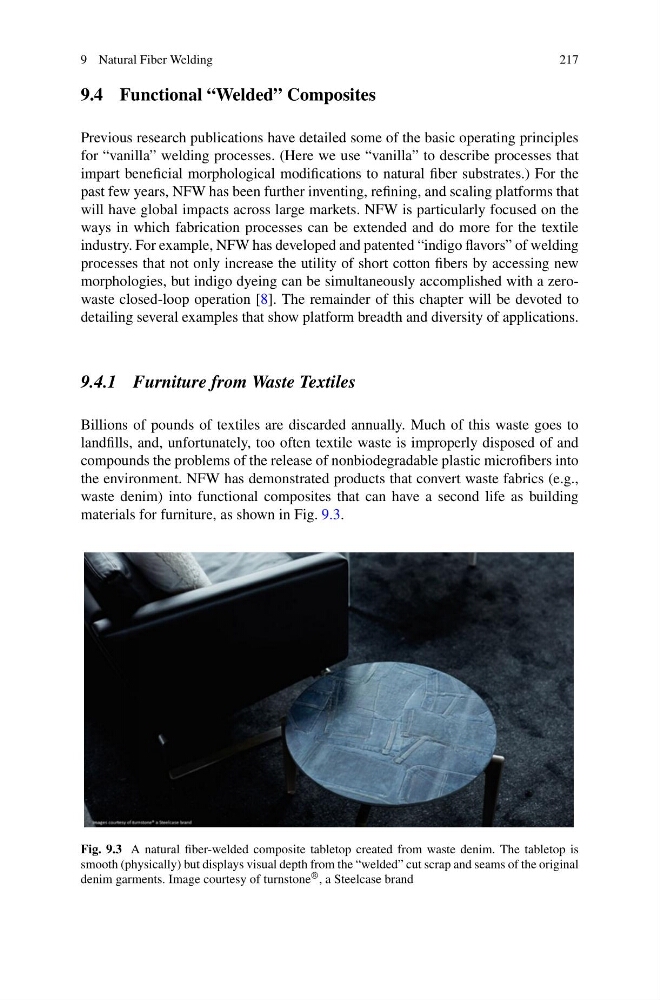
the environment. NFW has demonstrated products that convert waste fabrics (e.g.,
waste denim) into functional composites that can have a second life as building
materials for furniture, as shown in Fig. 9.3.
Fig. 9.3 A natural fiber-welded composite tabletop created from waste denim. The tabletop is
smooth (physically) but displays visual depth from the “welded” cut scrap and seams of the original
denim garments. Image courtesy of turnstone ® , a Steelcase brand
217
9.4 Functional “Welded” Composites
Previous research publications have detailed some of the basic operating principles
for “vanilla” welding processes. (Here we use “vanilla” to describe processes that
impart beneficial morphological modifications to natural fiber substrates.) For the
past few years, NFW has been further inventing, refining, and scaling platforms that
will have global impacts across large markets. NFW is particularly focused on the
ways in which fabrication processes can be extended and do more for the textile
industry. For example, NFW has developed and patented “indigo flavors” of welding
processes that not only increase the utility of short cotton fibers by accessing new
morphologies, but indigo dyeing can be simultaneously accomplished with a zerowaste closed-loop operation [8]. The remainder of this chapter will be devoted to
detailing several examples that show platform breadth and diversity of applications.
9.4.1 Furniture from Waste Textiles
Billions of pounds of textiles are discarded annually. Much of this waste goes to
landfills, and, unfortunately, too often textile waste is improperly disposed of and
compounds the problems of the release of nonbiodegradable plastic microfibers into
the environment. NFW has demonstrated products that convert waste fabrics (e.g.,
waste denim) into functional composites that can have a second life as building
materials for furniture, as shown in Fig. 9.3.
Fig. 9.3 A natural fiber-welded composite tabletop created from waste denim. The tabletop is
smooth (physically) but displays visual depth from the “welded” cut scrap and seams of the original
denim garments. Image courtesy of turnstone ® , a Steelcase brand