

216
L. M. Haverhals et al.
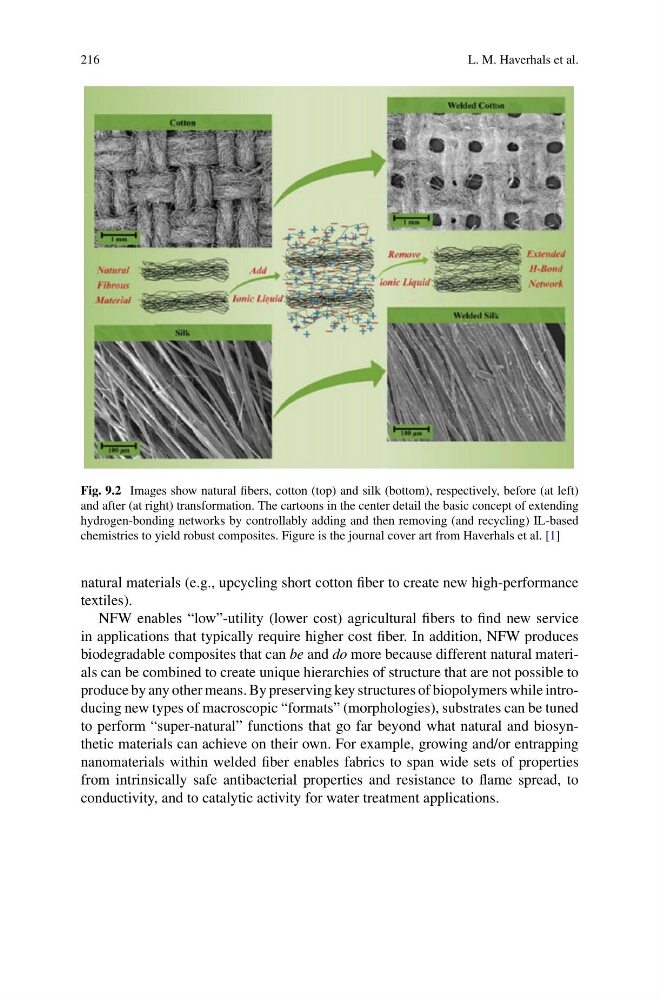
Fig. 9.2 Images show natural fibers, cotton (top) and silk (bottom), respectively, before (at left)
and after (at right) transformation. The cartoons in the center detail the basic concept of extending
hydrogen-bonding networks by controllably adding and then removing (and recycling) IL-based
chemistries to yield robust composites. Figure is the journal cover art from Haverhals et al. [1]
natural materials (e.g., upcycling short cotton fiber to create new high-performance
textiles).
NFW enables “low”-utility (lower cost) agricultural fibers to find new service
in applications that typically require higher cost fiber. In addition, NFW produces
biodegradable composites that can be and do more because different natural materials can be combined to create unique hierarchies of structure that are not possible to
produce by any other means. By preserving key structures of biopolymers while introducing new types of macroscopic “formats” (morphologies), substrates can be tuned
to perform “super-natural” functions that go far beyond what natural and biosynthetic materials can achieve on their own. For example, growing and/or entrapping
nanomaterials within welded fiber enables fabrics to span wide sets of properties
from intrinsically safe antibacterial properties and resistance to flame spread, to
conductivity, and to catalytic activity for water treatment applications.
L. M. Haverhals et al.
Fig. 9.2 Images show natural fibers, cotton (top) and silk (bottom), respectively, before (at left)
and after (at right) transformation. The cartoons in the center detail the basic concept of extending
hydrogen-bonding networks by controllably adding and then removing (and recycling) IL-based
chemistries to yield robust composites. Figure is the journal cover art from Haverhals et al. [1]
natural materials (e.g., upcycling short cotton fiber to create new high-performance
textiles).
NFW enables “low”-utility (lower cost) agricultural fibers to find new service
in applications that typically require higher cost fiber. In addition, NFW produces
biodegradable composites that can be and do more because different natural materials can be combined to create unique hierarchies of structure that are not possible to
produce by any other means. By preserving key structures of biopolymers while introducing new types of macroscopic “formats” (morphologies), substrates can be tuned
to perform “super-natural” functions that go far beyond what natural and biosynthetic materials can achieve on their own. For example, growing and/or entrapping
nanomaterials within welded fiber enables fabrics to span wide sets of properties
from intrinsically safe antibacterial properties and resistance to flame spread, to
conductivity, and to catalytic activity for water treatment applications.