

9 Natural Fiber Welding
215
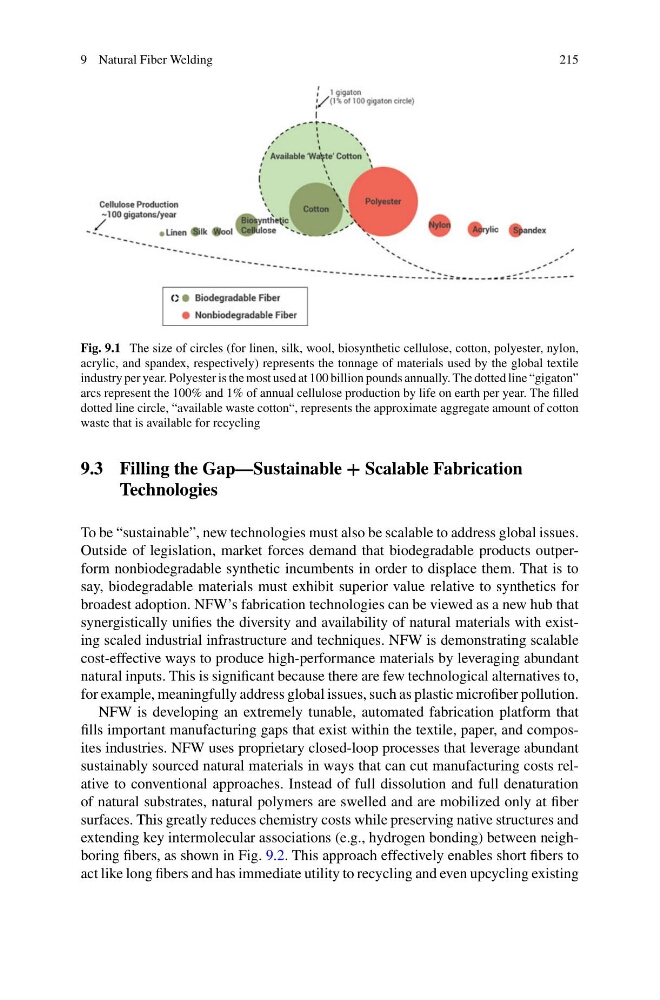
Fig. 9.1 The size of circles (for linen, silk, wool, biosynthetic cellulose, cotton, polyester, nylon,
acrylic, and spandex, respectively) represents the tonnage of materials used by the global textile
industry per year. Polyester is the most used at 100 billion pounds annually. The dotted line “gigaton”
arcs represent the 100% and 1% of annual cellulose production by life on earth per year. The filled
dotted line circle, “available waste cotton“, represents the approximate aggregate amount of cotton
waste that is available for recycling
9.3 Filling the Gap—Sustainable + Scalable Fabrication
Technologies
To be “sustainable”, new technologies must also be scalable to address global issues.
Outside of legislation, market forces demand that biodegradable products outperform nonbiodegradable synthetic incumbents in order to displace them. That is to
say, biodegradable materials must exhibit superior value relative to synthetics for
broadest adoption. NFW’s fabrication technologies can be viewed as a new hub that
synergistically unifies the diversity and availability of natural materials with existing scaled industrial infrastructure and techniques. NFW is demonstrating scalable
cost-effective ways to produce high-performance materials by leveraging abundant
natural inputs. This is significant because there are few technological alternatives to,
for example, meaningfully address global issues, such as plastic microfiber pollution.
NFW is developing an extremely tunable, automated fabrication platform that
fills important manufacturing gaps that exist within the textile, paper, and composites industries. NFW uses proprietary closed-loop processes that leverage abundant
sustainably sourced natural materials in ways that can cut manufacturing costs relative to conventional approaches. Instead of full dissolution and full denaturation
of natural substrates, natural polymers are swelled and are mobilized only at fiber
surfaces. This greatly reduces chemistry costs while preserving native structures and
extending key intermolecular associations (e.g., hydrogen bonding) between neighboring fibers, as shown in Fig. 9.2. This approach effectively enables short fibers to
act like long fibers and has immediate utility to recycling and even upcycling existing
215
Fig. 9.1 The size of circles (for linen, silk, wool, biosynthetic cellulose, cotton, polyester, nylon,
acrylic, and spandex, respectively) represents the tonnage of materials used by the global textile
industry per year. Polyester is the most used at 100 billion pounds annually. The dotted line “gigaton”
arcs represent the 100% and 1% of annual cellulose production by life on earth per year. The filled
dotted line circle, “available waste cotton“, represents the approximate aggregate amount of cotton
waste that is available for recycling
9.3 Filling the Gap—Sustainable + Scalable Fabrication
Technologies
To be “sustainable”, new technologies must also be scalable to address global issues.
Outside of legislation, market forces demand that biodegradable products outperform nonbiodegradable synthetic incumbents in order to displace them. That is to
say, biodegradable materials must exhibit superior value relative to synthetics for
broadest adoption. NFW’s fabrication technologies can be viewed as a new hub that
synergistically unifies the diversity and availability of natural materials with existing scaled industrial infrastructure and techniques. NFW is demonstrating scalable
cost-effective ways to produce high-performance materials by leveraging abundant
natural inputs. This is significant because there are few technological alternatives to,
for example, meaningfully address global issues, such as plastic microfiber pollution.
NFW is developing an extremely tunable, automated fabrication platform that
fills important manufacturing gaps that exist within the textile, paper, and composites industries. NFW uses proprietary closed-loop processes that leverage abundant
sustainably sourced natural materials in ways that can cut manufacturing costs relative to conventional approaches. Instead of full dissolution and full denaturation
of natural substrates, natural polymers are swelled and are mobilized only at fiber
surfaces. This greatly reduces chemistry costs while preserving native structures and
extending key intermolecular associations (e.g., hydrogen bonding) between neighboring fibers, as shown in Fig. 9.2. This approach effectively enables short fibers to
act like long fibers and has immediate utility to recycling and even upcycling existing