

218
L. M. Haverhals et al.
The composite tabletop shown in Fig. 9.3 is made only of scrap denim without any
glues or resins. Instead, cotton fibers have been fused by the extension of hydrogenbonding networks to span neighboring cotton fibers. The basic process begins when
a controlled amount of IL-based solvent is applied to the substrate. The materials are
heated, pressed, and then IL-based solvents, which enable tunable physical changes
to the substrate, are recovered and recycled for reuse. After drying, the final composite
is found to have properties similar to wood. The fabrication process that produced this
denim composite is immune to the fact that some of the denim scraps can contain
spandex and polyester. In fact, synthetic fibers are safely encapsulated within the
composite. As with wood, welded composites can be painted or coated with varnishes
that create water-repellant surfaces. The tabletop shown has had a natural wax applied
for water resistance.
9.4.2 Waterless Indigo Dye Processes
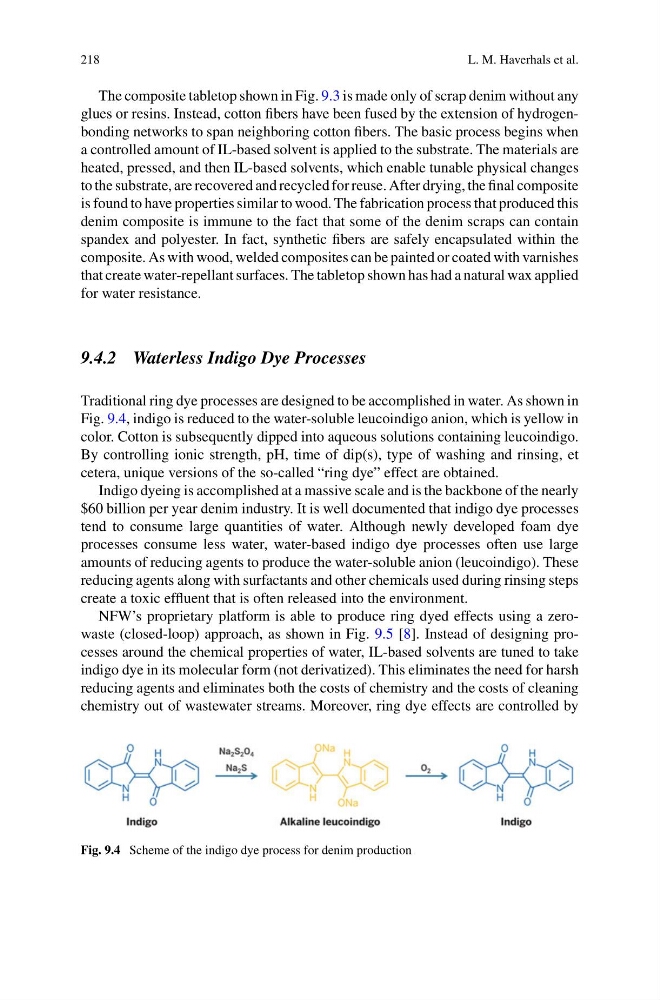
Traditional ring dye processes are designed to be accomplished in water. As shown in
Fig. 9.4, indigo is reduced to the water-soluble leucoindigo anion, which is yellow in
color. Cotton is subsequently dipped into aqueous solutions containing leucoindigo.
By controlling ionic strength, pH, time of dip(s), type of washing and rinsing, et
cetera, unique versions of the so-called “ring dye” effect are obtained.
Indigo dyeing is accomplished at a massive scale and is the backbone of the nearly
$60 billion per year denim industry. It is well documented that indigo dye processes
tend to consume large quantities of water. Although newly developed foam dye
processes consume less water, water-based indigo dye processes often use large
amounts of reducing agents to produce the water-soluble anion (leucoindigo). These
reducing agents along with surfactants and other chemicals used during rinsing steps
create a toxic effluent that is often released into the environment.
NFW’s proprietary platform is able to produce ring dyed effects using a zerowaste (closed-loop) approach, as shown in Fig. 9.5 [8]. Instead of designing processes around the chemical properties of water, IL-based solvents are tuned to take
indigo dye in its molecular form (not derivatized). This eliminates the need for harsh
reducing agents and eliminates both the costs of chemistry and the costs of cleaning
chemistry out of wastewater streams. Moreover, ring dye effects are controlled by
Fig. 9.4 Scheme of the indigo dye process for denim production
L. M. Haverhals et al.
The composite tabletop shown in Fig. 9.3 is made only of scrap denim without any
glues or resins. Instead, cotton fibers have been fused by the extension of hydrogenbonding networks to span neighboring cotton fibers. The basic process begins when
a controlled amount of IL-based solvent is applied to the substrate. The materials are
heated, pressed, and then IL-based solvents, which enable tunable physical changes
to the substrate, are recovered and recycled for reuse. After drying, the final composite
is found to have properties similar to wood. The fabrication process that produced this
denim composite is immune to the fact that some of the denim scraps can contain
spandex and polyester. In fact, synthetic fibers are safely encapsulated within the
composite. As with wood, welded composites can be painted or coated with varnishes
that create water-repellant surfaces. The tabletop shown has had a natural wax applied
for water resistance.
9.4.2 Waterless Indigo Dye Processes
Traditional ring dye processes are designed to be accomplished in water. As shown in
Fig. 9.4, indigo is reduced to the water-soluble leucoindigo anion, which is yellow in
color. Cotton is subsequently dipped into aqueous solutions containing leucoindigo.
By controlling ionic strength, pH, time of dip(s), type of washing and rinsing, et
cetera, unique versions of the so-called “ring dye” effect are obtained.
Indigo dyeing is accomplished at a massive scale and is the backbone of the nearly
$60 billion per year denim industry. It is well documented that indigo dye processes
tend to consume large quantities of water. Although newly developed foam dye
processes consume less water, water-based indigo dye processes often use large
amounts of reducing agents to produce the water-soluble anion (leucoindigo). These
reducing agents along with surfactants and other chemicals used during rinsing steps
create a toxic effluent that is often released into the environment.
NFW’s proprietary platform is able to produce ring dyed effects using a zerowaste (closed-loop) approach, as shown in Fig. 9.5 [8]. Instead of designing processes around the chemical properties of water, IL-based solvents are tuned to take
indigo dye in its molecular form (not derivatized). This eliminates the need for harsh
reducing agents and eliminates both the costs of chemistry and the costs of cleaning
chemistry out of wastewater streams. Moreover, ring dye effects are controlled by
Fig. 9.4 Scheme of the indigo dye process for denim production