

7 Ionic Liquid–Liquid Chromatography: A Novel Separation Method
181
The complete separation of glucose or fructose from sucrose was achieved on a
1.00 g scale (500 mg of monosaccharide + 500 mg of sucrose). A similar saccharide
separation by Shinomiya and Ito was carried out on a 2.5 mg scale on a 34 cm
3
coil [62]. Using the IL-Prep instrument with an ionic liquid system, on the 133 cm
3
coil (Table 7.1) [14b], 500 mg quantities of saccharides could be separated. This
gives a much-increased degree of process intensification (or space-time yield) of
50 times and shows what could be achieved with ionic liquid-containing solvent
systems. Commercially, the separation of fructose or glucose from sucrose is carried
out with crystallization methodologies, since chromatographic techniques are not
economically viable [63]. However, ILLC technology can be used successfully on
high-value saccharides and polysaccharides [26b].
7.7.3 Separation of Vetiver Oil
Vetiver oil is used in the perfume industry [64] and is extracted from the roots of
Chrysopogon zizanioides [65] by azeotropic (or steam) distillation [66]. Annually,
worldwide vetiver oil production is approximately 250 tons [67]. Of the 300+ chemical components of vetiver oil, compounds of interest to the fragrance industry include
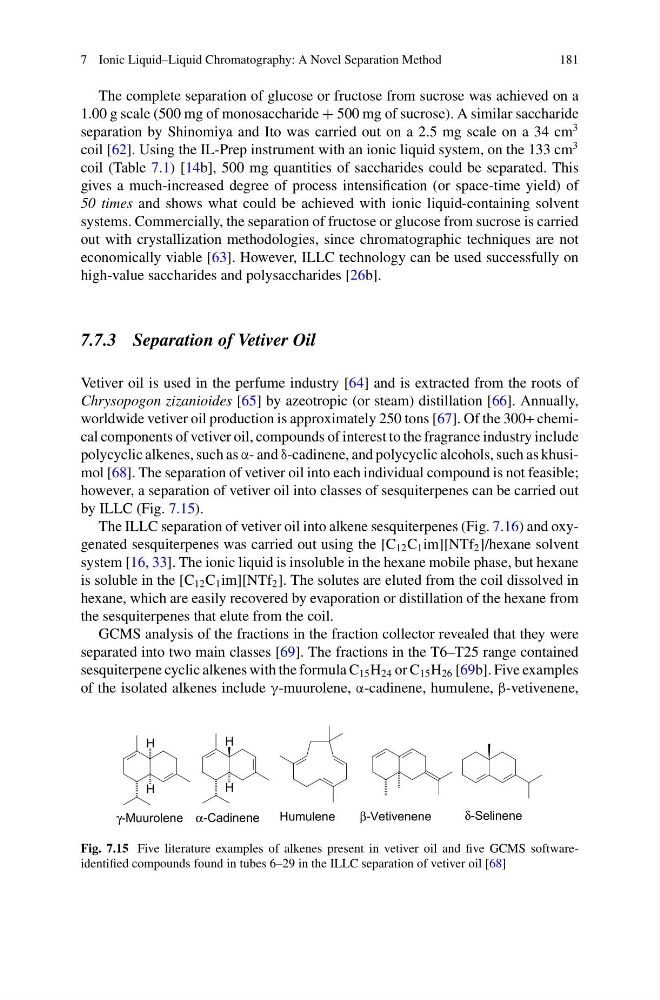
polycyclic alkenes, such as α- and δ-cadinene, and polycyclic alcohols, such as khusimol [68]. The separation of vetiver oil into each individual compound is not feasible;
however, a separation of vetiver oil into classes of sesquiterpenes can be carried out
by ILLC (Fig. 7.15).
The ILLC separation of vetiver oil into alkene sesquiterpenes (Fig. 7.16) and oxygenated sesquiterpenes was carried out using the [C 12 C 1 im][NTf 2 ]/hexane solvent
system [16, 33]. The ionic liquid is insoluble in the hexane mobile phase, but hexane
is soluble in the [C 12 C 1 im][NTf 2 ]. The solutes are eluted from the coil dissolved in
hexane, which are easily recovered by evaporation or distillation of the hexane from
the sesquiterpenes that elute from the coil.
GCMS analysis of the fractions in the fraction collector revealed that they were
separated into two main classes [69]. The fractions in the T6–T25 range contained
sesquiterpene cyclic alkenes with the formula C 15 H 24 or C 15 H 26 [69b]. Five examples
of the isolated alkenes include γ-muurolene, α-cadinene, humulene, β-vetivenene,
H
H
H
H
γ-Muurolene α-Cadinene
β-Vetivenene
δ-Selinene
Humulene
Fig. 7.15 Five literature examples of alkenes present in vetiver oil and five GCMS softwareidentified compounds found in tubes 6–29 in the ILLC separation of vetiver oil [68]
181
The complete separation of glucose or fructose from sucrose was achieved on a
1.00 g scale (500 mg of monosaccharide + 500 mg of sucrose). A similar saccharide
separation by Shinomiya and Ito was carried out on a 2.5 mg scale on a 34 cm
3
coil [62]. Using the IL-Prep instrument with an ionic liquid system, on the 133 cm
3
coil (Table 7.1) [14b], 500 mg quantities of saccharides could be separated. This
gives a much-increased degree of process intensification (or space-time yield) of
50 times and shows what could be achieved with ionic liquid-containing solvent
systems. Commercially, the separation of fructose or glucose from sucrose is carried
out with crystallization methodologies, since chromatographic techniques are not
economically viable [63]. However, ILLC technology can be used successfully on
high-value saccharides and polysaccharides [26b].
7.7.3 Separation of Vetiver Oil
Vetiver oil is used in the perfume industry [64] and is extracted from the roots of
Chrysopogon zizanioides [65] by azeotropic (or steam) distillation [66]. Annually,
worldwide vetiver oil production is approximately 250 tons [67]. Of the 300+ chemical components of vetiver oil, compounds of interest to the fragrance industry include
polycyclic alkenes, such as α- and δ-cadinene, and polycyclic alcohols, such as khusimol [68]. The separation of vetiver oil into each individual compound is not feasible;
however, a separation of vetiver oil into classes of sesquiterpenes can be carried out
by ILLC (Fig. 7.15).
The ILLC separation of vetiver oil into alkene sesquiterpenes (Fig. 7.16) and oxygenated sesquiterpenes was carried out using the [C 12 C 1 im][NTf 2 ]/hexane solvent
system [16, 33]. The ionic liquid is insoluble in the hexane mobile phase, but hexane
is soluble in the [C 12 C 1 im][NTf 2 ]. The solutes are eluted from the coil dissolved in
hexane, which are easily recovered by evaporation or distillation of the hexane from
the sesquiterpenes that elute from the coil.
GCMS analysis of the fractions in the fraction collector revealed that they were
separated into two main classes [69]. The fractions in the T6–T25 range contained
sesquiterpene cyclic alkenes with the formula C 15 H 24 or C 15 H 26 [69b]. Five examples
of the isolated alkenes include γ-muurolene, α-cadinene, humulene, β-vetivenene,
H
H
H
H
γ-Muurolene α-Cadinene
β-Vetivenene
δ-Selinene
Humulene
Fig. 7.15 Five literature examples of alkenes present in vetiver oil and five GCMS softwareidentified compounds found in tubes 6–29 in the ILLC separation of vetiver oil [68]