

182
L. Brown et al.
0
20
40
60
80
100
120
14
15
16
17
18
19
20
21
22
GC FID Response / Arbitry Units
GC Elution Time / min -1
T9
T19
T29
T39
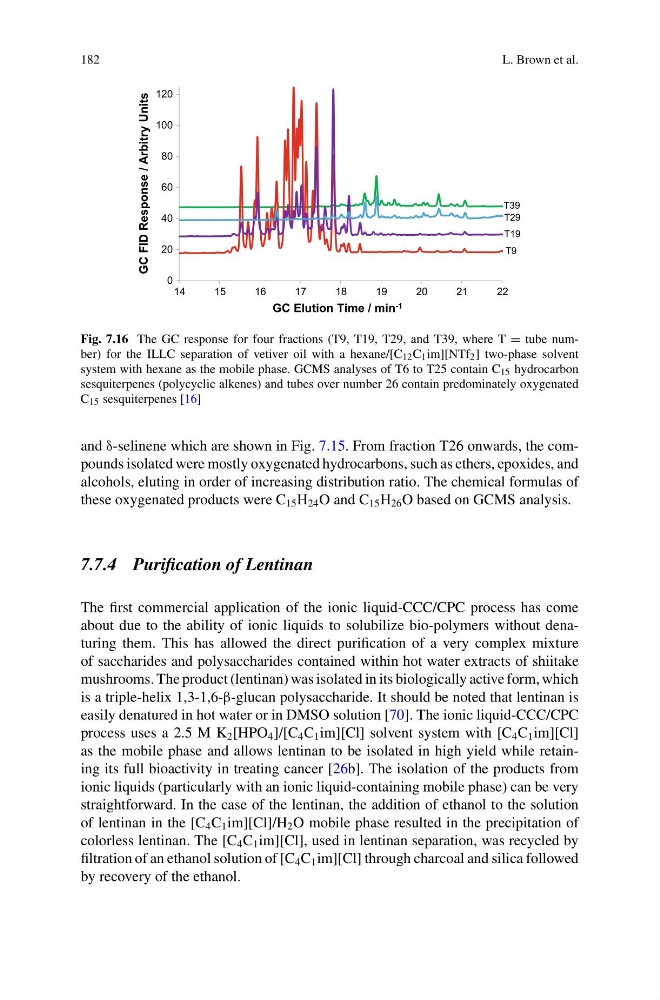
Fig. 7.16 The GC response for four fractions (T9, T19, T29, and T39, where T = tube number) for the ILLC separation of vetiver oil with a hexane/[C 12 C 1 im][NTf 2 ] two-phase solvent
system with hexane as the mobile phase. GCMS analyses of T6 to T25 contain C 15 hydrocarbon
sesquiterpenes (polycyclic alkenes) and tubes over number 26 contain predominately oxygenated
C 15 sesquiterpenes [16]
and δ-selinene which are shown in Fig. 7.15. From fraction T26 onwards, the compounds isolated were mostly oxygenated hydrocarbons, such as ethers, epoxides, and
alcohols, eluting in order of increasing distribution ratio. The chemical formulas of
these oxygenated products were C 15 H 24 O and C 15 H 26 O based on GCMS analysis.
7.7.4 Purification of Lentinan
The first commercial application of the ionic liquid-CCC/CPC process has come
about due to the ability of ionic liquids to solubilize bio-polymers without denaturing them. This has allowed the direct purification of a very complex mixture
of saccharides and polysaccharides contained within hot water extracts of shiitake
mushrooms. The product (lentinan) was isolated in its biologically active form, which
is a triple-helix 1,3-1,6-β-glucan polysaccharide. It should be noted that lentinan is
easily denatured in hot water or in DMSO solution [70]. The ionic liquid-CCC/CPC
process uses a 2.5 M K 2 [HPO 4 ]/[C 4 C 1 im][Cl] solvent system with [C 4 C 1 im][Cl]
as the mobile phase and allows lentinan to be isolated in high yield while retaining its full bioactivity in treating cancer [26b]. The isolation of the products from
ionic liquids (particularly with an ionic liquid-containing mobile phase) can be very
straightforward. In the case of the lentinan, the addition of ethanol to the solution
of lentinan in the [C 4 C 1 im][Cl]/H 2 O mobile phase resulted in the precipitation of
colorless lentinan. The [C 4 C 1 im][Cl], used in lentinan separation, was recycled by
filtration of an ethanol solution of [C 4 C 1 im][Cl] through charcoal and silica followed
by recovery of the ethanol.
L. Brown et al.
0
20
40
60
80
100
120
14
15
16
17
18
19
20
21
22
GC FID Response / Arbitry Units
GC Elution Time / min -1
T9
T19
T29
T39
Fig. 7.16 The GC response for four fractions (T9, T19, T29, and T39, where T = tube number) for the ILLC separation of vetiver oil with a hexane/[C 12 C 1 im][NTf 2 ] two-phase solvent
system with hexane as the mobile phase. GCMS analyses of T6 to T25 contain C 15 hydrocarbon
sesquiterpenes (polycyclic alkenes) and tubes over number 26 contain predominately oxygenated
C 15 sesquiterpenes [16]
and δ-selinene which are shown in Fig. 7.15. From fraction T26 onwards, the compounds isolated were mostly oxygenated hydrocarbons, such as ethers, epoxides, and
alcohols, eluting in order of increasing distribution ratio. The chemical formulas of
these oxygenated products were C 15 H 24 O and C 15 H 26 O based on GCMS analysis.
7.7.4 Purification of Lentinan
The first commercial application of the ionic liquid-CCC/CPC process has come
about due to the ability of ionic liquids to solubilize bio-polymers without denaturing them. This has allowed the direct purification of a very complex mixture
of saccharides and polysaccharides contained within hot water extracts of shiitake
mushrooms. The product (lentinan) was isolated in its biologically active form, which
is a triple-helix 1,3-1,6-β-glucan polysaccharide. It should be noted that lentinan is
easily denatured in hot water or in DMSO solution [70]. The ionic liquid-CCC/CPC
process uses a 2.5 M K 2 [HPO 4 ]/[C 4 C 1 im][Cl] solvent system with [C 4 C 1 im][Cl]
as the mobile phase and allows lentinan to be isolated in high yield while retaining its full bioactivity in treating cancer [26b]. The isolation of the products from
ionic liquids (particularly with an ionic liquid-containing mobile phase) can be very
straightforward. In the case of the lentinan, the addition of ethanol to the solution
of lentinan in the [C 4 C 1 im][Cl]/H 2 O mobile phase resulted in the precipitation of
colorless lentinan. The [C 4 C 1 im][Cl], used in lentinan separation, was recycled by
filtration of an ethanol solution of [C 4 C 1 im][Cl] through charcoal and silica followed
by recovery of the ethanol.