

176
L. Brown et al.
Copper(II), nickel(II), and cobalt(II) chloride salts in aqueous solution can be
separated from each other using ILLC. The solvent system used for the stationary
phase was based on [P 6 6 6 14 ][Cl], which is a viscous, hydrophobic ionic liquid, with
added ethyl ethanoate to reduce the viscosity of the ionic phase. Other co-solvents,
such as dichloromethane, propanone, or butanol, were also found to be effective.
Typically, the scale of the separation was 0.5–6.0 g (at ca. 0.6–7.0 M concentration)
on coil 2 and 2–10 g on coil 4 (see Table 7.1 for details).
In order to achieve an effective separation of the aqueous salts, it is necessary to
prepare the coils with a biphasic solvent system (degassed) consisting of [P 6 6 6 14 ][Cl]
(250 cm
3 ), ethyl ethanoate (125–250 cm
3 ), and pure water (1000 cm
3 ). The ionic
phase contains the majority of the ethyl ethanoate and forms the upper liquid layer.
The aqueous phase contains a small amount of ethyl ethanoate, but no ionic liquid
(<0.5 mol%) was detected by
1 H NMR spectroscopy [51]. For most chromatographic
separations, it is necessary to obtain a phase retention curve for the two phases used
in the separation. This shows how much stationary phase remains in the coils as the
mobile-phase flow rate is increased, for a given temperature and instrument rotation
rate. The performance of the four coils was tested using water, [P 6 6 6 14 ][Cl], and
ethyl ethanoate (4:1:1 ratio) solvent system at 35 °C, and the phase retention for the
four coils shown in Table 7.1 was determined (Fig. 7.7).
In order to obtain the phase retention curve, the coils were initially pumped full
of the stationary ionic liquid phase. The coil’s rotation rate was set to 865 rpm,
and the flow rate versus stationary phase retention curves were measured at a range
of flow rates ranging from 0.5 to 31.5 cm
3 min
−1 . The stationary phase retention
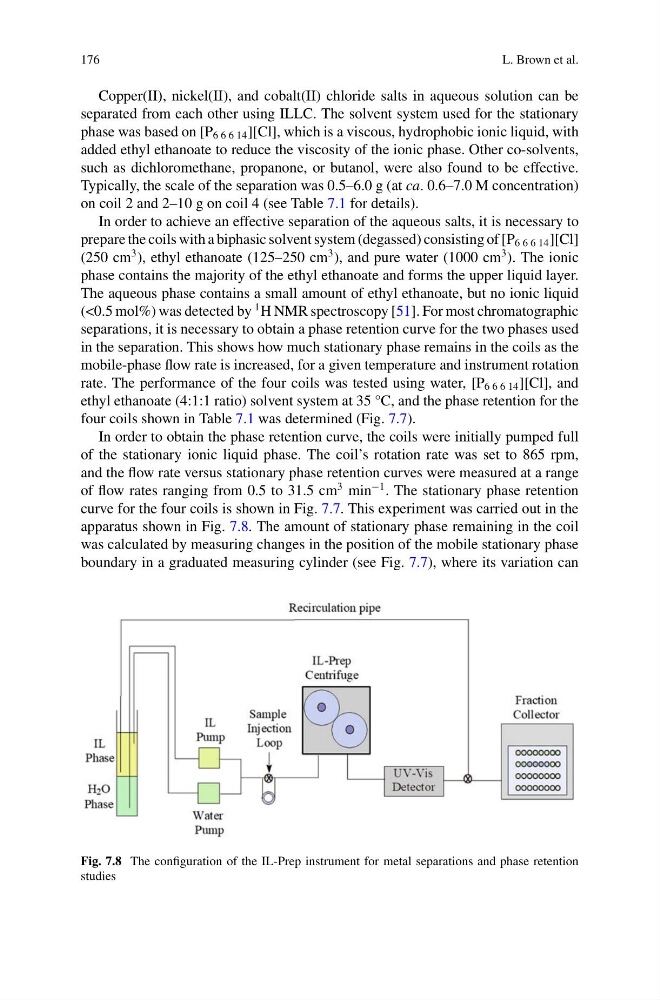
curve for the four coils is shown in Fig. 7.7. This experiment was carried out in the
apparatus shown in Fig. 7.8. The amount of stationary phase remaining in the coil
was calculated by measuring changes in the position of the mobile stationary phase
boundary in a graduated measuring cylinder (see Fig. 7.7), where its variation can
Fig. 7.8 The configuration of the IL-Prep instrument for metal separations and phase retention
studies
L. Brown et al.
Copper(II), nickel(II), and cobalt(II) chloride salts in aqueous solution can be
separated from each other using ILLC. The solvent system used for the stationary
phase was based on [P 6 6 6 14 ][Cl], which is a viscous, hydrophobic ionic liquid, with
added ethyl ethanoate to reduce the viscosity of the ionic phase. Other co-solvents,
such as dichloromethane, propanone, or butanol, were also found to be effective.
Typically, the scale of the separation was 0.5–6.0 g (at ca. 0.6–7.0 M concentration)
on coil 2 and 2–10 g on coil 4 (see Table 7.1 for details).
In order to achieve an effective separation of the aqueous salts, it is necessary to
prepare the coils with a biphasic solvent system (degassed) consisting of [P 6 6 6 14 ][Cl]
(250 cm
3 ), ethyl ethanoate (125–250 cm
3 ), and pure water (1000 cm
3 ). The ionic
phase contains the majority of the ethyl ethanoate and forms the upper liquid layer.
The aqueous phase contains a small amount of ethyl ethanoate, but no ionic liquid
(<0.5 mol%) was detected by
1 H NMR spectroscopy [51]. For most chromatographic
separations, it is necessary to obtain a phase retention curve for the two phases used
in the separation. This shows how much stationary phase remains in the coils as the
mobile-phase flow rate is increased, for a given temperature and instrument rotation
rate. The performance of the four coils was tested using water, [P 6 6 6 14 ][Cl], and
ethyl ethanoate (4:1:1 ratio) solvent system at 35 °C, and the phase retention for the
four coils shown in Table 7.1 was determined (Fig. 7.7).
In order to obtain the phase retention curve, the coils were initially pumped full
of the stationary ionic liquid phase. The coil’s rotation rate was set to 865 rpm,
and the flow rate versus stationary phase retention curves were measured at a range
of flow rates ranging from 0.5 to 31.5 cm
3 min
−1 . The stationary phase retention
curve for the four coils is shown in Fig. 7.7. This experiment was carried out in the
apparatus shown in Fig. 7.8. The amount of stationary phase remaining in the coil
was calculated by measuring changes in the position of the mobile stationary phase
boundary in a graduated measuring cylinder (see Fig. 7.7), where its variation can
Fig. 7.8 The configuration of the IL-Prep instrument for metal separations and phase retention
studies