

7 Ionic Liquid–Liquid Chromatography: A Novel Separation Method
175
Table 7.1 Details of the J-type centrifuge coils installed in the IL-Prep ILLC instrument
Coil number Bore (mm) Length (m) Number of turns Capacity (cm 3 ) L/D ratio
1
1.0
13.35
26
12
13,350
2
2.1
36.02
76
133
16,000
3
1.0
39.89
78
34
39,890
4
3.7
23.83
52
236
6440
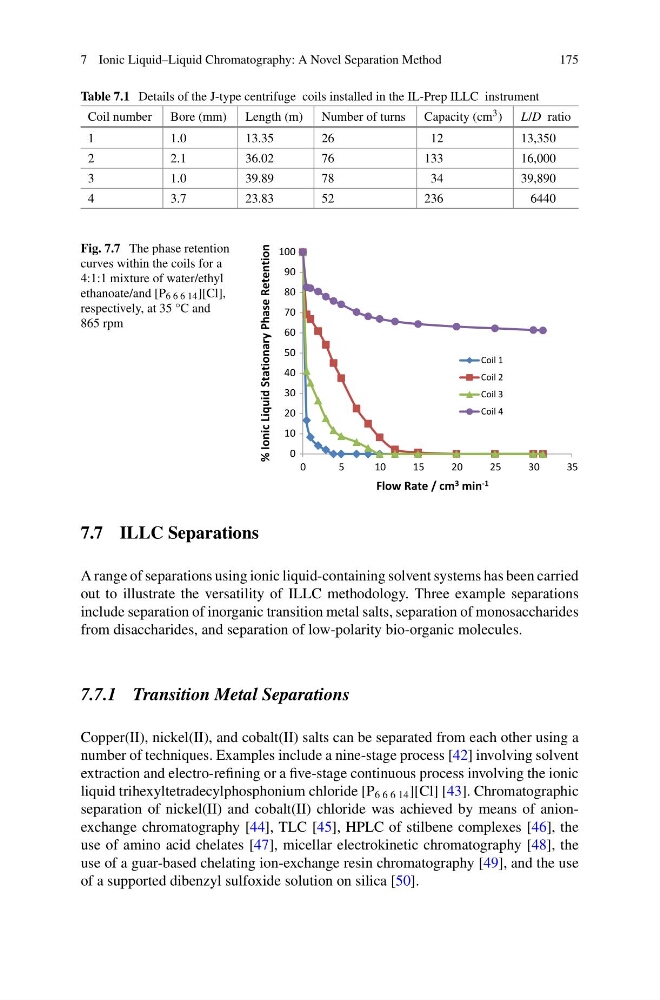
Fig. 7.7 The phase retention
curves within the coils for a
4:1:1 mixture of water/ethyl
ethanoate/and [P 6 6 6 14 ][Cl],
respectively, at 35 °C and
865 rpm
0
10
20
30
40
50
60
70
80
90
100
0
5
10
15
20
25
30
35
% Ionic Liquid Stationary Phase Retention
Flow Rate / cm 3 min -1
Coil 1
Coil 2
Coil 3
Coil 4
7.7 ILLC Separations
A range of separations using ionic liquid-containing solvent systems has been carried
out to illustrate the versatility of ILLC methodology. Three example separations
include separation of inorganic transition metal salts, separation of monosaccharides
from disaccharides, and separation of low-polarity bio-organic molecules.
7.7.1 Transition Metal Separations
Copper(II), nickel(II), and cobalt(II) salts can be separated from each other using a
number of techniques. Examples include a nine-stage process [42] involving solvent
extraction and electro-refining or a five-stage continuous process involving the ionic
liquid trihexyltetradecylphosphonium chloride [P 6 6 6 14 ][Cl] [43]. Chromatographic
separation of nickel(II) and cobalt(II) chloride was achieved by means of anionexchange chromatography [44], TLC [45], HPLC of stilbene complexes [46], the
use of amino acid chelates [47], micellar electrokinetic chromatography [48], the
use of a guar-based chelating ion-exchange resin chromatography [49], and the use
of a supported dibenzyl sulfoxide solution on silica [50].
175
Table 7.1 Details of the J-type centrifuge coils installed in the IL-Prep ILLC instrument
Coil number Bore (mm) Length (m) Number of turns Capacity (cm 3 ) L/D ratio
1
1.0
13.35
26
12
13,350
2
2.1
36.02
76
133
16,000
3
1.0
39.89
78
34
39,890
4
3.7
23.83
52
236
6440
Fig. 7.7 The phase retention
curves within the coils for a
4:1:1 mixture of water/ethyl
ethanoate/and [P 6 6 6 14 ][Cl],
respectively, at 35 °C and
865 rpm
0
10
20
30
40
50
60
70
80
90
100
0
5
10
15
20
25
30
35
% Ionic Liquid Stationary Phase Retention
Flow Rate / cm 3 min -1
Coil 1
Coil 2
Coil 3
Coil 4
7.7 ILLC Separations
A range of separations using ionic liquid-containing solvent systems has been carried
out to illustrate the versatility of ILLC methodology. Three example separations
include separation of inorganic transition metal salts, separation of monosaccharides
from disaccharides, and separation of low-polarity bio-organic molecules.
7.7.1 Transition Metal Separations
Copper(II), nickel(II), and cobalt(II) salts can be separated from each other using a
number of techniques. Examples include a nine-stage process [42] involving solvent
extraction and electro-refining or a five-stage continuous process involving the ionic
liquid trihexyltetradecylphosphonium chloride [P 6 6 6 14 ][Cl] [43]. Chromatographic
separation of nickel(II) and cobalt(II) chloride was achieved by means of anionexchange chromatography [44], TLC [45], HPLC of stilbene complexes [46], the
use of amino acid chelates [47], micellar electrokinetic chromatography [48], the
use of a guar-based chelating ion-exchange resin chromatography [49], and the use
of a supported dibenzyl sulfoxide solution on silica [50].