

140
M. Talebi et al.
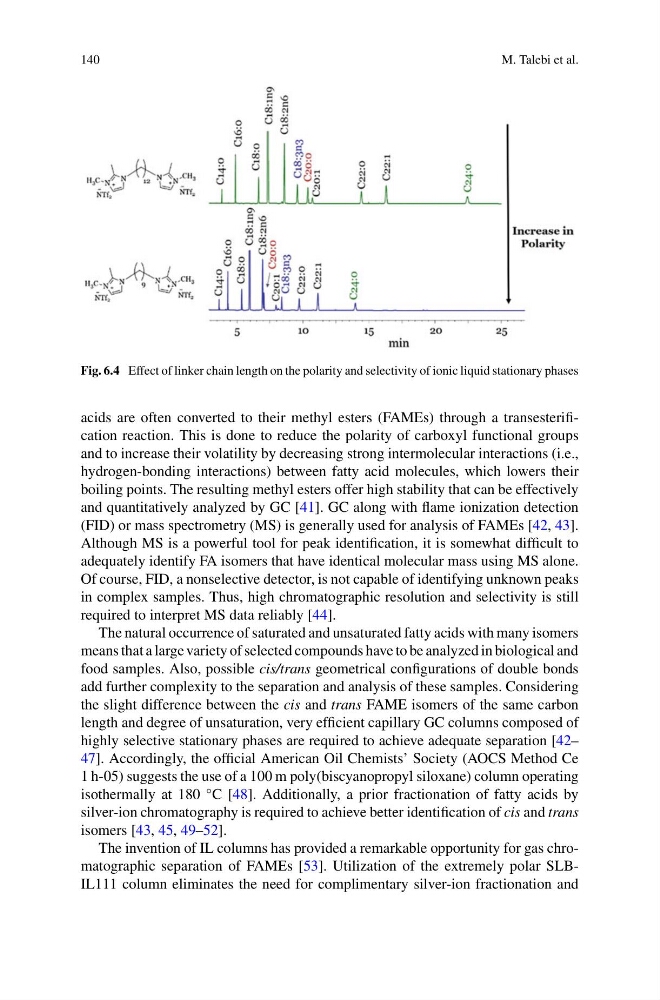
Fig. 6.4 Effect of linker chain length on the polarity and selectivity of ionic liquid stationary phases
acids are often converted to their methyl esters (FAMEs) through a transesterification reaction. This is done to reduce the polarity of carboxyl functional groups
and to increase their volatility by decreasing strong intermolecular interactions (i.e.,
hydrogen-bonding interactions) between fatty acid molecules, which lowers their
boiling points. The resulting methyl esters offer high stability that can be effectively
and quantitatively analyzed by GC [41]. GC along with flame ionization detection
(FID) or mass spectrometry (MS) is generally used for analysis of FAMEs [42, 43].
Although MS is a powerful tool for peak identification, it is somewhat difficult to
adequately identify FA isomers that have identical molecular mass using MS alone.
Of course, FID, a nonselective detector, is not capable of identifying unknown peaks
in complex samples. Thus, high chromatographic resolution and selectivity is still
required to interpret MS data reliably [44].
The natural occurrence of saturated and unsaturated fatty acids with many isomers
means that a large variety of selected compounds have to be analyzed in biological and
food samples. Also, possible cis/trans geometrical configurations of double bonds
add further complexity to the separation and analysis of these samples. Considering
the slight difference between the cis and trans FAME isomers of the same carbon
length and degree of unsaturation, very efficient capillary GC columns composed of
highly selective stationary phases are required to achieve adequate separation [42–
47]. Accordingly, the official American Oil Chemists’ Society (AOCS Method Ce
1 h-05) suggests the use of a 100 m poly(biscyanopropyl siloxane) column operating
isothermally at 180 °C [48]. Additionally, a prior fractionation of fatty acids by
silver-ion chromatography is required to achieve better identification of cis and trans
isomers [43, 45, 49–52].
The invention of IL columns has provided a remarkable opportunity for gas chromatographic separation of FAMEs [53]. Utilization of the extremely polar SLBIL111 column eliminates the need for complimentary silver-ion fractionation and
M. Talebi et al.
Fig. 6.4 Effect of linker chain length on the polarity and selectivity of ionic liquid stationary phases
acids are often converted to their methyl esters (FAMEs) through a transesterification reaction. This is done to reduce the polarity of carboxyl functional groups
and to increase their volatility by decreasing strong intermolecular interactions (i.e.,
hydrogen-bonding interactions) between fatty acid molecules, which lowers their
boiling points. The resulting methyl esters offer high stability that can be effectively
and quantitatively analyzed by GC [41]. GC along with flame ionization detection
(FID) or mass spectrometry (MS) is generally used for analysis of FAMEs [42, 43].
Although MS is a powerful tool for peak identification, it is somewhat difficult to
adequately identify FA isomers that have identical molecular mass using MS alone.
Of course, FID, a nonselective detector, is not capable of identifying unknown peaks
in complex samples. Thus, high chromatographic resolution and selectivity is still
required to interpret MS data reliably [44].
The natural occurrence of saturated and unsaturated fatty acids with many isomers
means that a large variety of selected compounds have to be analyzed in biological and
food samples. Also, possible cis/trans geometrical configurations of double bonds
add further complexity to the separation and analysis of these samples. Considering
the slight difference between the cis and trans FAME isomers of the same carbon
length and degree of unsaturation, very efficient capillary GC columns composed of
highly selective stationary phases are required to achieve adequate separation [42–
47]. Accordingly, the official American Oil Chemists’ Society (AOCS Method Ce
1 h-05) suggests the use of a 100 m poly(biscyanopropyl siloxane) column operating
isothermally at 180 °C [48]. Additionally, a prior fractionation of fatty acids by
silver-ion chromatography is required to achieve better identification of cis and trans
isomers [43, 45, 49–52].
The invention of IL columns has provided a remarkable opportunity for gas chromatographic separation of FAMEs [53]. Utilization of the extremely polar SLBIL111 column eliminates the need for complimentary silver-ion fractionation and