

6 Gas Chromatography Columns Using Ionic Liquids …
139
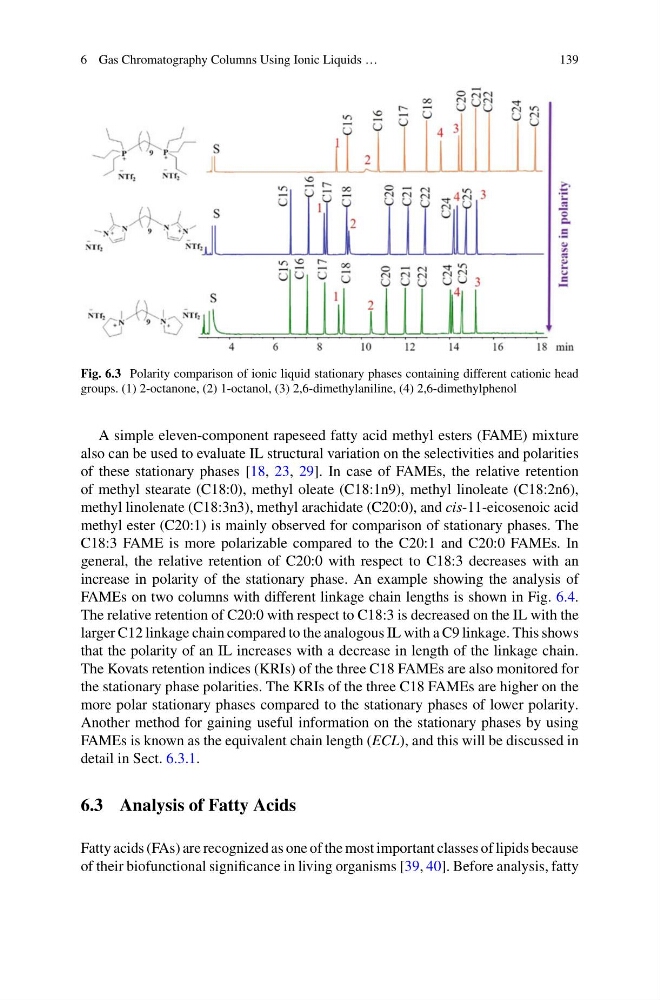
Fig. 6.3 Polarity comparison of ionic liquid stationary phases containing different cationic head
groups. (1) 2-octanone, (2) 1-octanol, (3) 2,6-dimethylaniline, (4) 2,6-dimethylphenol
A simple eleven-component rapeseed fatty acid methyl esters (FAME) mixture
also can be used to evaluate IL structural variation on the selectivities and polarities
of these stationary phases [18, 23, 29]. In case of FAMEs, the relative retention
of methyl stearate (C18:0), methyl oleate (C18:1n9), methyl linoleate (C18:2n6),
methyl linolenate (C18:3n3), methyl arachidate (C20:0), and cis-11-eicosenoic acid
methyl ester (C20:1) is mainly observed for comparison of stationary phases. The
C18:3 FAME is more polarizable compared to the C20:1 and C20:0 FAMEs. In
general, the relative retention of C20:0 with respect to C18:3 decreases with an
increase in polarity of the stationary phase. An example showing the analysis of
FAMEs on two columns with different linkage chain lengths is shown in Fig. 6.4.
The relative retention of C20:0 with respect to C18:3 is decreased on the IL with the
larger C12 linkage chain compared to the analogous IL with a C9 linkage. This shows
that the polarity of an IL increases with a decrease in length of the linkage chain.
The Kovats retention indices (KRIs) of the three C18 FAMEs are also monitored for
the stationary phase polarities. The KRIs of the three C18 FAMEs are higher on the
more polar stationary phases compared to the stationary phases of lower polarity.
Another method for gaining useful information on the stationary phases by using
FAMEs is known as the equivalent chain length (ECL), and this will be discussed in
detail in Sect. 6.3.1.
6.3 Analysis of Fatty Acids
Fatty acids (FAs) are recognized as one of the most important classes of lipids because
of their biofunctional significance in living organisms [39, 40]. Before analysis, fatty
139
Fig. 6.3 Polarity comparison of ionic liquid stationary phases containing different cationic head
groups. (1) 2-octanone, (2) 1-octanol, (3) 2,6-dimethylaniline, (4) 2,6-dimethylphenol
A simple eleven-component rapeseed fatty acid methyl esters (FAME) mixture
also can be used to evaluate IL structural variation on the selectivities and polarities
of these stationary phases [18, 23, 29]. In case of FAMEs, the relative retention
of methyl stearate (C18:0), methyl oleate (C18:1n9), methyl linoleate (C18:2n6),
methyl linolenate (C18:3n3), methyl arachidate (C20:0), and cis-11-eicosenoic acid
methyl ester (C20:1) is mainly observed for comparison of stationary phases. The
C18:3 FAME is more polarizable compared to the C20:1 and C20:0 FAMEs. In
general, the relative retention of C20:0 with respect to C18:3 decreases with an
increase in polarity of the stationary phase. An example showing the analysis of
FAMEs on two columns with different linkage chain lengths is shown in Fig. 6.4.
The relative retention of C20:0 with respect to C18:3 is decreased on the IL with the
larger C12 linkage chain compared to the analogous IL with a C9 linkage. This shows
that the polarity of an IL increases with a decrease in length of the linkage chain.
The Kovats retention indices (KRIs) of the three C18 FAMEs are also monitored for
the stationary phase polarities. The KRIs of the three C18 FAMEs are higher on the
more polar stationary phases compared to the stationary phases of lower polarity.
Another method for gaining useful information on the stationary phases by using
FAMEs is known as the equivalent chain length (ECL), and this will be discussed in
detail in Sect. 6.3.1.
6.3 Analysis of Fatty Acids
Fatty acids (FAs) are recognized as one of the most important classes of lipids because
of their biofunctional significance in living organisms [39, 40]. Before analysis, fatty