

6 Gas Chromatography Columns Using Ionic Liquids …
141
allows faster separation of FAMEs [42, 43]. Herein, the applicability of IL-based
columns for FAMEs separation and their unique selectivity to distinguish between
positional FAME isomers are discussed.
6.3.1 Selectivity
Highly selective IL stationary phases are particularly adept in analyzing complete
mixtures of fatty acids [18, 42–44, 46, 53–60]. Generally, the following behaviors
can be observed when separating FAMEs on polar ionic liquid columns: (1) shorter
analysis times than traditional GC stationary phases, (2) increased retention with
greater degrees of unsaturation, (3) elution of trans FAME isomers before cis isomers,
and (4) longer retention of unsaturated FAMEs with the double bond located closer
to the hydrocarbon chain terminus (e.g., ω-3 fatty acids tend to retain longer than
ω-6 isomers) [29, 57].
Retention patterns on IL columns are greatly dependent on chromatographic conditions. For example, the elution orders of fatty acids can sometimes be reversed with
a slight change in column temperature. Therefore, the peak identification should be
verified when working with IL columns at different temperatures, especially if a
nonselective detector (e.g., FID) is utilized [47, 60].
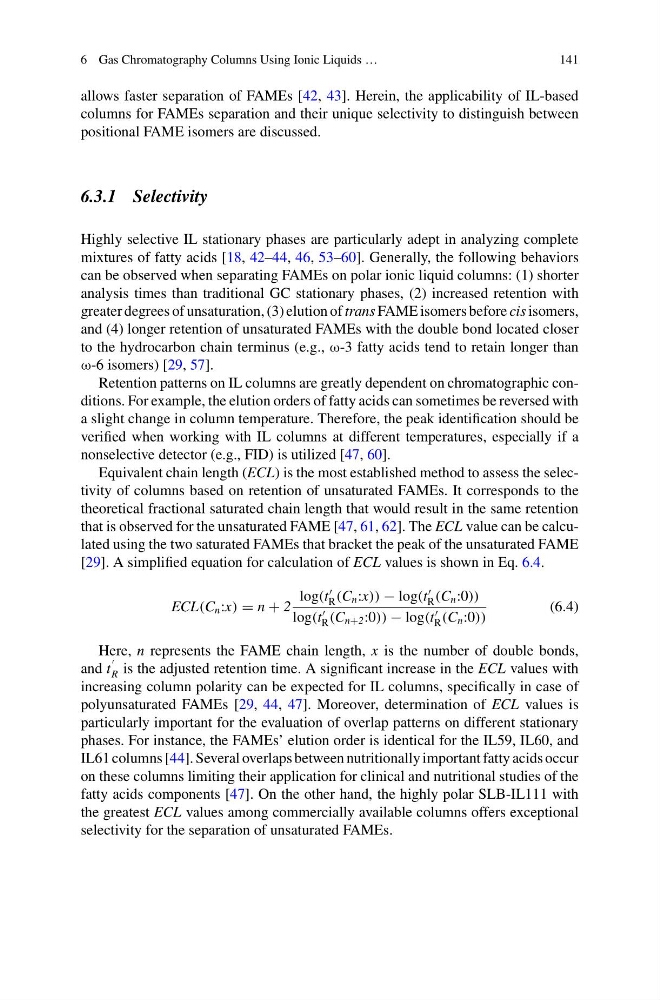
Equivalent chain length (ECL) is the most established method to assess the selectivity of columns based on retention of unsaturated FAMEs. It corresponds to the
theoretical fractional saturated chain length that would result in the same retention
that is observed for the unsaturated FAME [47, 61, 62]. The ECL value can be calculated using the two saturated FAMEs that bracket the peak of the unsaturated FAME
[29]. A simplified equation for calculation of ECL values is shown in Eq. 6.4.
ECL(C n :x) = n + 2
log(t
R (C n :x)) − log(t
R (C n :0))
log(t
R (C n+2 :0)) − log(t
R (C n :0))
(6.4)
Here, n represents the FAME chain length, x is the number of double bonds,
and t
R is the adjusted retention time. A significant increase in the ECL values with
increasing column polarity can be expected for IL columns, specifically in case of
polyunsaturated FAMEs [29, 44, 47]. Moreover, determination of ECL values is
particularly important for the evaluation of overlap patterns on different stationary
phases. For instance, the FAMEs’ elution order is identical for the IL59, IL60, and
IL61 columns [44]. Several overlaps between nutritionally important fatty acids occur
on these columns limiting their application for clinical and nutritional studies of the
fatty acids components [47]. On the other hand, the highly polar SLB-IL111 with
the greatest ECL values among commercially available columns offers exceptional
selectivity for the separation of unsaturated FAMEs.
141
allows faster separation of FAMEs [42, 43]. Herein, the applicability of IL-based
columns for FAMEs separation and their unique selectivity to distinguish between
positional FAME isomers are discussed.
6.3.1 Selectivity
Highly selective IL stationary phases are particularly adept in analyzing complete
mixtures of fatty acids [18, 42–44, 46, 53–60]. Generally, the following behaviors
can be observed when separating FAMEs on polar ionic liquid columns: (1) shorter
analysis times than traditional GC stationary phases, (2) increased retention with
greater degrees of unsaturation, (3) elution of trans FAME isomers before cis isomers,
and (4) longer retention of unsaturated FAMEs with the double bond located closer
to the hydrocarbon chain terminus (e.g., ω-3 fatty acids tend to retain longer than
ω-6 isomers) [29, 57].
Retention patterns on IL columns are greatly dependent on chromatographic conditions. For example, the elution orders of fatty acids can sometimes be reversed with
a slight change in column temperature. Therefore, the peak identification should be
verified when working with IL columns at different temperatures, especially if a
nonselective detector (e.g., FID) is utilized [47, 60].
Equivalent chain length (ECL) is the most established method to assess the selectivity of columns based on retention of unsaturated FAMEs. It corresponds to the
theoretical fractional saturated chain length that would result in the same retention
that is observed for the unsaturated FAME [47, 61, 62]. The ECL value can be calculated using the two saturated FAMEs that bracket the peak of the unsaturated FAME
[29]. A simplified equation for calculation of ECL values is shown in Eq. 6.4.
ECL(C n :x) = n + 2
log(t
R (C n :x)) − log(t
R (C n :0))
log(t
R (C n+2 :0)) − log(t
R (C n :0))
(6.4)
Here, n represents the FAME chain length, x is the number of double bonds,
and t
R is the adjusted retention time. A significant increase in the ECL values with
increasing column polarity can be expected for IL columns, specifically in case of
polyunsaturated FAMEs [29, 44, 47]. Moreover, determination of ECL values is
particularly important for the evaluation of overlap patterns on different stationary
phases. For instance, the FAMEs’ elution order is identical for the IL59, IL60, and
IL61 columns [44]. Several overlaps between nutritionally important fatty acids occur
on these columns limiting their application for clinical and nutritional studies of the
fatty acids components [47]. On the other hand, the highly polar SLB-IL111 with
the greatest ECL values among commercially available columns offers exceptional
selectivity for the separation of unsaturated FAMEs.