

78
J. L. Shamshina and R. D. Rogers
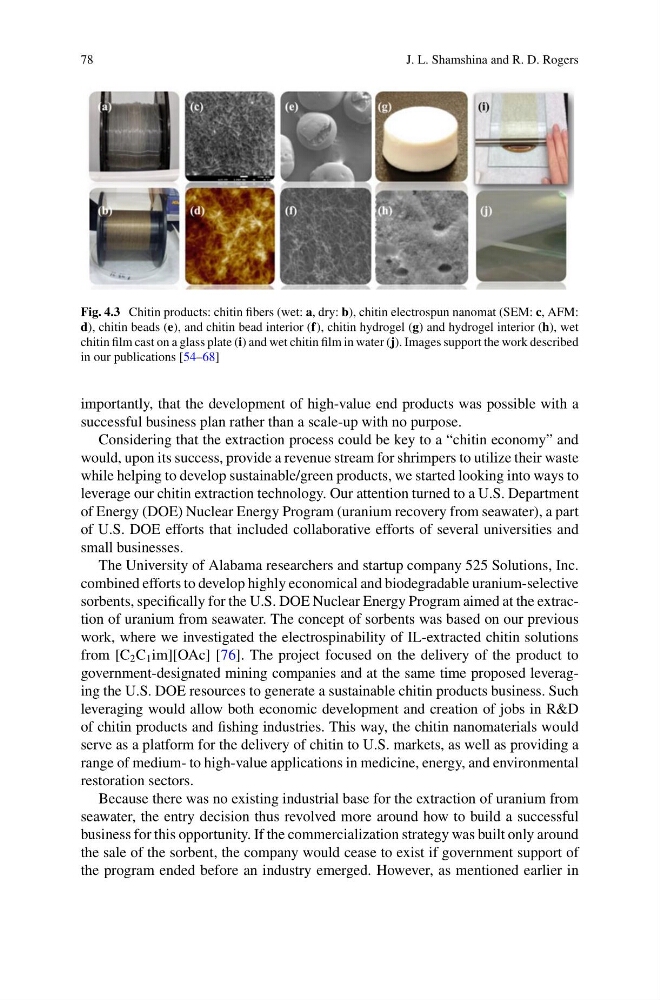
Fig. 4.3 Chitin products: chitin fibers (wet: a, dry: b), chitin electrospun nanomat (SEM: c, AFM:
d), chitin beads (e), and chitin bead interior (f), chitin hydrogel (g) and hydrogel interior (h), wet
chitin film cast on a glass plate (i) and wet chitin film in water (j). Images support the work described
in our publications [54–68]
importantly, that the development of high-value end products was possible with a
successful business plan rather than a scale-up with no purpose.
Considering that the extraction process could be key to a “chitin economy” and
would, upon its success, provide a revenue stream for shrimpers to utilize their waste
while helping to develop sustainable/green products, we started looking into ways to
leverage our chitin extraction technology. Our attention turned to a U.S. Department
of Energy (DOE) Nuclear Energy Program (uranium recovery from seawater), a part
of U.S. DOE efforts that included collaborative efforts of several universities and
small businesses.
The University of Alabama researchers and startup company 525 Solutions, Inc.
combined efforts to develop highly economical and biodegradable uranium-selective
sorbents, specifically for the U.S. DOE Nuclear Energy Program aimed at the extraction of uranium from seawater. The concept of sorbents was based on our previous
work, where we investigated the electrospinability of IL-extracted chitin solutions
from [C 2 C 1 im][OAc] [76]. The project focused on the delivery of the product to
government-designated mining companies and at the same time proposed leveraging the U.S. DOE resources to generate a sustainable chitin products business. Such
leveraging would allow both economic development and creation of jobs in R&D
of chitin products and fishing industries. This way, the chitin nanomaterials would
serve as a platform for the delivery of chitin to U.S. markets, as well as providing a
range of medium- to high-value applications in medicine, energy, and environmental
restoration sectors.
Because there was no existing industrial base for the extraction of uranium from
seawater, the entry decision thus revolved more around how to build a successful
business for this opportunity. If the commercialization strategy was built only around
the sale of the sorbent, the company would cease to exist if government support of
the program ended before an industry emerged. However, as mentioned earlier in
J. L. Shamshina and R. D. Rogers
Fig. 4.3 Chitin products: chitin fibers (wet: a, dry: b), chitin electrospun nanomat (SEM: c, AFM:
d), chitin beads (e), and chitin bead interior (f), chitin hydrogel (g) and hydrogel interior (h), wet
chitin film cast on a glass plate (i) and wet chitin film in water (j). Images support the work described
in our publications [54–68]
importantly, that the development of high-value end products was possible with a
successful business plan rather than a scale-up with no purpose.
Considering that the extraction process could be key to a “chitin economy” and
would, upon its success, provide a revenue stream for shrimpers to utilize their waste
while helping to develop sustainable/green products, we started looking into ways to
leverage our chitin extraction technology. Our attention turned to a U.S. Department
of Energy (DOE) Nuclear Energy Program (uranium recovery from seawater), a part
of U.S. DOE efforts that included collaborative efforts of several universities and
small businesses.
The University of Alabama researchers and startup company 525 Solutions, Inc.
combined efforts to develop highly economical and biodegradable uranium-selective
sorbents, specifically for the U.S. DOE Nuclear Energy Program aimed at the extraction of uranium from seawater. The concept of sorbents was based on our previous
work, where we investigated the electrospinability of IL-extracted chitin solutions
from [C 2 C 1 im][OAc] [76]. The project focused on the delivery of the product to
government-designated mining companies and at the same time proposed leveraging the U.S. DOE resources to generate a sustainable chitin products business. Such
leveraging would allow both economic development and creation of jobs in R&D
of chitin products and fishing industries. This way, the chitin nanomaterials would
serve as a platform for the delivery of chitin to U.S. markets, as well as providing a
range of medium- to high-value applications in medicine, energy, and environmental
restoration sectors.
Because there was no existing industrial base for the extraction of uranium from
seawater, the entry decision thus revolved more around how to build a successful
business for this opportunity. If the commercialization strategy was built only around
the sale of the sorbent, the company would cease to exist if government support of
the program ended before an industry emerged. However, as mentioned earlier in