

4 Are Ionic Liquids Enabling Technology? Startup to Scale-Up …
79
this chapter, numerous market opportunities were emerging based on the underlying
technology, chitin extraction. The ability to produce not only products from chitin,
but chitin itself, provided a competitive advantage to diversify the range of products
and enter several profitable specialized markets, while at the same time developing
the sorbents for the DOE Nuclear Energy Program. Such leveraging would lower the
bulk cost of the sorbent by building high-end markets that would help pay for the
process development and economy of scale.
For 2014–2015, a $1.5 million grant was funded by the U.S. DOE Small Business
Innovation Research Program, “Bench to pilot scale prototype for electrospinning
biorenewable chitin sorbents for uranium from seawater: Process development, cost,
and environmental analysis” (DOE-SBIR Grant No. DE-SC0010152, Phase I/II).
The ultimate goal of this project was to collect the industrial process parameters,
to conduct reliable economic estimates, and ultimately to generate data for the fullscale operating plant design.
To address the scalability of the IL technology platform for biomass processing, Rogers’ group (together with 525 Solutions, Inc.) refined the pilot plant operating conditions and plant design and prepared input-output diagrams of the process. This provided the relationships between the major equipment of a pilot plant
facility and the piping of the process flow together with all required equipment
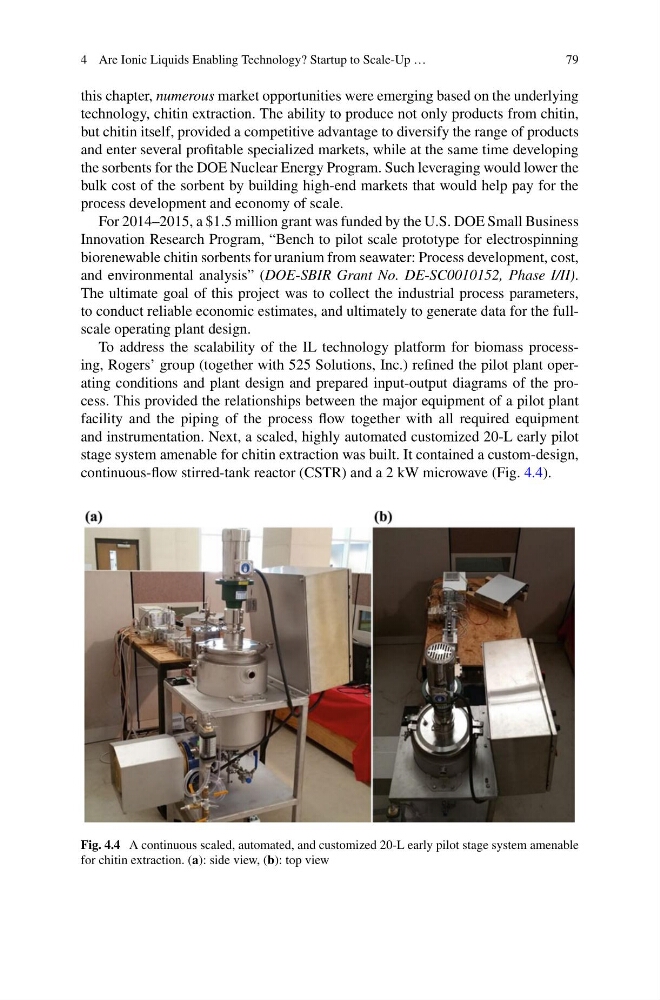
and instrumentation. Next, a scaled, highly automated customized 20-L early pilot
stage system amenable for chitin extraction was built. It contained a custom-design,
continuous-flow stirred-tank reactor (CSTR) and a 2 kW microwave (Fig. 4.4).
Fig. 4.4 A continuous scaled, automated, and customized 20-L early pilot stage system amenable
for chitin extraction. (a): side view, (b): top view
79
this chapter, numerous market opportunities were emerging based on the underlying
technology, chitin extraction. The ability to produce not only products from chitin,
but chitin itself, provided a competitive advantage to diversify the range of products
and enter several profitable specialized markets, while at the same time developing
the sorbents for the DOE Nuclear Energy Program. Such leveraging would lower the
bulk cost of the sorbent by building high-end markets that would help pay for the
process development and economy of scale.
For 2014–2015, a $1.5 million grant was funded by the U.S. DOE Small Business
Innovation Research Program, “Bench to pilot scale prototype for electrospinning
biorenewable chitin sorbents for uranium from seawater: Process development, cost,
and environmental analysis” (DOE-SBIR Grant No. DE-SC0010152, Phase I/II).
The ultimate goal of this project was to collect the industrial process parameters,
to conduct reliable economic estimates, and ultimately to generate data for the fullscale operating plant design.
To address the scalability of the IL technology platform for biomass processing, Rogers’ group (together with 525 Solutions, Inc.) refined the pilot plant operating conditions and plant design and prepared input-output diagrams of the process. This provided the relationships between the major equipment of a pilot plant
facility and the piping of the process flow together with all required equipment
and instrumentation. Next, a scaled, highly automated customized 20-L early pilot
stage system amenable for chitin extraction was built. It contained a custom-design,
continuous-flow stirred-tank reactor (CSTR) and a 2 kW microwave (Fig. 4.4).
Fig. 4.4 A continuous scaled, automated, and customized 20-L early pilot stage system amenable
for chitin extraction. (a): side view, (b): top view