

4 Are Ionic Liquids Enabling Technology? Startup to Scale-Up …
77
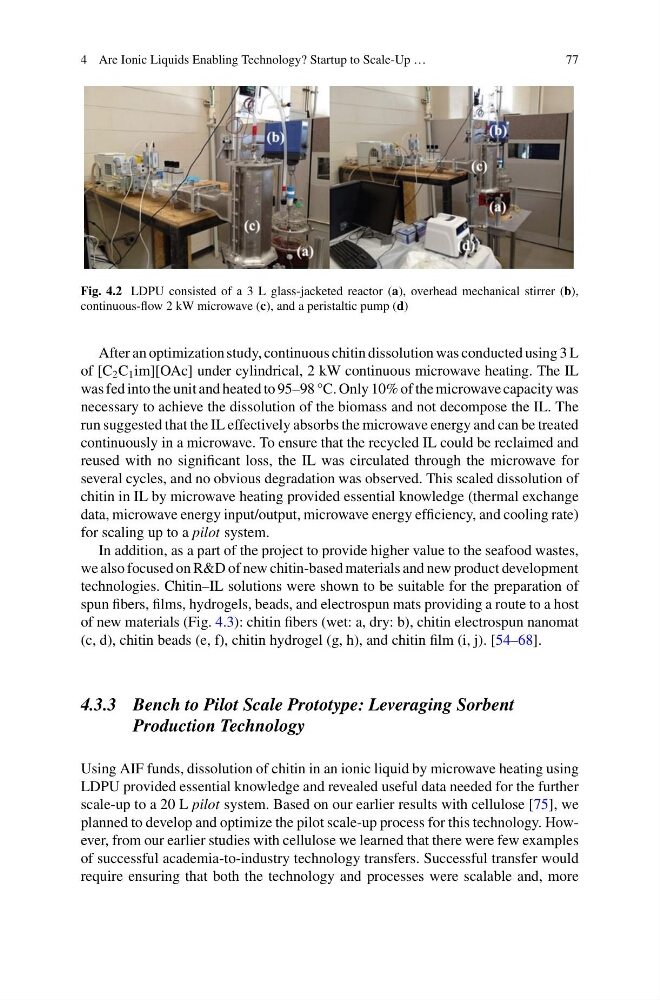
Fig. 4.2 LDPU consisted of a 3 L glass-jacketed reactor (a), overhead mechanical stirrer (b),
continuous-flow 2 kW microwave (c), and a peristaltic pump (d)
After an optimization study, continuous chitin dissolution was conducted using 3 L
of [C 2 C 1 im][OAc] under cylindrical, 2 kW continuous microwave heating. The IL
was fed into the unit and heated to 95–98 °C. Only 10% of the microwave capacity was
necessary to achieve the dissolution of the biomass and not decompose the IL. The
run suggested that the IL effectively absorbs the microwave energy and can be treated
continuously in a microwave. To ensure that the recycled IL could be reclaimed and
reused with no significant loss, the IL was circulated through the microwave for
several cycles, and no obvious degradation was observed. This scaled dissolution of
chitin in IL by microwave heating provided essential knowledge (thermal exchange
data, microwave energy input/output, microwave energy efficiency, and cooling rate)
for scaling up to a pilot system.
In addition, as a part of the project to provide higher value to the seafood wastes,
we also focused on R&D of new chitin-based materials and new product development
technologies. Chitin–IL solutions were shown to be suitable for the preparation of
spun fibers, films, hydrogels, beads, and electrospun mats providing a route to a host
of new materials (Fig. 4.3): chitin fibers (wet: a, dry: b), chitin electrospun nanomat
(c, d), chitin beads (e, f), chitin hydrogel (g, h), and chitin film (i, j). [54–68].
4.3.3 Bench to Pilot Scale Prototype: Leveraging Sorbent
Production Technology
Using AIF funds, dissolution of chitin in an ionic liquid by microwave heating using
LDPU provided essential knowledge and revealed useful data needed for the further
scale-up to a 20 L pilot system. Based on our earlier results with cellulose [75], we
planned to develop and optimize the pilot scale-up process for this technology. However, from our earlier studies with cellulose we learned that there were few examples
of successful academia-to-industry technology transfers. Successful transfer would
require ensuring that both the technology and processes were scalable and, more
77
Fig. 4.2 LDPU consisted of a 3 L glass-jacketed reactor (a), overhead mechanical stirrer (b),
continuous-flow 2 kW microwave (c), and a peristaltic pump (d)
After an optimization study, continuous chitin dissolution was conducted using 3 L
of [C 2 C 1 im][OAc] under cylindrical, 2 kW continuous microwave heating. The IL
was fed into the unit and heated to 95–98 °C. Only 10% of the microwave capacity was
necessary to achieve the dissolution of the biomass and not decompose the IL. The
run suggested that the IL effectively absorbs the microwave energy and can be treated
continuously in a microwave. To ensure that the recycled IL could be reclaimed and
reused with no significant loss, the IL was circulated through the microwave for
several cycles, and no obvious degradation was observed. This scaled dissolution of
chitin in IL by microwave heating provided essential knowledge (thermal exchange
data, microwave energy input/output, microwave energy efficiency, and cooling rate)
for scaling up to a pilot system.
In addition, as a part of the project to provide higher value to the seafood wastes,
we also focused on R&D of new chitin-based materials and new product development
technologies. Chitin–IL solutions were shown to be suitable for the preparation of
spun fibers, films, hydrogels, beads, and electrospun mats providing a route to a host
of new materials (Fig. 4.3): chitin fibers (wet: a, dry: b), chitin electrospun nanomat
(c, d), chitin beads (e, f), chitin hydrogel (g, h), and chitin film (i, j). [54–68].
4.3.3 Bench to Pilot Scale Prototype: Leveraging Sorbent
Production Technology
Using AIF funds, dissolution of chitin in an ionic liquid by microwave heating using
LDPU provided essential knowledge and revealed useful data needed for the further
scale-up to a 20 L pilot system. Based on our earlier results with cellulose [75], we
planned to develop and optimize the pilot scale-up process for this technology. However, from our earlier studies with cellulose we learned that there were few examples
of successful academia-to-industry technology transfers. Successful transfer would
require ensuring that both the technology and processes were scalable and, more