

construction of adequate models of complex
natural systems and the achievement of the theoretically best accuracy of mathematical models.
SAM is based on the system-hierarchical
approach and executed as a specific mathematical analysis of equations, which simulate intraand interannual dynamics of studied characteristics of natural systems (see more details in
(Kirsta 2006a; Kirsta and Kirsta 2014)). In our
case, it is intra-annual dynamics of river
WR/HCR calculated and compared with experimental data for each year of the available longterm records.
We apply SAM method to identify and
quantitatively characterize the functional relationships of river WR/HCR with meteorological
factors, morphometry, and landscape structure of
river basins. Similar to the methodological
approach of hydrograph separation by Tardy
et al. (2004), SAM allows to extract the information on these relationships from the experimental data series. The simulation balance
models of WR/HCR are constructed from algebraic equations since the use of differential
equations for the description of hydrological and
hydrochemical processes in mountain conditions
is hardly possible. We determine the character of
functional relationships between the processes
and factors by way of theoretically well-founded
selection and adjustment of the combined equations to minimize the RMS discrepancy (quadratic residual) between the calculated and the
observed dynamic characteristics. Using the
observed water and hydrochemical discharge
values as a left side of river discharge equations
permits to evaluate both the equations parameters
and quadratic residual for the test versions of the
mathematical model via inverse problem solution
by optimization methods. The model is considered to be constructed if it provides a minimal
residual value.
In order to take into account a landscape
structure of river basins, we have selected several
groups of geosystems peculiar to the Altai-Sayan
mountain country. Each group is characterized
by its own values of hydrological regime
parameters determined during SAM. Thus, the
WR/HCR model development is performed by
spatial division of the river basin into several
typical areas with different types of hydrological
and hydrochemical regimes jointly describing the
overall regime of the basin.
Low sensitivity to an experimental data error
is one of SAM features. The increase in data
error brings to residual enhance without change
in the target equations and values of model
parameters. In our case, SAM makes it possible
to use meteorological factors (monthly precipitation and air temperature), which are spatially
generalized throughout the Altai-Sayan mountain
country by regional climate model (Kirsta
2011b). The model performance is evaluated
with criterion RSR (RMSE-observations standard deviation ratio) defined as the ratio of the
standardized root mean square error to the
observed standard deviation of the target variable
(Singh et al. 2004; Moriasi et al. 2007). Such a
spatial generalization has RSR exceeded 0.7, that
is commonly inadmissible under the modeling of
hydrological processes (Koch and Cherie 2013).
Despite this, SAM makes the best use of these
data because the mandatory requirement for a
tenfold excess of experimental data over the
number of developed model parameters in SAM
does exist.
The second main feature of SAM is a fixationfree form of the sought-for dependence of model
variables on the environmental factors. Note, in
case of differential equations, this form is strictly
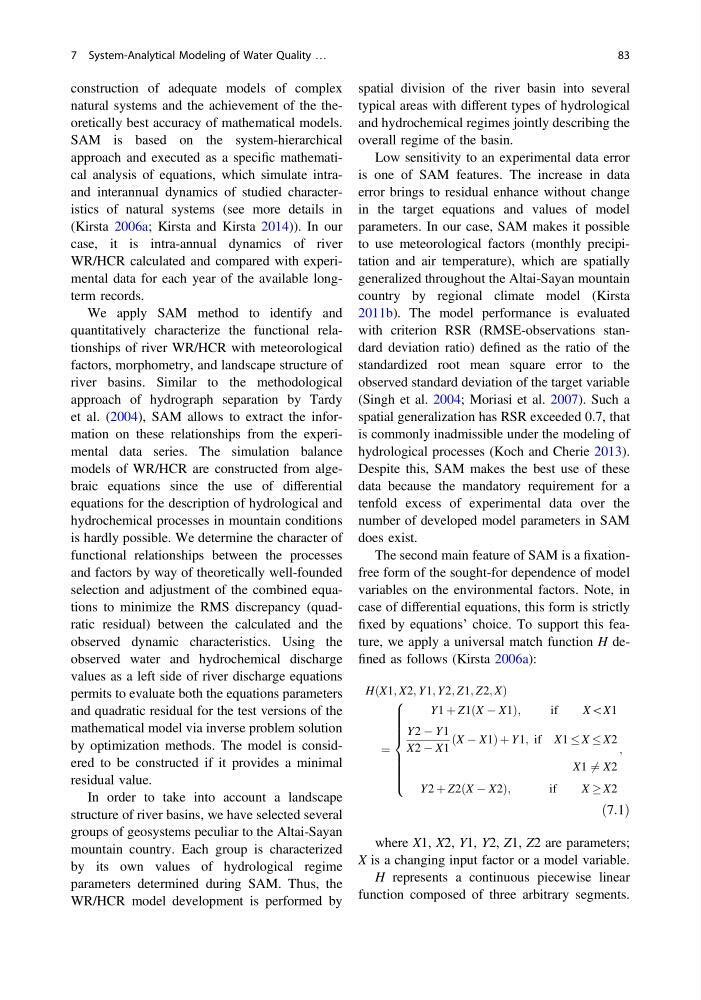
fixed by equations’ choice. To support this feature, we apply a universal match function H defined as follows (Kirsta 2006a):
H X1; X2; Y1; Y2; Z1; Z2; X
ð
Þ
¼
Y1 þ Z1 X À X1
ð
Þ ;
if
X\X1
Y2 À Y1
X2 À X1
X À X1
ð
ÞþY1; if X1 X X2
X1 6 ¼ X2
Y2 þ Z2 X À X2
ð
Þ ;
if
X ! X2
8
> > > > > > > <
> > > > > > > :
;
ð7:1Þ
where X1, X2, Y1, Y2, Z1, Z2 are parameters;
X is a changing input factor or a model variable.
H represents a continuous piecewise linear
function composed of three arbitrary segments.
7 System-Analytical Modeling of Water Quality …
83
natural systems and the achievement of the theoretically best accuracy of mathematical models.
SAM is based on the system-hierarchical
approach and executed as a specific mathematical analysis of equations, which simulate intraand interannual dynamics of studied characteristics of natural systems (see more details in
(Kirsta 2006a; Kirsta and Kirsta 2014)). In our
case, it is intra-annual dynamics of river
WR/HCR calculated and compared with experimental data for each year of the available longterm records.
We apply SAM method to identify and
quantitatively characterize the functional relationships of river WR/HCR with meteorological
factors, morphometry, and landscape structure of
river basins. Similar to the methodological
approach of hydrograph separation by Tardy
et al. (2004), SAM allows to extract the information on these relationships from the experimental data series. The simulation balance
models of WR/HCR are constructed from algebraic equations since the use of differential
equations for the description of hydrological and
hydrochemical processes in mountain conditions
is hardly possible. We determine the character of
functional relationships between the processes
and factors by way of theoretically well-founded
selection and adjustment of the combined equations to minimize the RMS discrepancy (quadratic residual) between the calculated and the
observed dynamic characteristics. Using the
observed water and hydrochemical discharge
values as a left side of river discharge equations
permits to evaluate both the equations parameters
and quadratic residual for the test versions of the
mathematical model via inverse problem solution
by optimization methods. The model is considered to be constructed if it provides a minimal
residual value.
In order to take into account a landscape
structure of river basins, we have selected several
groups of geosystems peculiar to the Altai-Sayan
mountain country. Each group is characterized
by its own values of hydrological regime
parameters determined during SAM. Thus, the
WR/HCR model development is performed by
spatial division of the river basin into several
typical areas with different types of hydrological
and hydrochemical regimes jointly describing the
overall regime of the basin.
Low sensitivity to an experimental data error
is one of SAM features. The increase in data
error brings to residual enhance without change
in the target equations and values of model
parameters. In our case, SAM makes it possible
to use meteorological factors (monthly precipitation and air temperature), which are spatially
generalized throughout the Altai-Sayan mountain
country by regional climate model (Kirsta
2011b). The model performance is evaluated
with criterion RSR (RMSE-observations standard deviation ratio) defined as the ratio of the
standardized root mean square error to the
observed standard deviation of the target variable
(Singh et al. 2004; Moriasi et al. 2007). Such a
spatial generalization has RSR exceeded 0.7, that
is commonly inadmissible under the modeling of
hydrological processes (Koch and Cherie 2013).
Despite this, SAM makes the best use of these
data because the mandatory requirement for a
tenfold excess of experimental data over the
number of developed model parameters in SAM
does exist.
The second main feature of SAM is a fixationfree form of the sought-for dependence of model
variables on the environmental factors. Note, in
case of differential equations, this form is strictly
fixed by equations’ choice. To support this feature, we apply a universal match function H defined as follows (Kirsta 2006a):
H X1; X2; Y1; Y2; Z1; Z2; X
ð
Þ
¼
Y1 þ Z1 X À X1
ð
Þ ;
if
X\X1
Y2 À Y1
X2 À X1
X À X1
ð
ÞþY1; if X1 X X2
X1 6 ¼ X2
Y2 þ Z2 X À X2
ð
Þ ;
if
X ! X2
8
> > > > > > > <
> > > > > > > :
;
ð7:1Þ
where X1, X2, Y1, Y2, Z1, Z2 are parameters;
X is a changing input factor or a model variable.
H represents a continuous piecewise linear
function composed of three arbitrary segments.
7 System-Analytical Modeling of Water Quality …
83