

Zimbabwe, like in other countries in southern
Africa, IWRM has been state driven and donor
funded. Water management experiences drawn
from the Turwi Basin allowed the exploration of
the implementation and performance of IWRM
in the basin so far. This way, insights into the
underlying practical and conjectural challenges
to the execution of IWRM emerged. The analysis
of the empirical data that were collected in the
Turwi Basin revealed that people cannot be
separated from their physical resource base (environment), especially its integral components
such as water and land. As demonstrated above
the Turwi basin the socio-economic processes
that define livelihoods are interconnected with
environmental resources, including water.
Therefore, the argument that IWRM can only be
achieved through coordinated development and
management of water, land and related resources,
in a manner that promotes economic efficiency
and social equity without compromising the
sustainability of vital ecosystems is valid (GWP
2000). At drainage basin level, there are factors
that promote as well as hinder the implementation of IWRM. In the case of the Turwi River
Basin, poverty and landlessness pose the greatest
threats to prospects for IWRM.
This chapter reflects on the extent to which
local actors are conscious of the steps that are
necessary for sustainable use of the environment.
This is a critical component in the use, management and conservation of water resources.
Sustainable water resource management is
interpreted as dealing with the relationship
between people and the environment. Hence,
there is need to examine how the basin community uses the environment and the impact of
their use of the environment on water resources.
There is need to check if land use practices in the
basin are compatible with conserving the environment (forest, land and water). Thus, there is
need to reflect on land use practices in the basin,
i.e. stream bank, slope and wetland cultivation
and deforestation. These activities are central in
water resources management in Turwi Basin.
4.7 Conclusion
While governments are quick to adopt IWRM
because of its perceived value as a tool for
guiding water resource governance, implementing this process is not easy. In the case of Zimbabwe, lack of resources has been the critical
limiting factor. The process was hinged on donor
funding. State contribution to IWRM diminished
with economic decline that started around 2000.
However, at grassroots community level, the
implementation of IWRM is constrained due to
the limited choices that these communities have.
Due to poverty, these communities depend
directly on land-based resources for livelihood,
many of which lead to environmental degradation, which in turn undermine the availability of
water in the environment. The polluter pays
principle is not compatible with the aspirations of
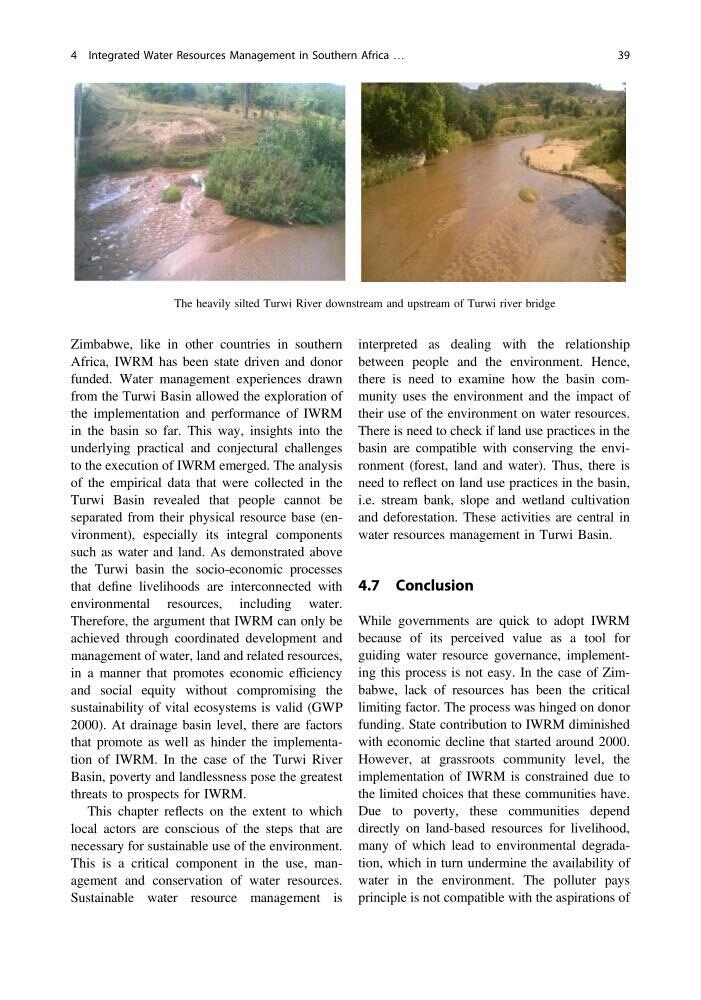
Plates 4.5 and 4.6 The heavily silted Turwi River downstream and upstream of Turwi river bridge
4 Integrated Water Resources Management in Southern Africa …
39
Africa, IWRM has been state driven and donor
funded. Water management experiences drawn
from the Turwi Basin allowed the exploration of
the implementation and performance of IWRM
in the basin so far. This way, insights into the
underlying practical and conjectural challenges
to the execution of IWRM emerged. The analysis
of the empirical data that were collected in the
Turwi Basin revealed that people cannot be
separated from their physical resource base (environment), especially its integral components
such as water and land. As demonstrated above
the Turwi basin the socio-economic processes
that define livelihoods are interconnected with
environmental resources, including water.
Therefore, the argument that IWRM can only be
achieved through coordinated development and
management of water, land and related resources,
in a manner that promotes economic efficiency
and social equity without compromising the
sustainability of vital ecosystems is valid (GWP
2000). At drainage basin level, there are factors
that promote as well as hinder the implementation of IWRM. In the case of the Turwi River
Basin, poverty and landlessness pose the greatest
threats to prospects for IWRM.
This chapter reflects on the extent to which
local actors are conscious of the steps that are
necessary for sustainable use of the environment.
This is a critical component in the use, management and conservation of water resources.
Sustainable water resource management is
interpreted as dealing with the relationship
between people and the environment. Hence,
there is need to examine how the basin community uses the environment and the impact of
their use of the environment on water resources.
There is need to check if land use practices in the
basin are compatible with conserving the environment (forest, land and water). Thus, there is
need to reflect on land use practices in the basin,
i.e. stream bank, slope and wetland cultivation
and deforestation. These activities are central in
water resources management in Turwi Basin.
4.7 Conclusion
While governments are quick to adopt IWRM
because of its perceived value as a tool for
guiding water resource governance, implementing this process is not easy. In the case of Zimbabwe, lack of resources has been the critical
limiting factor. The process was hinged on donor
funding. State contribution to IWRM diminished
with economic decline that started around 2000.
However, at grassroots community level, the
implementation of IWRM is constrained due to
the limited choices that these communities have.
Due to poverty, these communities depend
directly on land-based resources for livelihood,
many of which lead to environmental degradation, which in turn undermine the availability of
water in the environment. The polluter pays
principle is not compatible with the aspirations of
Plates 4.5 and 4.6 The heavily silted Turwi River downstream and upstream of Turwi river bridge
4 Integrated Water Resources Management in Southern Africa …
39