

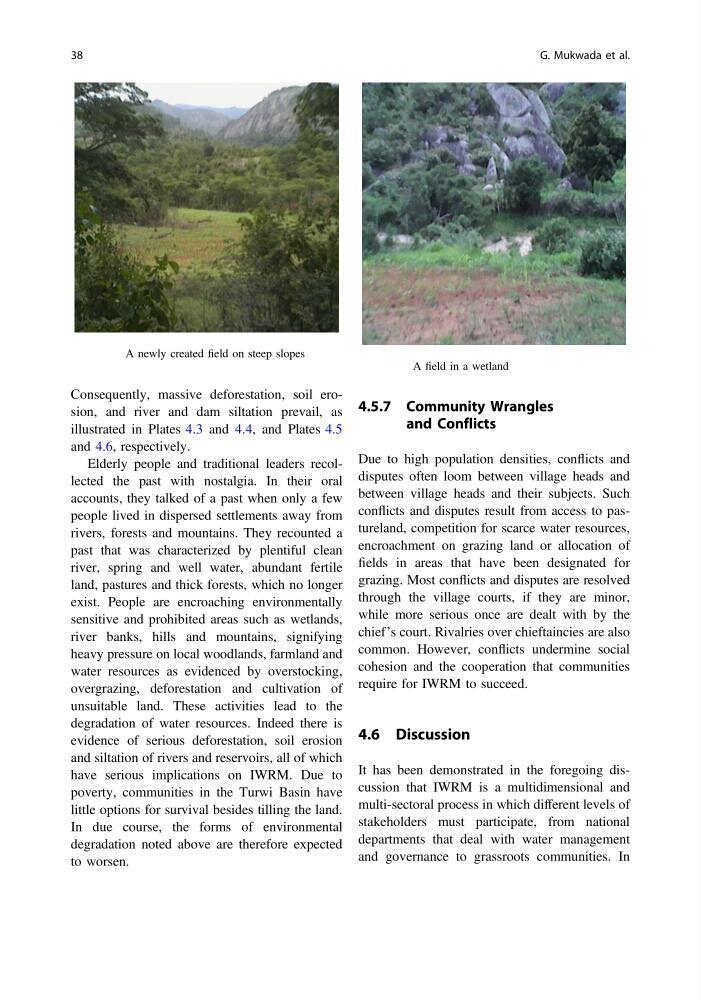
Consequently, massive deforestation, soil erosion, and river and dam siltation prevail, as
illustrated in Plates 4.3 and 4.4, and Plates 4.5
and 4.6, respectively.
Elderly people and traditional leaders recollected the past with nostalgia. In their oral
accounts, they talked of a past when only a few
people lived in dispersed settlements away from
rivers, forests and mountains. They recounted a
past that was characterized by plentiful clean
river, spring and well water, abundant fertile
land, pastures and thick forests, which no longer
exist. People are encroaching environmentally
sensitive and prohibited areas such as wetlands,
river banks, hills and mountains, signifying
heavy pressure on local woodlands, farmland and
water resources as evidenced by overstocking,
overgrazing, deforestation and cultivation of
unsuitable land. These activities lead to the
degradation of water resources. Indeed there is
evidence of serious deforestation, soil erosion
and siltation of rivers and reservoirs, all of which
have serious implications on IWRM. Due to
poverty, communities in the Turwi Basin have
little options for survival besides tilling the land.
In due course, the forms of environmental
degradation noted above are therefore expected
to worsen.
4.5.7 Community Wrangles
and Conflicts
Due to high population densities, conflicts and
disputes often loom between village heads and
between village heads and their subjects. Such
conflicts and disputes result from access to pastureland, competition for scarce water resources,
encroachment on grazing land or allocation of
fields in areas that have been designated for
grazing. Most conflicts and disputes are resolved
through the village courts, if they are minor,
while more serious once are dealt with by the
chief’s court. Rivalries over chieftaincies are also
common. However, conflicts undermine social
cohesion and the cooperation that communities
require for IWRM to succeed.
4.6 Discussion
It has been demonstrated in the foregoing discussion that IWRM is a multidimensional and
multi-sectoral process in which different levels of
stakeholders must participate, from national
departments that deal with water management
and governance to grassroots communities. In
Plate 4.3 A newly created field on steep slopes
Plate 4.4 A field in a wetland
38
G. Mukwada et al.
illustrated in Plates 4.3 and 4.4, and Plates 4.5
and 4.6, respectively.
Elderly people and traditional leaders recollected the past with nostalgia. In their oral
accounts, they talked of a past when only a few
people lived in dispersed settlements away from
rivers, forests and mountains. They recounted a
past that was characterized by plentiful clean
river, spring and well water, abundant fertile
land, pastures and thick forests, which no longer
exist. People are encroaching environmentally
sensitive and prohibited areas such as wetlands,
river banks, hills and mountains, signifying
heavy pressure on local woodlands, farmland and
water resources as evidenced by overstocking,
overgrazing, deforestation and cultivation of
unsuitable land. These activities lead to the
degradation of water resources. Indeed there is
evidence of serious deforestation, soil erosion
and siltation of rivers and reservoirs, all of which
have serious implications on IWRM. Due to
poverty, communities in the Turwi Basin have
little options for survival besides tilling the land.
In due course, the forms of environmental
degradation noted above are therefore expected
to worsen.
4.5.7 Community Wrangles
and Conflicts
Due to high population densities, conflicts and
disputes often loom between village heads and
between village heads and their subjects. Such
conflicts and disputes result from access to pastureland, competition for scarce water resources,
encroachment on grazing land or allocation of
fields in areas that have been designated for
grazing. Most conflicts and disputes are resolved
through the village courts, if they are minor,
while more serious once are dealt with by the
chief’s court. Rivalries over chieftaincies are also
common. However, conflicts undermine social
cohesion and the cooperation that communities
require for IWRM to succeed.
4.6 Discussion
It has been demonstrated in the foregoing discussion that IWRM is a multidimensional and
multi-sectoral process in which different levels of
stakeholders must participate, from national
departments that deal with water management
and governance to grassroots communities. In
Plate 4.3 A newly created field on steep slopes
Plate 4.4 A field in a wetland
38
G. Mukwada et al.