

In many rural areas of the developing world,
rapidly increasing population pressure often
leads to changes in land use in terms of deforestation, reclamation of wetlands, etc. with the
aim of increasing agricultural production. In
addition, land mismanagement has inadvertent
negative effects on the hydrological regime,
leading to the increasing occurrence of floods and
decreasing dry season flows (Lørup et al. 1998).
UN population projections indicate that Zimbabwe’s population will reach 17.7 million by
2025 and 19.1 million by 2030 (ZimStat 2015). It
is also assumed that the amount of water potentially available for internal development in
Zimbabwe is approximately 8.5 billion km
3 ,
which will only be sufficient to meet the country’s water requirements up to 2025, after which
the country has to find new sources of water.
4.4.4 Infrastructure
Over 90% to the country’s water supply comes
from surface water resources, with rivers supplying the highest proportion. However, annual
and inter-annual variability of river regimes
associated with the tropical and subtropical climate that prevails in Zimbabwe makes water
supply unreliable. National statistics regarding
water resource infrastructure are not up-to-date,
though it can be established that the supply of
surface water resources is supplemented by dam
construction. According to Mtisi and Nicol
(2003) in 1998 Zimbabwe had a total of 140
dams with a capacity of one million cubic meters,
and 10,747 smaller ones providing more than
five billion cubic meters of impounded water
capacity. Patterns of water use vary spatially
according to demands related to irrigation,
commercial/industrial, domestic supply, power
generation, and recreation.
4.4.5 Complex Institutional
Arrangements
Zimbabwe’s water sector is characterized by
complex institutional arrangements. The huge
number of stakeholders involved in these
arrangements makes IWRM difficult to implement, due to the cumbersome nature of the
coordination and the harmonization of the roles
of these stakeholders. Table 4.1 shows some of
the government institutions that play an important role in water resource management.
Other government institutions include the
Ministry of Health and Child Welfare; Ministry
of Environment and Tourism; Ministry of
Finance; the National Economic Planning Commission and parastatal organizations. Some of the
parastatals that were involved are the Regional
Water Authority, the District Development Fund
23
24
25
26
27
28
29
30
31
32
0
20
40
60
80
100
120
140
160
180
Jan Feb Mar Apr May Jun
Jul Aug Sep Oct Nov Dec
monthly rainfall (mm)
mothly temperature (°C)
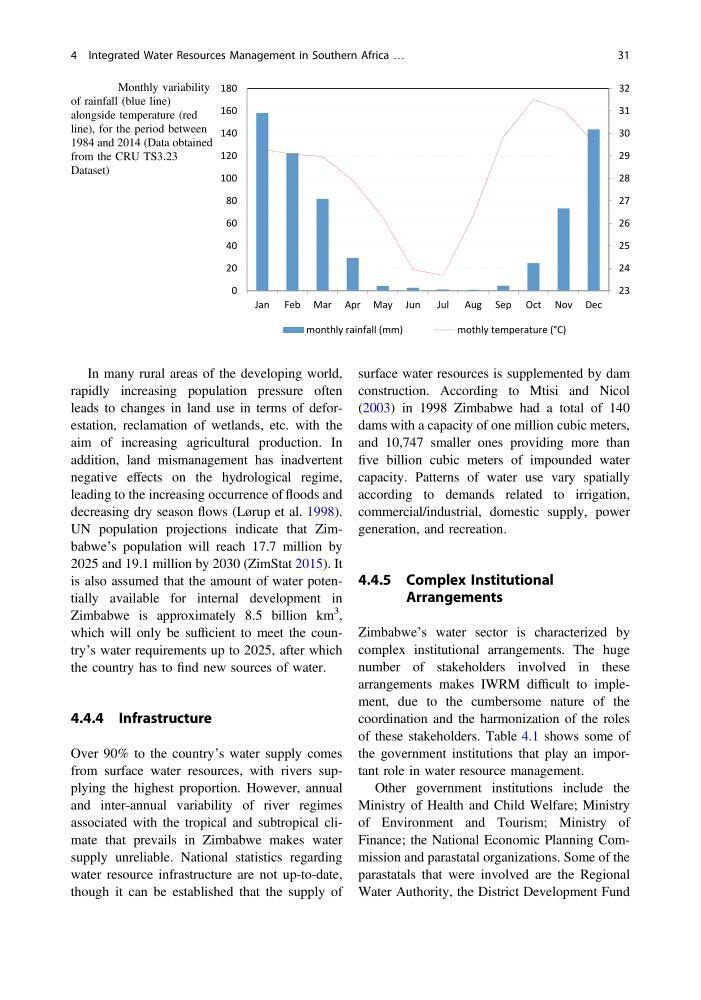
Fig. 4.4 Monthly variability
of rainfall (blue line)
alongside temperature (red
line), for the period between
1984 and 2014 (Data obtained
from the CRU TS3.23
Dataset)
4 Integrated Water Resources Management in Southern Africa …
31
rapidly increasing population pressure often
leads to changes in land use in terms of deforestation, reclamation of wetlands, etc. with the
aim of increasing agricultural production. In
addition, land mismanagement has inadvertent
negative effects on the hydrological regime,
leading to the increasing occurrence of floods and
decreasing dry season flows (Lørup et al. 1998).
UN population projections indicate that Zimbabwe’s population will reach 17.7 million by
2025 and 19.1 million by 2030 (ZimStat 2015). It
is also assumed that the amount of water potentially available for internal development in
Zimbabwe is approximately 8.5 billion km
3 ,
which will only be sufficient to meet the country’s water requirements up to 2025, after which
the country has to find new sources of water.
4.4.4 Infrastructure
Over 90% to the country’s water supply comes
from surface water resources, with rivers supplying the highest proportion. However, annual
and inter-annual variability of river regimes
associated with the tropical and subtropical climate that prevails in Zimbabwe makes water
supply unreliable. National statistics regarding
water resource infrastructure are not up-to-date,
though it can be established that the supply of
surface water resources is supplemented by dam
construction. According to Mtisi and Nicol
(2003) in 1998 Zimbabwe had a total of 140
dams with a capacity of one million cubic meters,
and 10,747 smaller ones providing more than
five billion cubic meters of impounded water
capacity. Patterns of water use vary spatially
according to demands related to irrigation,
commercial/industrial, domestic supply, power
generation, and recreation.
4.4.5 Complex Institutional
Arrangements
Zimbabwe’s water sector is characterized by
complex institutional arrangements. The huge
number of stakeholders involved in these
arrangements makes IWRM difficult to implement, due to the cumbersome nature of the
coordination and the harmonization of the roles
of these stakeholders. Table 4.1 shows some of
the government institutions that play an important role in water resource management.
Other government institutions include the
Ministry of Health and Child Welfare; Ministry
of Environment and Tourism; Ministry of
Finance; the National Economic Planning Commission and parastatal organizations. Some of the
parastatals that were involved are the Regional
Water Authority, the District Development Fund
23
24
25
26
27
28
29
30
31
32
0
20
40
60
80
100
120
140
160
180
Jan Feb Mar Apr May Jun
Jul Aug Sep Oct Nov Dec
monthly rainfall (mm)
mothly temperature (°C)
Fig. 4.4 Monthly variability
of rainfall (blue line)
alongside temperature (red
line), for the period between
1984 and 2014 (Data obtained
from the CRU TS3.23
Dataset)
4 Integrated Water Resources Management in Southern Africa …
31