

poverty. Population growth and accelerating
economic development, together with climate
change impose huge demands on water resources.
In Zimbabwean rural areas, where the majority of
the people depend on agriculture for livelihood,
rapid population growth has been associated with
land use and land cover changes. In some areas,
especially in the communal areas, population
growth has been accompanied by deforestation,
siltation and water shortages. It is also mostly in
the drier areas that the communal areas are located
and rural population densities are highest, posing
enormous pressure on both the environment and
water resources.
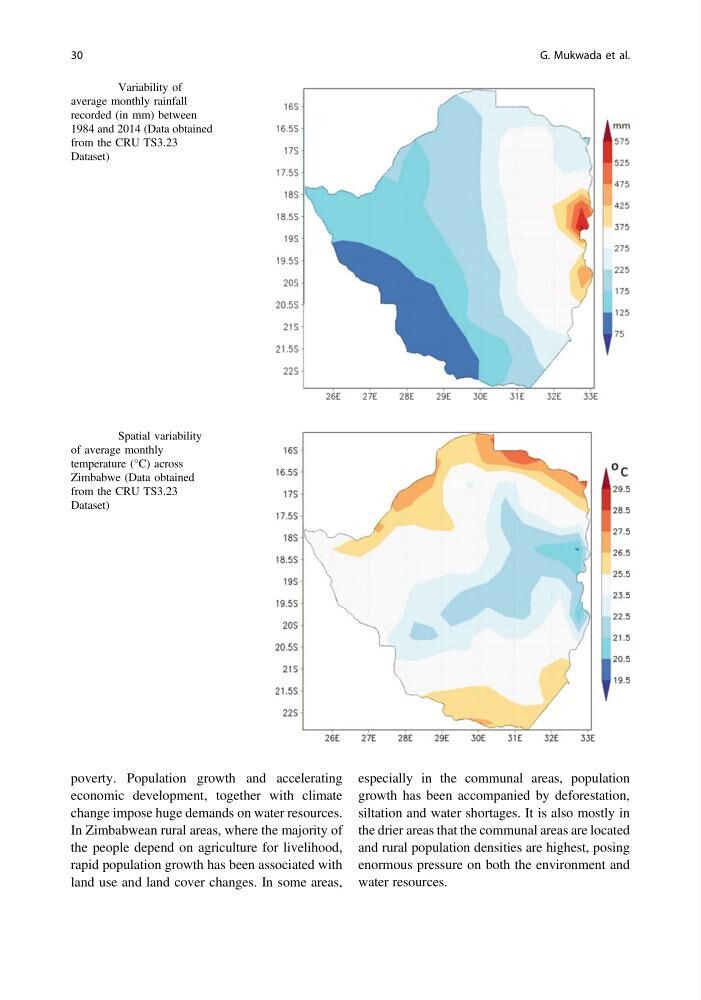
Fig. 4.2 Variability of
average monthly rainfall
recorded (in mm) between
1984 and 2014 (Data obtained
from the CRU TS3.23
Dataset)
Fig. 4.3 Spatial variability
of average monthly
temperature (°C) across
Zimbabwe (Data obtained
from the CRU TS3.23
Dataset)
30
G. Mukwada et al.
economic development, together with climate
change impose huge demands on water resources.
In Zimbabwean rural areas, where the majority of
the people depend on agriculture for livelihood,
rapid population growth has been associated with
land use and land cover changes. In some areas,
especially in the communal areas, population
growth has been accompanied by deforestation,
siltation and water shortages. It is also mostly in
the drier areas that the communal areas are located
and rural population densities are highest, posing
enormous pressure on both the environment and
water resources.
Fig. 4.2 Variability of
average monthly rainfall
recorded (in mm) between
1984 and 2014 (Data obtained
from the CRU TS3.23
Dataset)
Fig. 4.3 Spatial variability
of average monthly
temperature (°C) across
Zimbabwe (Data obtained
from the CRU TS3.23
Dataset)
30
G. Mukwada et al.