

and Agribank, Urban and Rural District Councils, as well as stakeholder institutions such as
Catchment Councils and research organizations.
The Institute of Water and Sanitation Development (IWSD) and universities were also incorporated as stakeholders. The efforts and roles of
these stakeholders have to be harmonized and
integrated. Other legitimate stakeholders include
traditional leaders such as chiefs, village heads
and local councils, as well as ordinary community members.
It was this realization that led government to
set up an Inter-Ministerial Review Committee in
1993 to review the national water laws. The
committee consisted representatives from the
AGRITEX, Regional Water Authority, Department of Water Development, Ministry of Local
Government, Rural and Urban Development,
Zimbabwe Farmers Union, Commercial Farmers
Union, an Administrative/Water Court Judge,
and a retired judge of the Water Court. The
Ministry of Lands, Agriculture and Water
Development chaired the Inter-Ministerial
Review Committee (Mtisi and Nicol 2003). The
ensuing review gave rise to water reforms that
introduced new water management institutions,
including Catchment and Sub-Catchment Councils, which complicated the water sector even
further. The Zimbabwe National Water Authority
(ZINWA) was set up to improve the institutional
coordination of the roles of these players, in
terms of the ZINWA Act of 1998, as well as to
collect revenue required for water management
in the country.
4.5 Implementation of IWRM
at Local Level: Experiences
from the Turwi River Basin
In this section, we draw from the empirical data
that were gathered through FDGs and interviews
that were held with water management stakeholders in the Turwi River Basin (Fig. 4.1). The
Turwi Basin is approximately 4 500 km
2 in
extend. It is a sub-catchment of the Save River
Basin (Fig. 4.1). The Save River Basin is one of
Zimbabwe’s seven major catchments. Rivers in
this basin flow southeastwards into the SaveLimpopo River Basin. In order to tackle the
questions that we raised in the introduction we
first had to establish the availability of water
resources in the Turwi Basin, the sources of
water that the grassroots communities had access
to, how they were using these resources and
managing them, before examining the challenges
experienced.
Empirical evidence from the Turwi River
Basin shows that though grassroots communities
are the appropriate level at which the IWRM can
be implemented, there are a number of conditions
that constrain it. Contrary to conventional
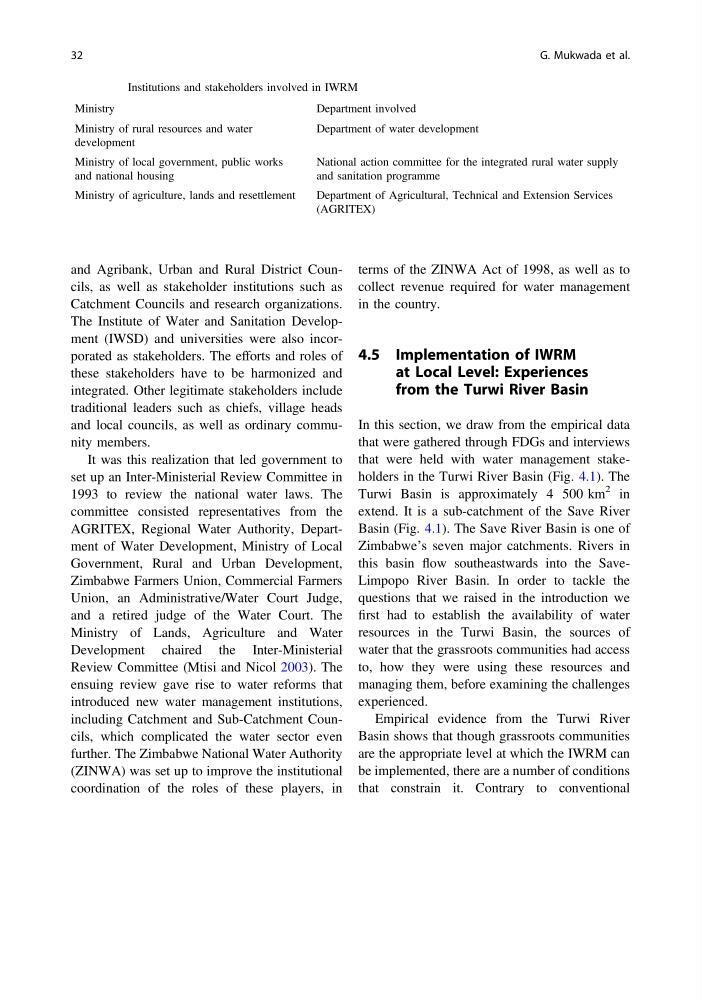
Table 4.1 Institutions and stakeholders involved in IWRM
Ministry
Department involved
Ministry of rural resources and water
development
Department of water development
Ministry of local government, public works
and national housing
National action committee for the integrated rural water supply
and sanitation programme
Ministry of agriculture, lands and resettlement
Department of Agricultural, Technical and Extension Services
(AGRITEX)
32
G. Mukwada et al.
Catchment Councils and research organizations.
The Institute of Water and Sanitation Development (IWSD) and universities were also incorporated as stakeholders. The efforts and roles of
these stakeholders have to be harmonized and
integrated. Other legitimate stakeholders include
traditional leaders such as chiefs, village heads
and local councils, as well as ordinary community members.
It was this realization that led government to
set up an Inter-Ministerial Review Committee in
1993 to review the national water laws. The
committee consisted representatives from the
AGRITEX, Regional Water Authority, Department of Water Development, Ministry of Local
Government, Rural and Urban Development,
Zimbabwe Farmers Union, Commercial Farmers
Union, an Administrative/Water Court Judge,
and a retired judge of the Water Court. The
Ministry of Lands, Agriculture and Water
Development chaired the Inter-Ministerial
Review Committee (Mtisi and Nicol 2003). The
ensuing review gave rise to water reforms that
introduced new water management institutions,
including Catchment and Sub-Catchment Councils, which complicated the water sector even
further. The Zimbabwe National Water Authority
(ZINWA) was set up to improve the institutional
coordination of the roles of these players, in
terms of the ZINWA Act of 1998, as well as to
collect revenue required for water management
in the country.
4.5 Implementation of IWRM
at Local Level: Experiences
from the Turwi River Basin
In this section, we draw from the empirical data
that were gathered through FDGs and interviews
that were held with water management stakeholders in the Turwi River Basin (Fig. 4.1). The
Turwi Basin is approximately 4 500 km
2 in
extend. It is a sub-catchment of the Save River
Basin (Fig. 4.1). The Save River Basin is one of
Zimbabwe’s seven major catchments. Rivers in
this basin flow southeastwards into the SaveLimpopo River Basin. In order to tackle the
questions that we raised in the introduction we
first had to establish the availability of water
resources in the Turwi Basin, the sources of
water that the grassroots communities had access
to, how they were using these resources and
managing them, before examining the challenges
experienced.
Empirical evidence from the Turwi River
Basin shows that though grassroots communities
are the appropriate level at which the IWRM can
be implemented, there are a number of conditions
that constrain it. Contrary to conventional
Table 4.1 Institutions and stakeholders involved in IWRM
Ministry
Department involved
Ministry of rural resources and water
development
Department of water development
Ministry of local government, public works
and national housing
National action committee for the integrated rural water supply
and sanitation programme
Ministry of agriculture, lands and resettlement
Department of Agricultural, Technical and Extension Services
(AGRITEX)
32
G. Mukwada et al.