

the Mozyr hydrological station residing on the
Pripyat river (these data have been collected on
daily basis from January to April during the
1980–2005 years range), as far as ground air
temperature and rainfall on the meteorological
stations of the watershed, residing upper than
Mozyr hydrological station, and also the snow
cover water equivalent data taken from the
microwave SMMR and SSM/I satellite passive
sensors.
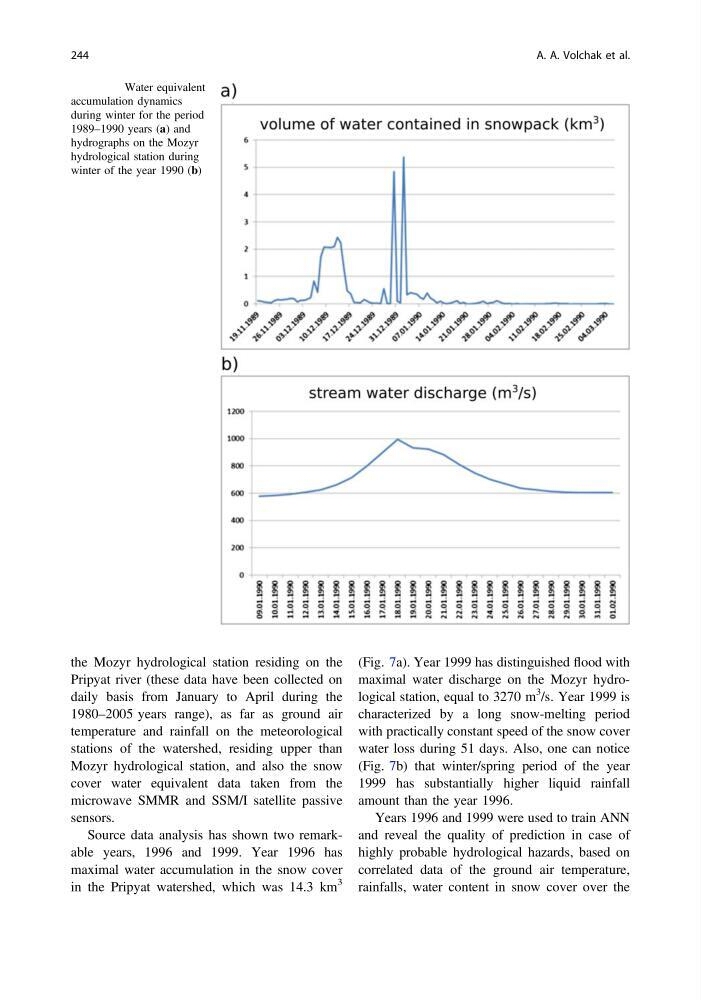
Source data analysis has shown two remarkable years, 1996 and 1999. Year 1996 has
maximal water accumulation in the snow cover
in the Pripyat watershed, which was 14.3 km
3
(Fig. 7a). Year 1999 has distinguished flood with
maximal water discharge on the Mozyr hydrological station, equal to 3270 m
3 /s. Year 1999 is
characterized by a long snow-melting period
with practically constant speed of the snow cover
water loss during 51 days. Also, one can notice
(Fig. 7b) that winter/spring period of the year
1999 has substantially higher liquid rainfall
amount than the year 1996.
Years 1996 and 1999 were used to train ANN
and reveal the quality of prediction in case of
highly probable hydrological hazards, based on
correlated data of the ground air temperature,
rainfalls, water content in snow cover over the
Fig. 18.6 Water equivalent
accumulation dynamics
during winter for the period
1989–1990 years (a) and
hydrographs on the Mozyr
hydrological station during
winter of the year 1990 (b)
244
A. A. Volchak et al.
Pripyat river (these data have been collected on
daily basis from January to April during the
1980–2005 years range), as far as ground air
temperature and rainfall on the meteorological
stations of the watershed, residing upper than
Mozyr hydrological station, and also the snow
cover water equivalent data taken from the
microwave SMMR and SSM/I satellite passive
sensors.
Source data analysis has shown two remarkable years, 1996 and 1999. Year 1996 has
maximal water accumulation in the snow cover
in the Pripyat watershed, which was 14.3 km
3
(Fig. 7a). Year 1999 has distinguished flood with
maximal water discharge on the Mozyr hydrological station, equal to 3270 m
3 /s. Year 1999 is
characterized by a long snow-melting period
with practically constant speed of the snow cover
water loss during 51 days. Also, one can notice
(Fig. 7b) that winter/spring period of the year
1999 has substantially higher liquid rainfall
amount than the year 1996.
Years 1996 and 1999 were used to train ANN
and reveal the quality of prediction in case of
highly probable hydrological hazards, based on
correlated data of the ground air temperature,
rainfalls, water content in snow cover over the
Fig. 18.6 Water equivalent
accumulation dynamics
during winter for the period
1989–1990 years (a) and
hydrographs on the Mozyr
hydrological station during
winter of the year 1990 (b)
244
A. A. Volchak et al.