

quantitative restoration of the water discharge
depends on such important factors as the presence and the amount of rainfalls during the
spring melting period, and also precipitation of
snow-originated water into the ground.
Good illustration of the possibility to have
non-adequate prediction of the water discharge
because of ignoring these factors can be seen on
relatively snow-free winter in the years 1989–
1990, and calculations for which are shown in
Fig. 18.6. One can notice that despite the water
equivalent volume reaching 5 km
3 several times,
the hydrological station has not registered any
proportional increase of the water discharge.
Visible difference in this and similar cases
cannot be corrected by a simple adjustment
coefficient. Additional integrated accounting of
the above spoken factor is a necessary condition
to increase the prediction accuracy.
Results of the research show that remote
microwave scanning can be used to quickly
control the daily dynamics of the snow cover
water equivalent value on large territories, which
is sufficient to provide qualitative prediction of
the water discharge spring dynamics on a
hydrological station. Quantitative restoration of
the water discharge, nevertheless, demands
accounting of important factors such as rainfall
during the spring thaw and amount of rainfall, as
well as precipitation of the snow-originated water
by the ground.
18.5 Applying Artificial Neural
Networks to Predict the Water
Discharge in a River Flow
Control Point
Using ANN mathematical apparatus allows us to
take into account the whole complex of parameters while making the hydrological forecast for
the river flow control points, such as air average
daily temperature, water discharge on the
hydrological station, level of the snow cover and
rainfall on the watershed (Vladimirov et al.
2012).
Owing to substantial time gaps between traditional snow cover measurements and rather
sparse network of meteorological stations, it is
reasonable to use the results of daily estimates of
the water content in a snow cover made by
passive microwave sensing done by a satellite.
Source data to carry on such research in our
case were water discharge observations done on
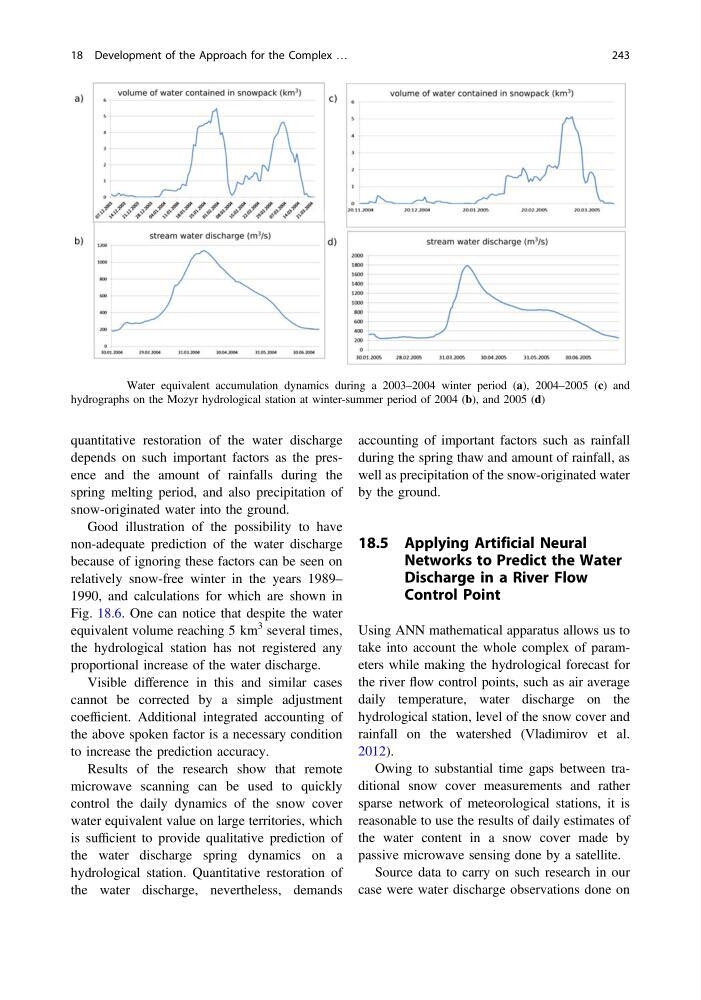
Fig. 18.5 Water equivalent accumulation dynamics during a 2003–2004 winter period (a), 2004–2005 (c) and
hydrographs on the Mozyr hydrological station at winter-summer period of 2004 (b), and 2005 (d)
18 Development of the Approach for the Complex …
243
depends on such important factors as the presence and the amount of rainfalls during the
spring melting period, and also precipitation of
snow-originated water into the ground.
Good illustration of the possibility to have
non-adequate prediction of the water discharge
because of ignoring these factors can be seen on
relatively snow-free winter in the years 1989–
1990, and calculations for which are shown in
Fig. 18.6. One can notice that despite the water
equivalent volume reaching 5 km
3 several times,
the hydrological station has not registered any
proportional increase of the water discharge.
Visible difference in this and similar cases
cannot be corrected by a simple adjustment
coefficient. Additional integrated accounting of
the above spoken factor is a necessary condition
to increase the prediction accuracy.
Results of the research show that remote
microwave scanning can be used to quickly
control the daily dynamics of the snow cover
water equivalent value on large territories, which
is sufficient to provide qualitative prediction of
the water discharge spring dynamics on a
hydrological station. Quantitative restoration of
the water discharge, nevertheless, demands
accounting of important factors such as rainfall
during the spring thaw and amount of rainfall, as
well as precipitation of the snow-originated water
by the ground.
18.5 Applying Artificial Neural
Networks to Predict the Water
Discharge in a River Flow
Control Point
Using ANN mathematical apparatus allows us to
take into account the whole complex of parameters while making the hydrological forecast for
the river flow control points, such as air average
daily temperature, water discharge on the
hydrological station, level of the snow cover and
rainfall on the watershed (Vladimirov et al.
2012).
Owing to substantial time gaps between traditional snow cover measurements and rather
sparse network of meteorological stations, it is
reasonable to use the results of daily estimates of
the water content in a snow cover made by
passive microwave sensing done by a satellite.
Source data to carry on such research in our
case were water discharge observations done on
Fig. 18.5 Water equivalent accumulation dynamics during a 2003–2004 winter period (a), 2004–2005 (c) and
hydrographs on the Mozyr hydrological station at winter-summer period of 2004 (b), and 2005 (d)
18 Development of the Approach for the Complex …
243