

watershed and the water discharge on the
hydrological station.
An MLP with one hidden layer was used as a
predicting ANN architecture. Taking into
account that the time gap between beginning of
the snow water content stable decrease and the
increase of water discharge on the hydrological
station was 28 days, we have used the sliding
window method (Golovko, 2001) for the ANN,
with the window size equal to 28 and step equal
to 1.
Quality of the 3, 5 and 7-day prediction was
investigated while carrying out digital experiments with the data of snow melting and rainfall
at positive average daily air temperature, so
without these factors. Best results were obtained
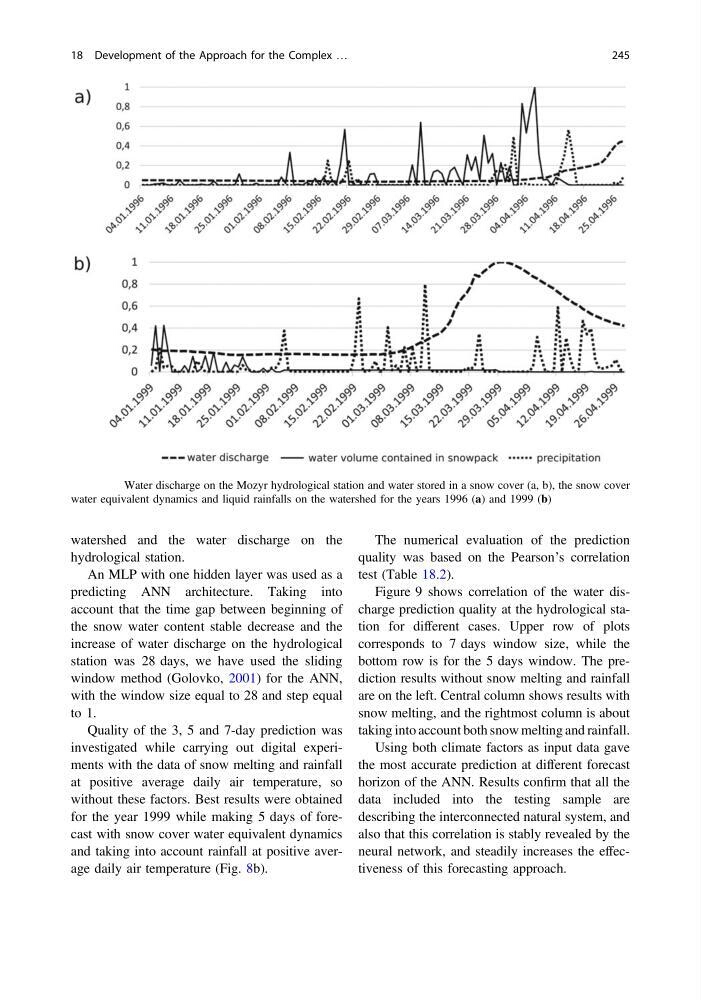
for the year 1999 while making 5 days of forecast with snow cover water equivalent dynamics
and taking into account rainfall at positive average daily air temperature (Fig. 8b).
The numerical evaluation of the prediction
quality was based on the Pearson’s correlation
test (Table 18.2).
Figure 9 shows correlation of the water discharge prediction quality at the hydrological station for different cases. Upper row of plots
corresponds to 7 days window size, while the
bottom row is for the 5 days window. The prediction results without snow melting and rainfall
are on the left. Central column shows results with
snow melting, and the rightmost column is about
taking into account both snow melting and rainfall.
Using both climate factors as input data gave
the most accurate prediction at different forecast
horizon of the ANN. Results confirm that all the
data included into the testing sample are
describing the interconnected natural system, and
also that this correlation is stably revealed by the
neural network, and steadily increases the effectiveness of this forecasting approach.
Fig. 18.7 Water discharge on the Mozyr hydrological station and water stored in a snow cover (a, b), the snow cover
water equivalent dynamics and liquid rainfalls on the watershed for the years 1996 (a) and 1999 (b)
18 Development of the Approach for the Complex …
245
hydrological station.
An MLP with one hidden layer was used as a
predicting ANN architecture. Taking into
account that the time gap between beginning of
the snow water content stable decrease and the
increase of water discharge on the hydrological
station was 28 days, we have used the sliding
window method (Golovko, 2001) for the ANN,
with the window size equal to 28 and step equal
to 1.
Quality of the 3, 5 and 7-day prediction was
investigated while carrying out digital experiments with the data of snow melting and rainfall
at positive average daily air temperature, so
without these factors. Best results were obtained
for the year 1999 while making 5 days of forecast with snow cover water equivalent dynamics
and taking into account rainfall at positive average daily air temperature (Fig. 8b).
The numerical evaluation of the prediction
quality was based on the Pearson’s correlation
test (Table 18.2).
Figure 9 shows correlation of the water discharge prediction quality at the hydrological station for different cases. Upper row of plots
corresponds to 7 days window size, while the
bottom row is for the 5 days window. The prediction results without snow melting and rainfall
are on the left. Central column shows results with
snow melting, and the rightmost column is about
taking into account both snow melting and rainfall.
Using both climate factors as input data gave
the most accurate prediction at different forecast
horizon of the ANN. Results confirm that all the
data included into the testing sample are
describing the interconnected natural system, and
also that this correlation is stably revealed by the
neural network, and steadily increases the effectiveness of this forecasting approach.
Fig. 18.7 Water discharge on the Mozyr hydrological station and water stored in a snow cover (a, b), the snow cover
water equivalent dynamics and liquid rainfalls on the watershed for the years 1996 (a) and 1999 (b)
18 Development of the Approach for the Complex …
245