

neural
network
architecture
and
the
training/testing datasets constitution were as in
the first experiment. Three different neural networks were constructed and trained for SWE
retrieval from brightness temperatures for channels at 19.35, 37.0 and 85.5 GHz of different
polarizations:
(a) ANN for brightness temperatures of horizontal channel polarization;
(b) ANN for brightness temperatures of vertical
channel polarization;
(c) ANN for brightness temperatures of both
orthogonal channel polarizations.
Performance tests for brightness temperatures
of horizontal channel polarization gave very low
value of r = 0.11 ± 0.01, and use of vertical
channel polarization had risen the correlation
coefficient value to 0.12 ± 0.01. The input data
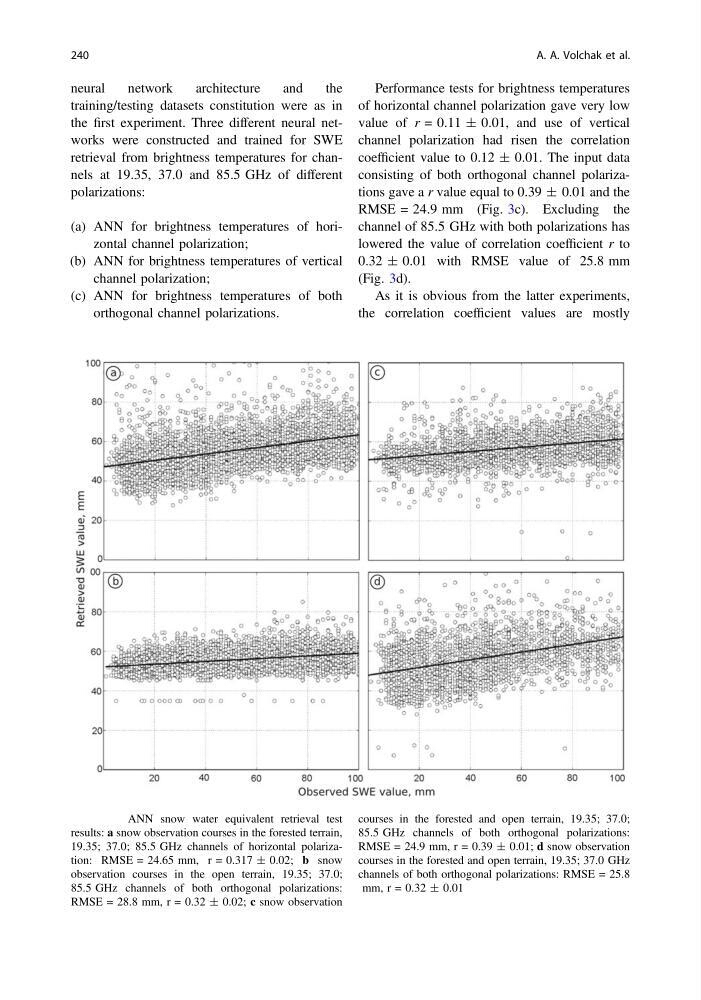
consisting of both orthogonal channel polarizations gave a r value equal to 0.39 ± 0.01 and the
RMSE = 24.9 mm (Fig. 3c). Excluding the
channel of 85.5 GHz with both polarizations has
lowered the value of correlation coefficient r to
0.32 ± 0.01 with RMSE value of 25.8 mm
(Fig. 3d).
As it is obvious from the latter experiments,
the correlation coefficient values are mostly
Fig. 18.3 ANN snow water equivalent retrieval test
results: a snow observation courses in the forested terrain,
19.35; 37.0; 85.5 GHz channels of horizontal polarization: RMSE = 24.65 mm, r = 0.317 ± 0.02; b snow
observation courses in the open terrain, 19.35; 37.0;
85.5 GHz channels of both orthogonal polarizations:
RMSE = 28.8 mm, r = 0.32 ± 0.02; c snow observation
courses in the forested and open terrain, 19.35; 37.0;
85.5 GHz channels of both orthogonal polarizations:
RMSE = 24.9 mm, r = 0.39 ± 0.01; d snow observation
courses in the forested and open terrain, 19.35; 37.0 GHz
channels of both orthogonal polarizations: RMSE = 25.8
mm, r = 0.32 ± 0.01
240
A. A. Volchak et al.
network
architecture
and
the
training/testing datasets constitution were as in
the first experiment. Three different neural networks were constructed and trained for SWE
retrieval from brightness temperatures for channels at 19.35, 37.0 and 85.5 GHz of different
polarizations:
(a) ANN for brightness temperatures of horizontal channel polarization;
(b) ANN for brightness temperatures of vertical
channel polarization;
(c) ANN for brightness temperatures of both
orthogonal channel polarizations.
Performance tests for brightness temperatures
of horizontal channel polarization gave very low
value of r = 0.11 ± 0.01, and use of vertical
channel polarization had risen the correlation
coefficient value to 0.12 ± 0.01. The input data
consisting of both orthogonal channel polarizations gave a r value equal to 0.39 ± 0.01 and the
RMSE = 24.9 mm (Fig. 3c). Excluding the
channel of 85.5 GHz with both polarizations has
lowered the value of correlation coefficient r to
0.32 ± 0.01 with RMSE value of 25.8 mm
(Fig. 3d).
As it is obvious from the latter experiments,
the correlation coefficient values are mostly
Fig. 18.3 ANN snow water equivalent retrieval test
results: a snow observation courses in the forested terrain,
19.35; 37.0; 85.5 GHz channels of horizontal polarization: RMSE = 24.65 mm, r = 0.317 ± 0.02; b snow
observation courses in the open terrain, 19.35; 37.0;
85.5 GHz channels of both orthogonal polarizations:
RMSE = 28.8 mm, r = 0.32 ± 0.02; c snow observation
courses in the forested and open terrain, 19.35; 37.0;
85.5 GHz channels of both orthogonal polarizations:
RMSE = 24.9 mm, r = 0.39 ± 0.01; d snow observation
courses in the forested and open terrain, 19.35; 37.0 GHz
channels of both orthogonal polarizations: RMSE = 25.8
mm, r = 0.32 ± 0.01
240
A. A. Volchak et al.