

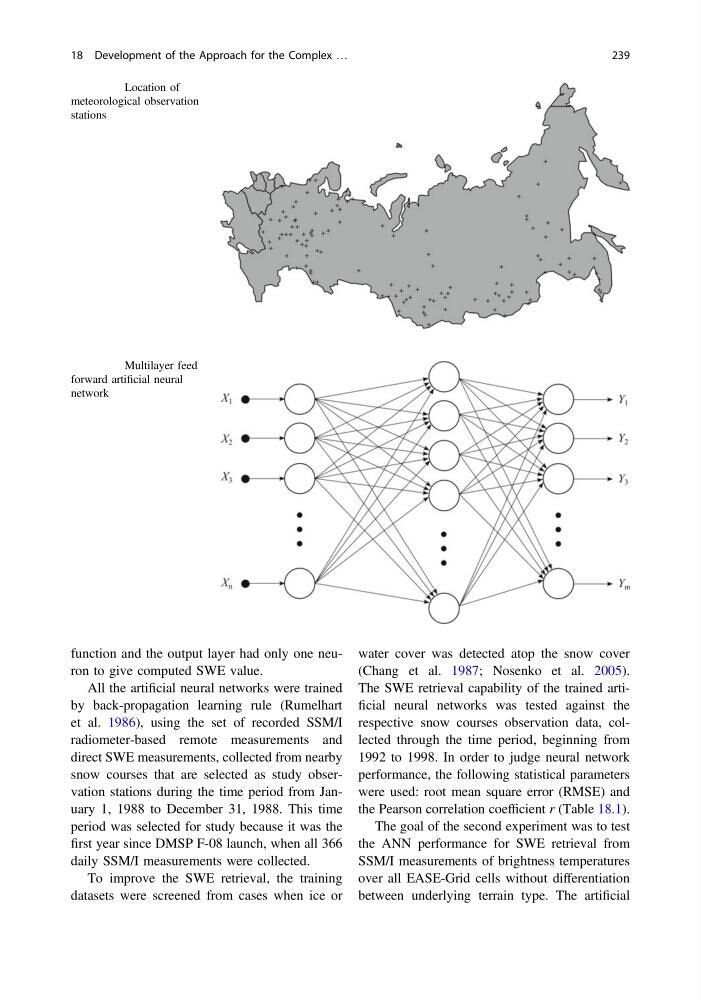
function and the output layer had only one neuron to give computed SWE value.
All the artificial neural networks were trained
by back-propagation learning rule (Rumelhart
et al. 1986), using the set of recorded SSM/I
radiometer-based remote measurements and
direct SWE measurements, collected from nearby
snow courses that are selected as study observation stations during the time period from January 1, 1988 to December 31, 1988. This time
period was selected for study because it was the
first year since DMSP F-08 launch, when all 366
daily SSM/I measurements were collected.
To improve the SWE retrieval, the training
datasets were screened from cases when ice or
water cover was detected atop the snow cover
(Chang et al. 1987; Nosenko et al. 2005).
The SWE retrieval capability of the trained artificial neural networks was tested against the
respective snow courses observation data, collected through the time period, beginning from
1992 to 1998. In order to judge neural network
performance, the following statistical parameters
were used: root mean square error (RMSE) and
the Pearson correlation coefficient r (Table 18.1).
The goal of the second experiment was to test
the ANN performance for SWE retrieval from
SSM/I measurements of brightness temperatures
over all EASE-Grid cells without differentiation
between underlying terrain type. The artificial
Fig. 18.1 Location of
meteorological observation
stations
Fig. 18.2 Multilayer feed
forward artificial neural
network
18 Development of the Approach for the Complex …
239
All the artificial neural networks were trained
by back-propagation learning rule (Rumelhart
et al. 1986), using the set of recorded SSM/I
radiometer-based remote measurements and
direct SWE measurements, collected from nearby
snow courses that are selected as study observation stations during the time period from January 1, 1988 to December 31, 1988. This time
period was selected for study because it was the
first year since DMSP F-08 launch, when all 366
daily SSM/I measurements were collected.
To improve the SWE retrieval, the training
datasets were screened from cases when ice or
water cover was detected atop the snow cover
(Chang et al. 1987; Nosenko et al. 2005).
The SWE retrieval capability of the trained artificial neural networks was tested against the
respective snow courses observation data, collected through the time period, beginning from
1992 to 1998. In order to judge neural network
performance, the following statistical parameters
were used: root mean square error (RMSE) and
the Pearson correlation coefficient r (Table 18.1).
The goal of the second experiment was to test
the ANN performance for SWE retrieval from
SSM/I measurements of brightness temperatures
over all EASE-Grid cells without differentiation
between underlying terrain type. The artificial
Fig. 18.1 Location of
meteorological observation
stations
Fig. 18.2 Multilayer feed
forward artificial neural
network
18 Development of the Approach for the Complex …
239