

lower than those given in the published research
papers (Gan et al. 2009; Tedesco et al. 2004;
Tong et al. 2010). To further investigate the
reason behind the low obtained r values, third
experiment was carried out to test SWE retrieval
performance for ANNs constructed and trained
for every individual EASE-Grid cell with distinct
snow course terrain features. The results obtained
from testing of neural networks which were
trained to retrieve snow water equivalent from
brightness temperatures for channels 19.35, 37.0
and 85.5 GHz of horizontal polarization for open
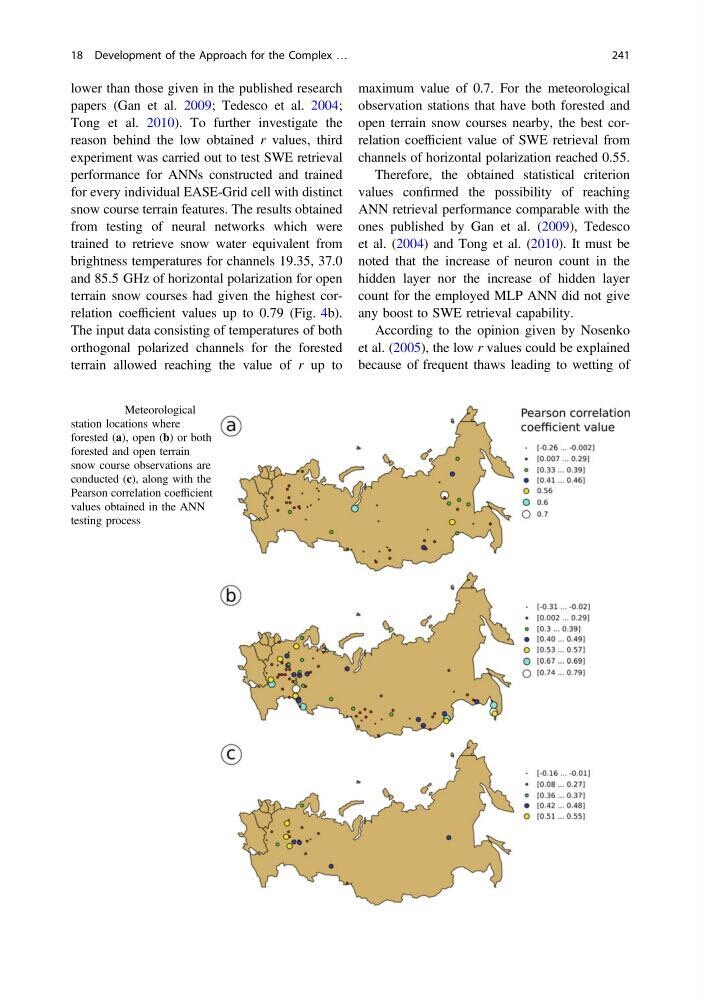
terrain snow courses had given the highest correlation coefficient values up to 0.79 (Fig. 4b).
The input data consisting of temperatures of both
orthogonal polarized channels for the forested
terrain allowed reaching the value of r up to
maximum value of 0.7. For the meteorological
observation stations that have both forested and
open terrain snow courses nearby, the best correlation coefficient value of SWE retrieval from
channels of horizontal polarization reached 0.55.
Therefore, the obtained statistical criterion
values confirmed the possibility of reaching
ANN retrieval performance comparable with the
ones published by Gan et al. (2009), Tedesco
et al. (2004) and Tong et al. (2010). It must be
noted that the increase of neuron count in the
hidden layer nor the increase of hidden layer
count for the employed MLP ANN did not give
any boost to SWE retrieval capability.
According to the opinion given by Nosenko
et al. (2005), the low r values could be explained
because of frequent thaws leading to wetting of
Fig. 18.4 Meteorological
station locations where
forested (a), open (b) or both
forested and open terrain
snow course observations are
conducted (c), along with the
Pearson correlation coefficient
values obtained in the ANN
testing process
18 Development of the Approach for the Complex …
241
papers (Gan et al. 2009; Tedesco et al. 2004;
Tong et al. 2010). To further investigate the
reason behind the low obtained r values, third
experiment was carried out to test SWE retrieval
performance for ANNs constructed and trained
for every individual EASE-Grid cell with distinct
snow course terrain features. The results obtained
from testing of neural networks which were
trained to retrieve snow water equivalent from
brightness temperatures for channels 19.35, 37.0
and 85.5 GHz of horizontal polarization for open
terrain snow courses had given the highest correlation coefficient values up to 0.79 (Fig. 4b).
The input data consisting of temperatures of both
orthogonal polarized channels for the forested
terrain allowed reaching the value of r up to
maximum value of 0.7. For the meteorological
observation stations that have both forested and
open terrain snow courses nearby, the best correlation coefficient value of SWE retrieval from
channels of horizontal polarization reached 0.55.
Therefore, the obtained statistical criterion
values confirmed the possibility of reaching
ANN retrieval performance comparable with the
ones published by Gan et al. (2009), Tedesco
et al. (2004) and Tong et al. (2010). It must be
noted that the increase of neuron count in the
hidden layer nor the increase of hidden layer
count for the employed MLP ANN did not give
any boost to SWE retrieval capability.
According to the opinion given by Nosenko
et al. (2005), the low r values could be explained
because of frequent thaws leading to wetting of
Fig. 18.4 Meteorological
station locations where
forested (a), open (b) or both
forested and open terrain
snow course observations are
conducted (c), along with the
Pearson correlation coefficient
values obtained in the ANN
testing process
18 Development of the Approach for the Complex …
241