

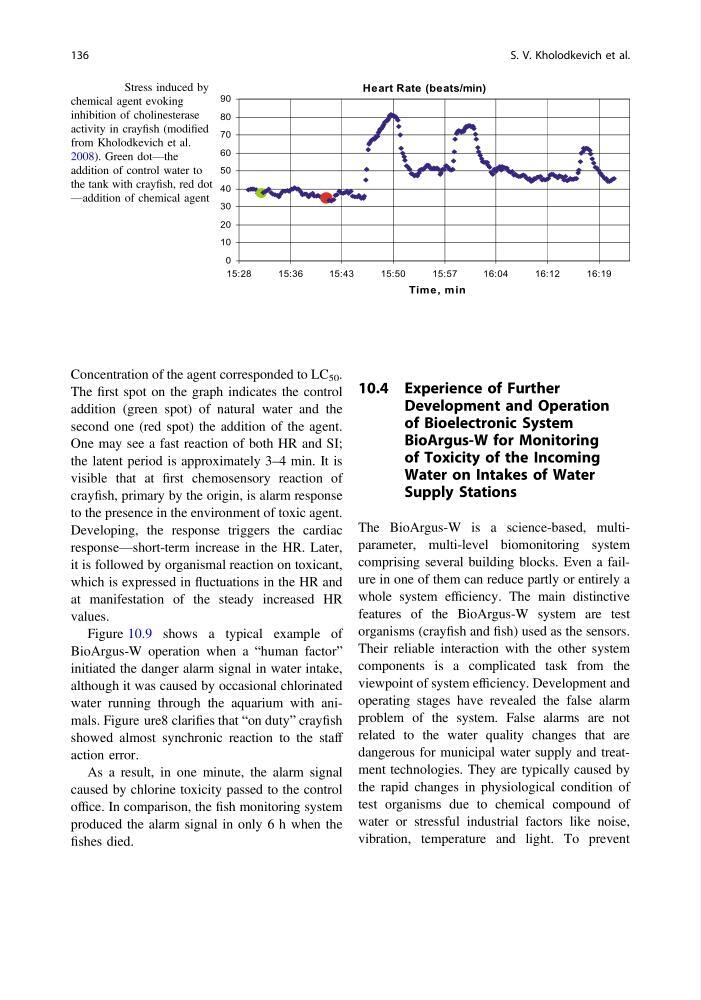
Concentration of the agent corresponded to LC 50 .
The first spot on the graph indicates the control
addition (green spot) of natural water and the
second one (red spot) the addition of the agent.
One may see a fast reaction of both HR and SI;
the latent period is approximately 3–4 min. It is
visible that at first chemosensory reaction of
crayfish, primary by the origin, is alarm response
to the presence in the environment of toxic agent.
Developing, the response triggers the cardiac
response—short-term increase in the HR. Later,
it is followed by organismal reaction on toxicant,
which is expressed in fluctuations in the HR and
at manifestation of the steady increased HR
values.
Figure 10.9 shows a typical example of
BioArgus-W operation when a “human factor”
initiated the danger alarm signal in water intake,
although it was caused by occasional chlorinated
water running through the aquarium with animals. Figure ure8 clarifies that “on duty” crayfish
showed almost synchronic reaction to the staff
action error.
As a result, in one minute, the alarm signal
caused by chlorine toxicity passed to the control
office. In comparison, the fish monitoring system
produced the alarm signal in only 6 h when the
fishes died.
10.4 Experience of Further
Development and Operation
of Bioelectronic System
BioArgus-W for Monitoring
of Toxicity of the Incoming
Water on Intakes of Water
Supply Stations
The BioArgus-W is a science-based, multiparameter, multi-level biomonitoring system
comprising several building blocks. Even a failure in one of them can reduce partly or entirely a
whole system efficiency. The main distinctive
features of the BioArgus-W system are test
organisms (crayfish and fish) used as the sensors.
Their reliable interaction with the other system
components is a complicated task from the
viewpoint of system efficiency. Development and
operating stages have revealed the false alarm
problem of the system. False alarms are not
related to the water quality changes that are
dangerous for municipal water supply and treatment technologies. They are typically caused by
the rapid changes in physiological condition of
test organisms due to chemical compound of
water or stressful industrial factors like noise,
vibration, temperature and light. To prevent
Heart Rate (beats/min)
0
10
20
30
40
50
60
70
80
90
15:28
15:36
15:43
15:50
15:57
16:04
16:12
16:19
Time, m in
Fig. 10.8 Stress induced by
chemical agent evoking
inhibition of cholinesterase
activity in crayfish (modified
from Kholodkevich et al.
2008). Green dot—the
addition of control water to
the tank with crayfish, red dot
—addition of chemical agent
136
S. V. Kholodkevich et al.
The first spot on the graph indicates the control
addition (green spot) of natural water and the
second one (red spot) the addition of the agent.
One may see a fast reaction of both HR and SI;
the latent period is approximately 3–4 min. It is
visible that at first chemosensory reaction of
crayfish, primary by the origin, is alarm response
to the presence in the environment of toxic agent.
Developing, the response triggers the cardiac
response—short-term increase in the HR. Later,
it is followed by organismal reaction on toxicant,
which is expressed in fluctuations in the HR and
at manifestation of the steady increased HR
values.
Figure 10.9 shows a typical example of
BioArgus-W operation when a “human factor”
initiated the danger alarm signal in water intake,
although it was caused by occasional chlorinated
water running through the aquarium with animals. Figure ure8 clarifies that “on duty” crayfish
showed almost synchronic reaction to the staff
action error.
As a result, in one minute, the alarm signal
caused by chlorine toxicity passed to the control
office. In comparison, the fish monitoring system
produced the alarm signal in only 6 h when the
fishes died.
10.4 Experience of Further
Development and Operation
of Bioelectronic System
BioArgus-W for Monitoring
of Toxicity of the Incoming
Water on Intakes of Water
Supply Stations
The BioArgus-W is a science-based, multiparameter, multi-level biomonitoring system
comprising several building blocks. Even a failure in one of them can reduce partly or entirely a
whole system efficiency. The main distinctive
features of the BioArgus-W system are test
organisms (crayfish and fish) used as the sensors.
Their reliable interaction with the other system
components is a complicated task from the
viewpoint of system efficiency. Development and
operating stages have revealed the false alarm
problem of the system. False alarms are not
related to the water quality changes that are
dangerous for municipal water supply and treatment technologies. They are typically caused by
the rapid changes in physiological condition of
test organisms due to chemical compound of
water or stressful industrial factors like noise,
vibration, temperature and light. To prevent
Heart Rate (beats/min)
0
10
20
30
40
50
60
70
80
90
15:28
15:36
15:43
15:50
15:57
16:04
16:12
16:19
Time, m in
Fig. 10.8 Stress induced by
chemical agent evoking
inhibition of cholinesterase
activity in crayfish (modified
from Kholodkevich et al.
2008). Green dot—the
addition of control water to
the tank with crayfish, red dot
—addition of chemical agent
136
S. V. Kholodkevich et al.