

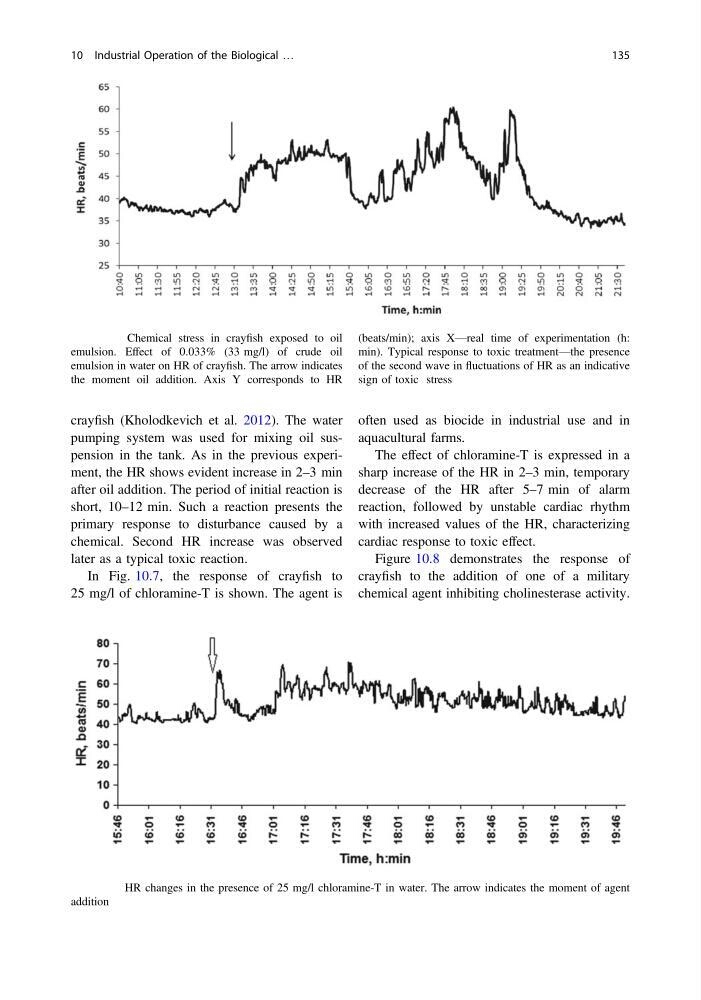
crayfish (Kholodkevich et al. 2012). The water
pumping system was used for mixing oil suspension in the tank. As in the previous experiment, the HR shows evident increase in 2–3 min
after oil addition. The period of initial reaction is
short, 10–12 min. Such a reaction presents the
primary response to disturbance caused by a
chemical. Second HR increase was observed
later as a typical toxic reaction.
In Fig. 10.7, the response of crayfish to
25 mg/l of chloramine-T is shown. The agent is
often used as biocide in industrial use and in
aquacultural farms.
The effect of chloramine-T is expressed in a
sharp increase of the HR in 2–3 min, temporary
decrease of the HR after 5–7 min of alarm
reaction, followed by unstable cardiac rhythm
with increased values of the HR, characterizing
cardiac response to toxic effect.
Figure 10.8 demonstrates the response of
crayfish to the addition of one of a military
chemical agent inhibiting cholinesterase activity.
Fig. 10.6 Chemical stress in crayfish exposed to oil
emulsion. Effect of 0.033% (33 mg/l) of crude oil
emulsion in water on HR of crayfish. The arrow indicates
the moment oil addition. Axis Y corresponds to HR
(beats/min); axis X—real time of experimentation (h:
min). Typical response to toxic treatment—the presence
of the second wave in fluctuations of HR as an indicative
sign of toxic stress
Fig. 10.7 HR changes in the presence of 25 mg/l chloramine-T in water. The arrow indicates the moment of agent
addition
10 Industrial Operation of the Biological …
135
pumping system was used for mixing oil suspension in the tank. As in the previous experiment, the HR shows evident increase in 2–3 min
after oil addition. The period of initial reaction is
short, 10–12 min. Such a reaction presents the
primary response to disturbance caused by a
chemical. Second HR increase was observed
later as a typical toxic reaction.
In Fig. 10.7, the response of crayfish to
25 mg/l of chloramine-T is shown. The agent is
often used as biocide in industrial use and in
aquacultural farms.
The effect of chloramine-T is expressed in a
sharp increase of the HR in 2–3 min, temporary
decrease of the HR after 5–7 min of alarm
reaction, followed by unstable cardiac rhythm
with increased values of the HR, characterizing
cardiac response to toxic effect.
Figure 10.8 demonstrates the response of
crayfish to the addition of one of a military
chemical agent inhibiting cholinesterase activity.
Fig. 10.6 Chemical stress in crayfish exposed to oil
emulsion. Effect of 0.033% (33 mg/l) of crude oil
emulsion in water on HR of crayfish. The arrow indicates
the moment oil addition. Axis Y corresponds to HR
(beats/min); axis X—real time of experimentation (h:
min). Typical response to toxic treatment—the presence
of the second wave in fluctuations of HR as an indicative
sign of toxic stress
Fig. 10.7 HR changes in the presence of 25 mg/l chloramine-T in water. The arrow indicates the moment of agent
addition
10 Industrial Operation of the Biological …
135