

Testing of crayfish in case of “suspension
test” was performed as lifting of crayfish over the
bottom of the tank (by the optical cable attached
to its carapace), but within a water column. At
the same time, the contact of tarsus of legs
(proximal part of leg) with substrate was lost.
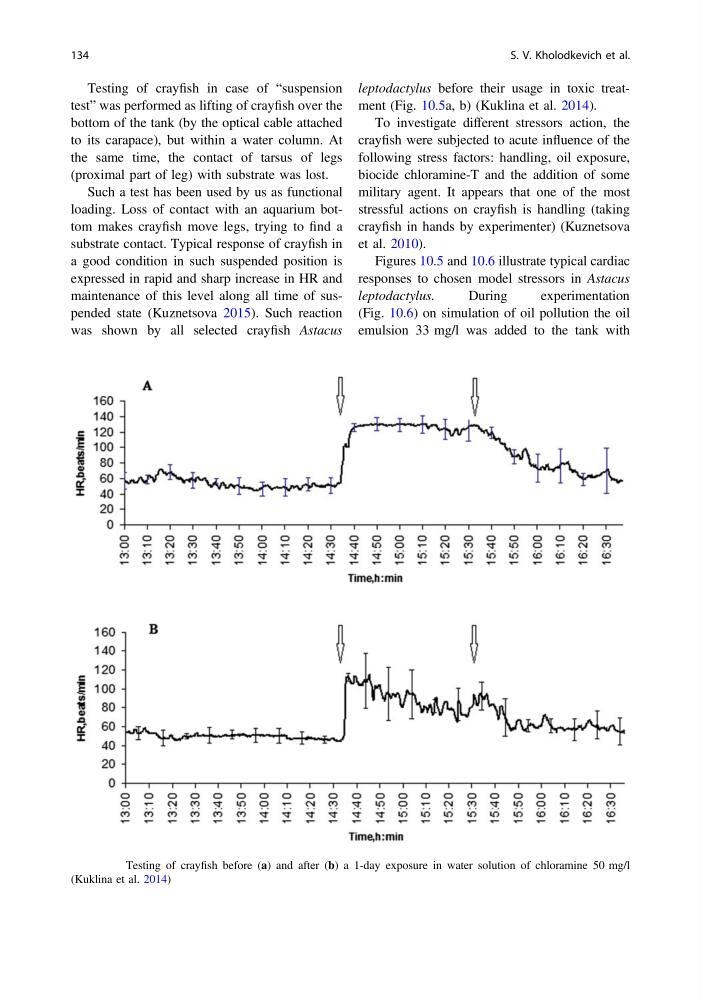
Such a test has been used by us as functional
loading. Loss of contact with an aquarium bottom makes crayfish move legs, trying to find a
substrate contact. Typical response of crayfish in
a good condition in such suspended position is
expressed in rapid and sharp increase in HR and
maintenance of this level along all time of suspended state (Kuznetsova 2015). Such reaction
was shown by all selected crayfish Astacus
leptodactylus before their usage in toxic treatment (Fig. 10.5a, b) (Kuklina et al. 2014).
To investigate different stressors action, the
crayfish were subjected to acute influence of the
following stress factors: handling, oil exposure,
biocide chloramine-T and the addition of some
military agent. It appears that one of the most
stressful actions on crayfish is handling (taking
crayfish in hands by experimenter) (Kuznetsova
et al. 2010).
Figures 10.5 and 10.6 illustrate typical cardiac
responses to chosen model stressors in Astacus
leptodactylus.
During
experimentation
(Fig. 10.6) on simulation of oil pollution the oil
emulsion 33 mg/l was added to the tank with
Fig. 10.5 Testing of crayfish before (a) and after (b) a 1-day exposure in water solution of chloramine 50 mg/l
(Kuklina et al. 2014)
134
S. V. Kholodkevich et al.
test” was performed as lifting of crayfish over the
bottom of the tank (by the optical cable attached
to its carapace), but within a water column. At
the same time, the contact of tarsus of legs
(proximal part of leg) with substrate was lost.
Such a test has been used by us as functional
loading. Loss of contact with an aquarium bottom makes crayfish move legs, trying to find a
substrate contact. Typical response of crayfish in
a good condition in such suspended position is
expressed in rapid and sharp increase in HR and
maintenance of this level along all time of suspended state (Kuznetsova 2015). Such reaction
was shown by all selected crayfish Astacus
leptodactylus before their usage in toxic treatment (Fig. 10.5a, b) (Kuklina et al. 2014).
To investigate different stressors action, the
crayfish were subjected to acute influence of the
following stress factors: handling, oil exposure,
biocide chloramine-T and the addition of some
military agent. It appears that one of the most
stressful actions on crayfish is handling (taking
crayfish in hands by experimenter) (Kuznetsova
et al. 2010).
Figures 10.5 and 10.6 illustrate typical cardiac
responses to chosen model stressors in Astacus
leptodactylus.
During
experimentation
(Fig. 10.6) on simulation of oil pollution the oil
emulsion 33 mg/l was added to the tank with
Fig. 10.5 Testing of crayfish before (a) and after (b) a 1-day exposure in water solution of chloramine 50 mg/l
(Kuklina et al. 2014)
134
S. V. Kholodkevich et al.