

9.8 Over Exploitation
of Groundwater
The development blocks are categorized for
groundwater development by the state Water
Resource Department (2015, pp 34–35) based on
two criteria—stage of groundwater development
determined on the basis of the proportion of draft
of groundwater in net replenishable groundwater
of the block, and by long term trend of pre- and
postmonsoon water levels. Four categories of
development blocks/districts thus identified.
They are:
1. Safe areas (proportion of draft below 70% of
net rechargeable resource) which have
groundwater
potential
for
future
development,
2. Semi-critical areas (proportion of draft
between 70 and 90% of net rechargeable
resource) where cautious groundwater development is recommended,
3. Critical area (proportion of draft between 90
and 100% of net rechargeable resource)
where regular monitoring and evaluation is
required for future groundwater development,
4. Over exploited areas (proportion of draft
above 100% of net rechargeable resource)
where intensive monitoring and evaluation
linked with water conservation measures are
essential for future groundwater development.
Out of 313 blocks of the state, the entire
command areas of 218 blocks fall under safe
category of utilization. Non-command areas of
67 blocks are in semi-critical, 4 blocks are in
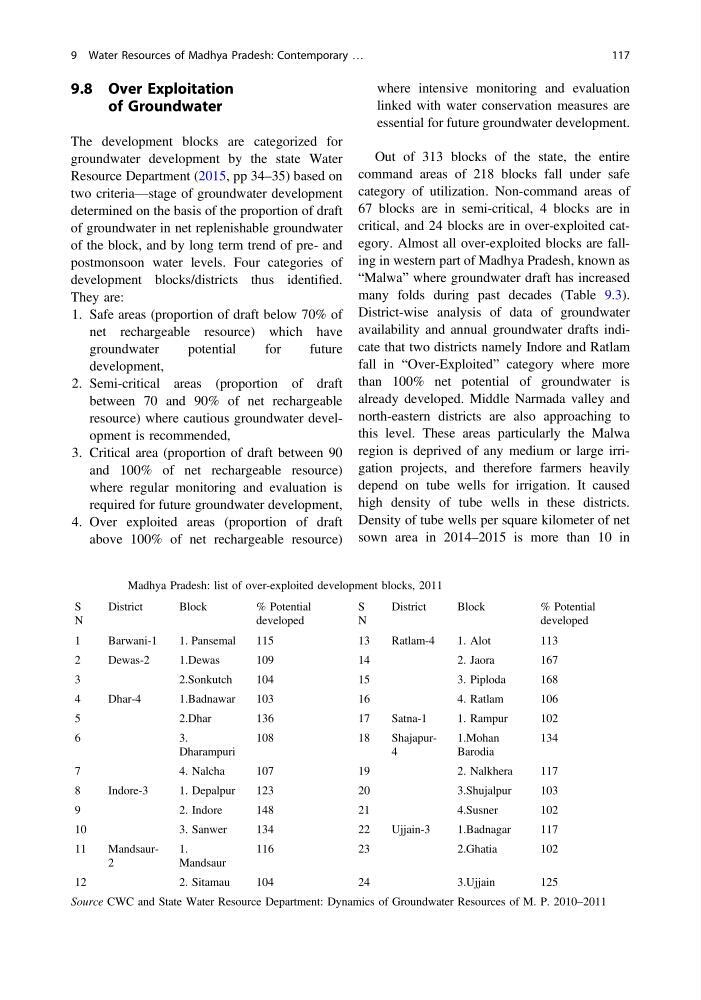
critical, and 24 blocks are in over-exploited category. Almost all over-exploited blocks are falling in western part of Madhya Pradesh, known as
“Malwa” where groundwater draft has increased
many folds during past decades (Table 9.3).
District-wise analysis of data of groundwater
availability and annual groundwater drafts indicate that two districts namely Indore and Ratlam
fall in “Over-Exploited” category where more
than 100% net potential of groundwater is
already developed. Middle Narmada valley and
north-eastern districts are also approaching to
this level. These areas particularly the Malwa
region is deprived of any medium or large irrigation projects, and therefore farmers heavily
depend on tube wells for irrigation. It caused
high density of tube wells in these districts.
Density of tube wells per square kilometer of net
sown area in 2014–2015 is more than 10 in
Table 9.3 Madhya Pradesh: list of over-exploited development blocks, 2011
S
N
District
Block
% Potential
developed
S
N
District
Block
% Potential
developed
1
Barwani-1
1. Pansemal
115
13
Ratlam-4
1. Alot
113
2
Dewas-2
1.Dewas
109
14
2. Jaora
167
3
2.Sonkutch
104
15
3. Piploda
168
4
Dhar-4
1.Badnawar
103
16
4. Ratlam
106
5
2.Dhar
136
17
Satna-1
1. Rampur
102
6
3 .
Dharampuri
108
18
Shajapur4
1.Mohan
Barodia
134
7
4. Nalcha
107
19
2. Nalkhera
117
8
Indore-3
1. Depalpur
123
20
3.Shujalpur
103
9
2. Indore
148
21
4.Susner
102
10
3. Sanwer
134
22
Ujjain-3
1.Badnagar
117
11
Mandsaur2
1.
Mandsaur
116
23
2.Ghatia
102
12
2. Sitamau
104
24
3.Ujjain
125
Source CWC and State Water Resource Department: Dynamics of Groundwater Resources of M. P. 2010–2011
9 Water Resources of Madhya Pradesh: Contemporary …
117
of Groundwater
The development blocks are categorized for
groundwater development by the state Water
Resource Department (2015, pp 34–35) based on
two criteria—stage of groundwater development
determined on the basis of the proportion of draft
of groundwater in net replenishable groundwater
of the block, and by long term trend of pre- and
postmonsoon water levels. Four categories of
development blocks/districts thus identified.
They are:
1. Safe areas (proportion of draft below 70% of
net rechargeable resource) which have
groundwater
potential
for
future
development,
2. Semi-critical areas (proportion of draft
between 70 and 90% of net rechargeable
resource) where cautious groundwater development is recommended,
3. Critical area (proportion of draft between 90
and 100% of net rechargeable resource)
where regular monitoring and evaluation is
required for future groundwater development,
4. Over exploited areas (proportion of draft
above 100% of net rechargeable resource)
where intensive monitoring and evaluation
linked with water conservation measures are
essential for future groundwater development.
Out of 313 blocks of the state, the entire
command areas of 218 blocks fall under safe
category of utilization. Non-command areas of
67 blocks are in semi-critical, 4 blocks are in
critical, and 24 blocks are in over-exploited category. Almost all over-exploited blocks are falling in western part of Madhya Pradesh, known as
“Malwa” where groundwater draft has increased
many folds during past decades (Table 9.3).
District-wise analysis of data of groundwater
availability and annual groundwater drafts indicate that two districts namely Indore and Ratlam
fall in “Over-Exploited” category where more
than 100% net potential of groundwater is
already developed. Middle Narmada valley and
north-eastern districts are also approaching to
this level. These areas particularly the Malwa
region is deprived of any medium or large irrigation projects, and therefore farmers heavily
depend on tube wells for irrigation. It caused
high density of tube wells in these districts.
Density of tube wells per square kilometer of net
sown area in 2014–2015 is more than 10 in
Table 9.3 Madhya Pradesh: list of over-exploited development blocks, 2011
S
N
District
Block
% Potential
developed
S
N
District
Block
% Potential
developed
1
Barwani-1
1. Pansemal
115
13
Ratlam-4
1. Alot
113
2
Dewas-2
1.Dewas
109
14
2. Jaora
167
3
2.Sonkutch
104
15
3. Piploda
168
4
Dhar-4
1.Badnawar
103
16
4. Ratlam
106
5
2.Dhar
136
17
Satna-1
1. Rampur
102
6
3 .
Dharampuri
108
18
Shajapur4
1.Mohan
Barodia
134
7
4. Nalcha
107
19
2. Nalkhera
117
8
Indore-3
1. Depalpur
123
20
3.Shujalpur
103
9
2. Indore
148
21
4.Susner
102
10
3. Sanwer
134
22
Ujjain-3
1.Badnagar
117
11
Mandsaur2
1.
Mandsaur
116
23
2.Ghatia
102
12
2. Sitamau
104
24
3.Ujjain
125
Source CWC and State Water Resource Department: Dynamics of Groundwater Resources of M. P. 2010–2011
9 Water Resources of Madhya Pradesh: Contemporary …
117