

state. Droughts in the recent years were severe
and wide-spread. The number of hot days has
increased significantly in the state. It will
increase the need of water. This is just an indication that the present potential of water resources is likely to decline in future which must be
taken into account while planning for their
development in the state.
9.7 Groundwater Draft
The most serious problem is of rapid lowering of
water level and depletion of groundwater in the
state. It can be sensed from the fact that per sq km
of net sown area there are 14.53 dug wells and 4.31
tube wells in the state in 2014–2015. Groundwater
draft for various uses has been calculated separately for command and non-command areas by
the state Water resource Department (2015). Total
draft of groundwater for all uses in state is calculated as 18, 83,352 ham (18.83 BCM). It is seen
that maximum groundwater drawl for all uses is
96,822 ham in Shajapur district and minimum
draft of groundwater for all uses is 2,180 ham in
Annupur district in the eastern part of the state.
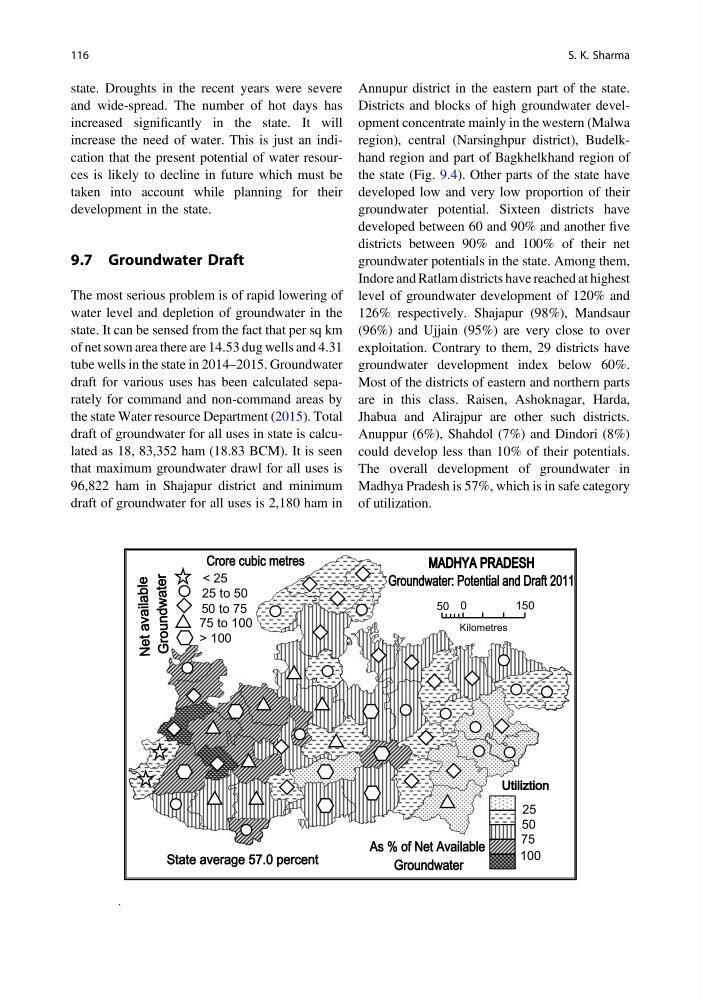
Districts and blocks of high groundwater development concentrate mainly in the western (Malwa
region), central (Narsinghpur district), Budelkhand region and part of Bagkhelkhand region of
the state (Fig. 9.4). Other parts of the state have
developed low and very low proportion of their
groundwater potential. Sixteen districts have
developed between 60 and 90% and another five
districts between 90% and 100% of their net
groundwater potentials in the state. Among them,
Indore and Ratlam districts have reached at highest
level of groundwater development of 120% and
126% respectively. Shajapur (98%), Mandsaur
(96%) and Ujjain (95%) are very close to over
exploitation. Contrary to them, 29 districts have
groundwater development index below 60%.
Most of the districts of eastern and northern parts
are in this class. Raisen, Ashoknagar, Harda,
Jhabua and Alirajpur are other such districts.
Anuppur (6%), Shahdol (7%) and Dindori (8%)
could develop less than 10% of their potentials.
The overall development of groundwater in
Madhya Pradesh is 57%, which is in safe category
of utilization.
50 0
150
Kilometres
< 25
25 to 50
75 to 100
50 to 75
> 100
25
50
100
75
Fig. 9.4 .
116
S. K. Sharma
and wide-spread. The number of hot days has
increased significantly in the state. It will
increase the need of water. This is just an indication that the present potential of water resources is likely to decline in future which must be
taken into account while planning for their
development in the state.
9.7 Groundwater Draft
The most serious problem is of rapid lowering of
water level and depletion of groundwater in the
state. It can be sensed from the fact that per sq km
of net sown area there are 14.53 dug wells and 4.31
tube wells in the state in 2014–2015. Groundwater
draft for various uses has been calculated separately for command and non-command areas by
the state Water resource Department (2015). Total
draft of groundwater for all uses in state is calculated as 18, 83,352 ham (18.83 BCM). It is seen
that maximum groundwater drawl for all uses is
96,822 ham in Shajapur district and minimum
draft of groundwater for all uses is 2,180 ham in
Annupur district in the eastern part of the state.
Districts and blocks of high groundwater development concentrate mainly in the western (Malwa
region), central (Narsinghpur district), Budelkhand region and part of Bagkhelkhand region of
the state (Fig. 9.4). Other parts of the state have
developed low and very low proportion of their
groundwater potential. Sixteen districts have
developed between 60 and 90% and another five
districts between 90% and 100% of their net
groundwater potentials in the state. Among them,
Indore and Ratlam districts have reached at highest
level of groundwater development of 120% and
126% respectively. Shajapur (98%), Mandsaur
(96%) and Ujjain (95%) are very close to over
exploitation. Contrary to them, 29 districts have
groundwater development index below 60%.
Most of the districts of eastern and northern parts
are in this class. Raisen, Ashoknagar, Harda,
Jhabua and Alirajpur are other such districts.
Anuppur (6%), Shahdol (7%) and Dindori (8%)
could develop less than 10% of their potentials.
The overall development of groundwater in
Madhya Pradesh is 57%, which is in safe category
of utilization.
50 0
150
Kilometres
< 25
25 to 50
75 to 100
50 to 75
> 100
25
50
100
75
Fig. 9.4 .
116
S. K. Sharma