

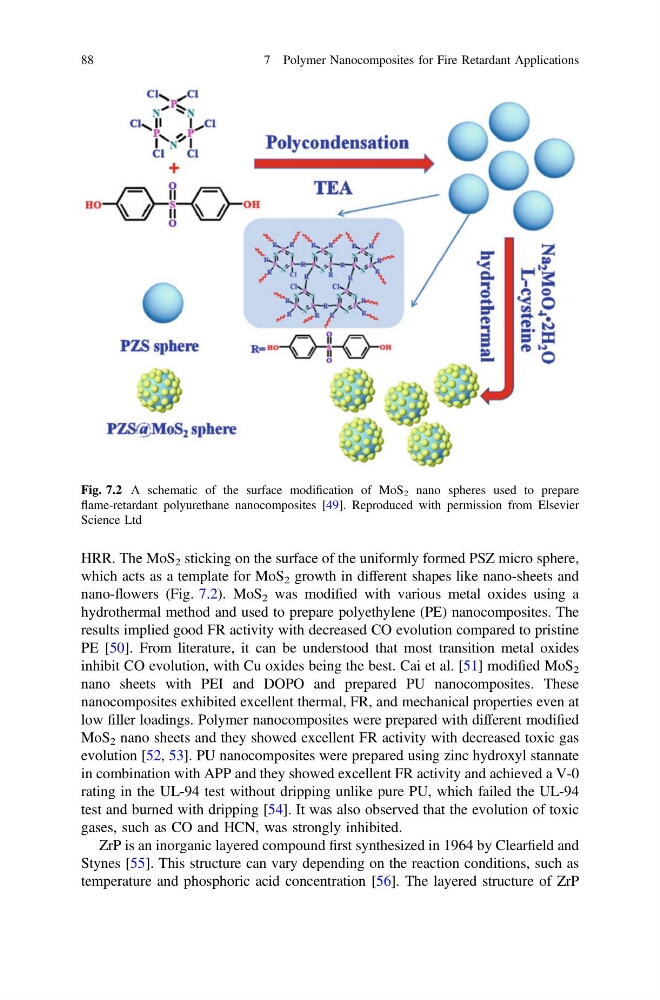
HRR. The MoS 2 sticking on the surface of the uniformly formed PSZ micro sphere,
which acts as a template for MoS 2 growth in different shapes like nano-sheets and
nano-flowers (Fig. 7.2). MoS 2 was modified with various metal oxides using a
hydrothermal method and used to prepare polyethylene (PE) nanocomposites. The
results implied good FR activity with decreased CO evolution compared to pristine
PE [50]. From literature, it can be understood that most transition metal oxides
inhibit CO evolution, with Cu oxides being the best. Cai et al. [51] modified MoS 2
nano sheets with PEI and DOPO and prepared PU nanocomposites. These
nanocomposites exhibited excellent thermal, FR, and mechanical properties even at
low filler loadings. Polymer nanocomposites were prepared with different modified
MoS 2 nano sheets and they showed excellent FR activity with decreased toxic gas
evolution [52, 53]. PU nanocomposites were prepared using zinc hydroxyl stannate
in combination with APP and they showed excellent FR activity and achieved a V-0
rating in the UL-94 test without dripping unlike pure PU, which failed the UL-94
test and burned with dripping [54]. It was also observed that the evolution of toxic
gases, such as CO and HCN, was strongly inhibited.
ZrP is an inorganic layered compound first synthesized in 1964 by Clearfield and
Stynes [55]. This structure can vary depending on the reaction conditions, such as
temperature and phosphoric acid concentration [56]. The layered structure of ZrP
Fig. 7.2 A schematic of the surface modification of MoS 2 nano spheres used to prepare
flame-retardant polyurethane nanocomposites [49]. Reproduced with permission from Elsevier
Science Ltd
88
7 Polymer Nanocomposites for Fire Retardant Applications
which acts as a template for MoS 2 growth in different shapes like nano-sheets and
nano-flowers (Fig. 7.2). MoS 2 was modified with various metal oxides using a
hydrothermal method and used to prepare polyethylene (PE) nanocomposites. The
results implied good FR activity with decreased CO evolution compared to pristine
PE [50]. From literature, it can be understood that most transition metal oxides
inhibit CO evolution, with Cu oxides being the best. Cai et al. [51] modified MoS 2
nano sheets with PEI and DOPO and prepared PU nanocomposites. These
nanocomposites exhibited excellent thermal, FR, and mechanical properties even at
low filler loadings. Polymer nanocomposites were prepared with different modified
MoS 2 nano sheets and they showed excellent FR activity with decreased toxic gas
evolution [52, 53]. PU nanocomposites were prepared using zinc hydroxyl stannate
in combination with APP and they showed excellent FR activity and achieved a V-0
rating in the UL-94 test without dripping unlike pure PU, which failed the UL-94
test and burned with dripping [54]. It was also observed that the evolution of toxic
gases, such as CO and HCN, was strongly inhibited.
ZrP is an inorganic layered compound first synthesized in 1964 by Clearfield and
Stynes [55]. This structure can vary depending on the reaction conditions, such as
temperature and phosphoric acid concentration [56]. The layered structure of ZrP
Fig. 7.2 A schematic of the surface modification of MoS 2 nano spheres used to prepare
flame-retardant polyurethane nanocomposites [49]. Reproduced with permission from Elsevier
Science Ltd
88
7 Polymer Nanocomposites for Fire Retardant Applications