

resembles the montmorillonite (MMT) clay structure; in the layered structure, the
Zr atoms are connected to the oxygen atoms of phosphate groups. The ZrP layered
structure was modified with different types of organic compounds and
organo-phosphorus compounds similar to MMT clays to prepare polymer
nanocomposites for FR applications. Zhang et al. [57] modified ZrP with
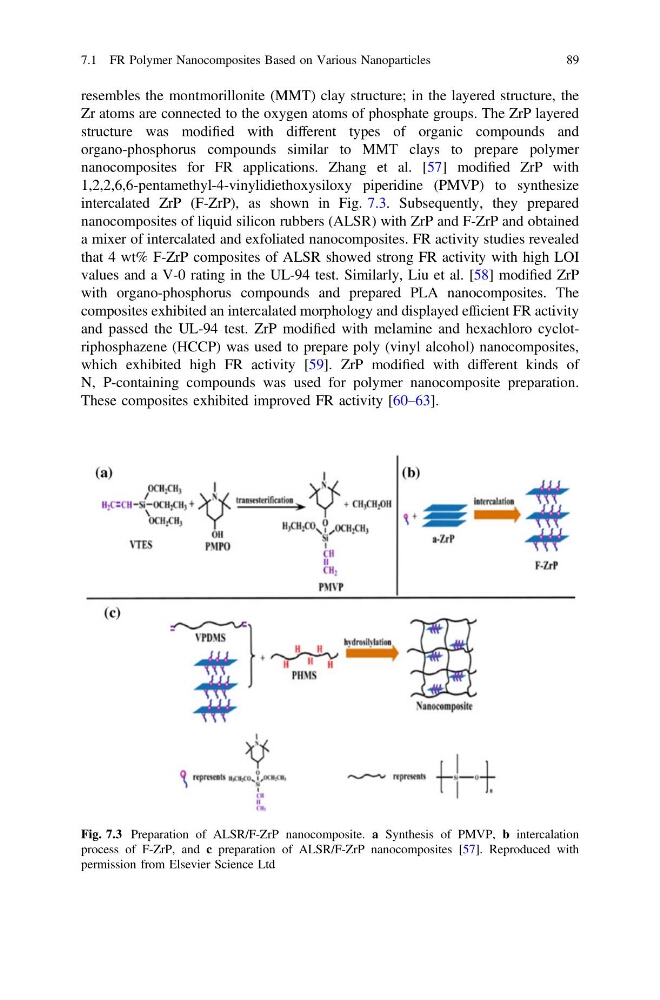
1,2,2,6,6-pentamethyl-4-vinylidiethoxysiloxy piperidine (PMVP) to synthesize
intercalated ZrP (F-ZrP), as shown in Fig. 7.3. Subsequently, they prepared
nanocomposites of liquid silicon rubbers (ALSR) with ZrP and F-ZrP and obtained
a mixer of intercalated and exfoliated nanocomposites. FR activity studies revealed
that 4 wt% F-ZrP composites of ALSR showed strong FR activity with high LOI
values and a V-0 rating in the UL-94 test. Similarly, Liu et al. [58] modified ZrP
with organo-phosphorus compounds and prepared PLA nanocomposites. The
composites exhibited an intercalated morphology and displayed efficient FR activity
and passed the UL-94 test. ZrP modified with melamine and hexachloro cyclotriphosphazene (HCCP) was used to prepare poly (vinyl alcohol) nanocomposites,
which exhibited high FR activity [59]. ZrP modified with different kinds of
N, P-containing compounds was used for polymer nanocomposite preparation.
These composites exhibited improved FR activity [60–63].
Fig. 7.3 Preparation of ALSR/F-ZrP nanocomposite. a Synthesis of PMVP, b intercalation
process of F-ZrP, and c preparation of ALSR/F-ZrP nanocomposites [57]. Reproduced with
permission from Elsevier Science Ltd
7.1 FR Polymer Nanocomposites Based on Various Nanoparticles
89
Zr atoms are connected to the oxygen atoms of phosphate groups. The ZrP layered
structure was modified with different types of organic compounds and
organo-phosphorus compounds similar to MMT clays to prepare polymer
nanocomposites for FR applications. Zhang et al. [57] modified ZrP with
1,2,2,6,6-pentamethyl-4-vinylidiethoxysiloxy piperidine (PMVP) to synthesize
intercalated ZrP (F-ZrP), as shown in Fig. 7.3. Subsequently, they prepared
nanocomposites of liquid silicon rubbers (ALSR) with ZrP and F-ZrP and obtained
a mixer of intercalated and exfoliated nanocomposites. FR activity studies revealed
that 4 wt% F-ZrP composites of ALSR showed strong FR activity with high LOI
values and a V-0 rating in the UL-94 test. Similarly, Liu et al. [58] modified ZrP
with organo-phosphorus compounds and prepared PLA nanocomposites. The
composites exhibited an intercalated morphology and displayed efficient FR activity
and passed the UL-94 test. ZrP modified with melamine and hexachloro cyclotriphosphazene (HCCP) was used to prepare poly (vinyl alcohol) nanocomposites,
which exhibited high FR activity [59]. ZrP modified with different kinds of
N, P-containing compounds was used for polymer nanocomposite preparation.
These composites exhibited improved FR activity [60–63].
Fig. 7.3 Preparation of ALSR/F-ZrP nanocomposite. a Synthesis of PMVP, b intercalation
process of F-ZrP, and c preparation of ALSR/F-ZrP nanocomposites [57]. Reproduced with
permission from Elsevier Science Ltd
7.1 FR Polymer Nanocomposites Based on Various Nanoparticles
89