

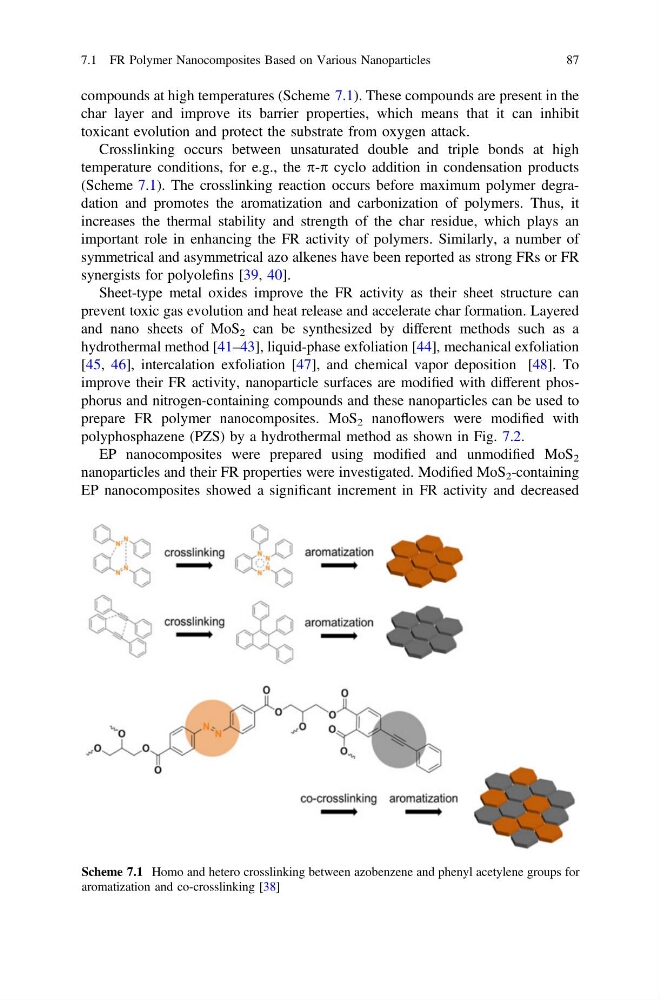
compounds at high temperatures (Scheme 7.1). These compounds are present in the
char layer and improve its barrier properties, which means that it can inhibit
toxicant evolution and protect the substrate from oxygen attack.
Crosslinking occurs between unsaturated double and triple bonds at high
temperature conditions, for e.g., the p-p cyclo addition in condensation products
(Scheme 7.1). The crosslinking reaction occurs before maximum polymer degradation and promotes the aromatization and carbonization of polymers. Thus, it
increases the thermal stability and strength of the char residue, which plays an
important role in enhancing the FR activity of polymers. Similarly, a number of
symmetrical and asymmetrical azo alkenes have been reported as strong FRs or FR
synergists for polyolefins [39, 40].
Sheet-type metal oxides improve the FR activity as their sheet structure can
prevent toxic gas evolution and heat release and accelerate char formation. Layered
and nano sheets of MoS 2 can be synthesized by different methods such as a
hydrothermal method [41–43], liquid-phase exfoliation [44], mechanical exfoliation
[45, 46], intercalation exfoliation [47], and chemical vapor deposition [48]. To
improve their FR activity, nanoparticle surfaces are modified with different phosphorus and nitrogen-containing compounds and these nanoparticles can be used to
prepare FR polymer nanocomposites. MoS 2 nanoflowers were modified with
polyphosphazene (PZS) by a hydrothermal method as shown in Fig. 7.2.
EP nanocomposites were prepared using modified and unmodified MoS 2
nanoparticles and their FR properties were investigated. Modified MoS 2 -containing
EP nanocomposites showed a significant increment in FR activity and decreased
Scheme 7.1 Homo and hetero crosslinking between azobenzene and phenyl acetylene groups for
aromatization and co-crosslinking [38]
7.1 FR Polymer Nanocomposites Based on Various Nanoparticles
87
char layer and improve its barrier properties, which means that it can inhibit
toxicant evolution and protect the substrate from oxygen attack.
Crosslinking occurs between unsaturated double and triple bonds at high
temperature conditions, for e.g., the p-p cyclo addition in condensation products
(Scheme 7.1). The crosslinking reaction occurs before maximum polymer degradation and promotes the aromatization and carbonization of polymers. Thus, it
increases the thermal stability and strength of the char residue, which plays an
important role in enhancing the FR activity of polymers. Similarly, a number of
symmetrical and asymmetrical azo alkenes have been reported as strong FRs or FR
synergists for polyolefins [39, 40].
Sheet-type metal oxides improve the FR activity as their sheet structure can
prevent toxic gas evolution and heat release and accelerate char formation. Layered
and nano sheets of MoS 2 can be synthesized by different methods such as a
hydrothermal method [41–43], liquid-phase exfoliation [44], mechanical exfoliation
[45, 46], intercalation exfoliation [47], and chemical vapor deposition [48]. To
improve their FR activity, nanoparticle surfaces are modified with different phosphorus and nitrogen-containing compounds and these nanoparticles can be used to
prepare FR polymer nanocomposites. MoS 2 nanoflowers were modified with
polyphosphazene (PZS) by a hydrothermal method as shown in Fig. 7.2.
EP nanocomposites were prepared using modified and unmodified MoS 2
nanoparticles and their FR properties were investigated. Modified MoS 2 -containing
EP nanocomposites showed a significant increment in FR activity and decreased
Scheme 7.1 Homo and hetero crosslinking between azobenzene and phenyl acetylene groups for
aromatization and co-crosslinking [38]
7.1 FR Polymer Nanocomposites Based on Various Nanoparticles
87