

be further dehydrate the polymer chains to form char as we observed in the case of
nanocomposite samples. In the OMMT-1, phosphonium derivatives are formed
from the surfactant during combustion at high temperatures, creating the possibility
for the formation of aryl phosphine, phosphite oxides, and also graphitic crosslinked char, resulting in highly compact and strong char, which inhibits the volatile
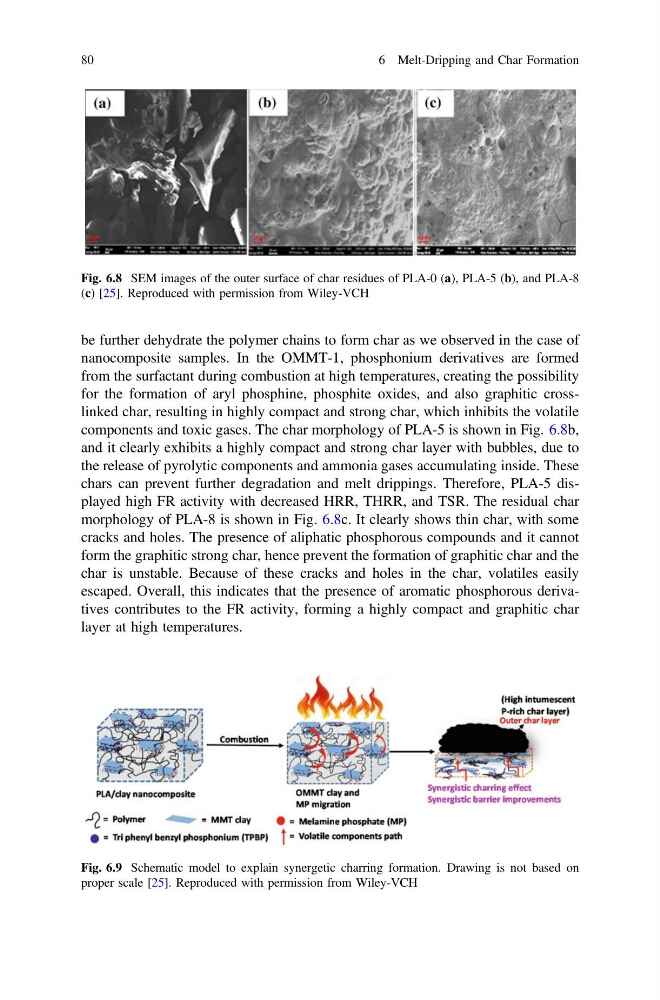
components and toxic gases. The char morphology of PLA-5 is shown in Fig. 6.8b,
and it clearly exhibits a highly compact and strong char layer with bubbles, due to
the release of pyrolytic components and ammonia gases accumulating inside. These
chars can prevent further degradation and melt drippings. Therefore, PLA-5 displayed high FR activity with decreased HRR, THRR, and TSR. The residual char
morphology of PLA-8 is shown in Fig. 6.8c. It clearly shows thin char, with some
cracks and holes. The presence of aliphatic phosphorous compounds and it cannot
form the graphitic strong char, hence prevent the formation of graphitic char and the
char is unstable. Because of these cracks and holes in the char, volatiles easily
escaped. Overall, this indicates that the presence of aromatic phosphorous derivatives contributes to the FR activity, forming a highly compact and graphitic char
layer at high temperatures.
Fig. 6.8 SEM images of the outer surface of char residues of PLA-0 (a), PLA-5 (b), and PLA-8
(c) [25]. Reproduced with permission from Wiley-VCH
Fig. 6.9 Schematic model to explain synergetic charring formation. Drawing is not based on
proper scale [25]. Reproduced with permission from Wiley-VCH
80
6 Melt-Dripping and Char Formation
nanocomposite samples. In the OMMT-1, phosphonium derivatives are formed
from the surfactant during combustion at high temperatures, creating the possibility
for the formation of aryl phosphine, phosphite oxides, and also graphitic crosslinked char, resulting in highly compact and strong char, which inhibits the volatile
components and toxic gases. The char morphology of PLA-5 is shown in Fig. 6.8b,
and it clearly exhibits a highly compact and strong char layer with bubbles, due to
the release of pyrolytic components and ammonia gases accumulating inside. These
chars can prevent further degradation and melt drippings. Therefore, PLA-5 displayed high FR activity with decreased HRR, THRR, and TSR. The residual char
morphology of PLA-8 is shown in Fig. 6.8c. It clearly shows thin char, with some
cracks and holes. The presence of aliphatic phosphorous compounds and it cannot
form the graphitic strong char, hence prevent the formation of graphitic char and the
char is unstable. Because of these cracks and holes in the char, volatiles easily
escaped. Overall, this indicates that the presence of aromatic phosphorous derivatives contributes to the FR activity, forming a highly compact and graphitic char
layer at high temperatures.
Fig. 6.8 SEM images of the outer surface of char residues of PLA-0 (a), PLA-5 (b), and PLA-8
(c) [25]. Reproduced with permission from Wiley-VCH
Fig. 6.9 Schematic model to explain synergetic charring formation. Drawing is not based on
proper scale [25]. Reproduced with permission from Wiley-VCH
80
6 Melt-Dripping and Char Formation