

TEM analyses, in PLA-5, a greater degree of delamination of silicate layers occurs
during the melt-blending process. We also believe at this specific composition,
there may be strong interactions between the OMMT-1 (nanocomposite containing
1 wt% OMMT) and MP. Hence, while burning with the clay, the high phosphorous
containing compounds migrate to the polymer surface and enrich the char residue
and char strength. Forming a continuous, highly compact char layer on the substrate
results in the excellent FR activity of the PLA-5 nanocomposite system. Another
explanation is a possible synergetic effect at this specific composition, because such
an improvement in char residue was not observed in the other compositions, PLA-3
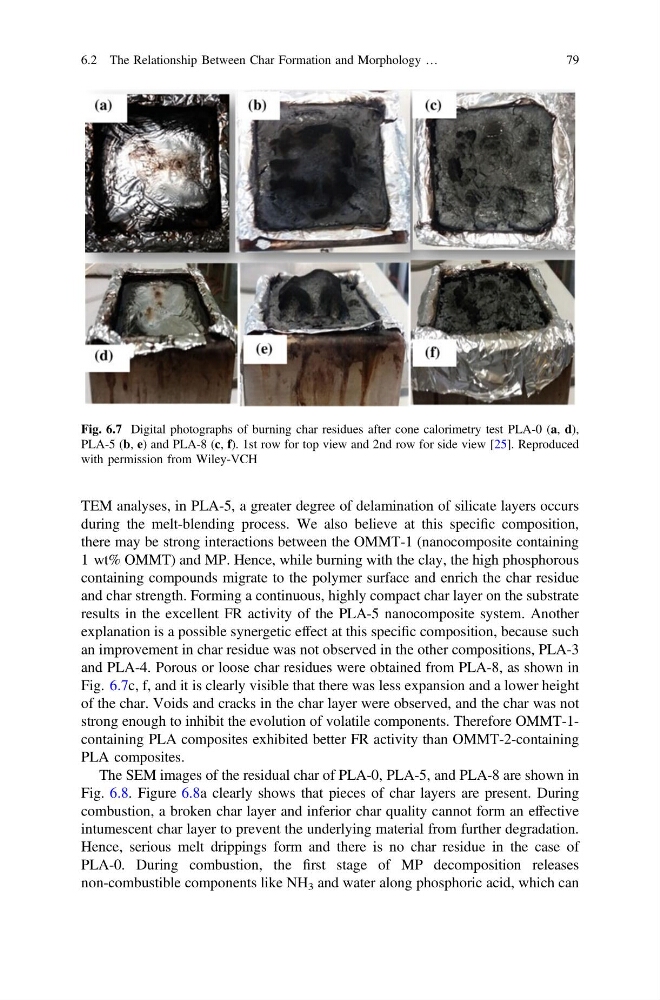
and PLA-4. Porous or loose char residues were obtained from PLA-8, as shown in
Fig. 6.7c, f, and it is clearly visible that there was less expansion and a lower height
of the char. Voids and cracks in the char layer were observed, and the char was not
strong enough to inhibit the evolution of volatile components. Therefore OMMT-1containing PLA composites exhibited better FR activity than OMMT-2-containing
PLA composites.
The SEM images of the residual char of PLA-0, PLA-5, and PLA-8 are shown in
Fig. 6.8. Figure 6.8a clearly shows that pieces of char layers are present. During
combustion, a broken char layer and inferior char quality cannot form an effective
intumescent char layer to prevent the underlying material from further degradation.
Hence, serious melt drippings form and there is no char residue in the case of
PLA-0. During combustion, the first stage of MP decomposition releases
non-combustible components like NH 3 and water along phosphoric acid, which can
Fig. 6.7 Digital photographs of burning char residues after cone calorimetry test PLA-0 (a, d),
PLA-5 (b, e) and PLA-8 (c, f). 1st row for top view and 2nd row for side view [25]. Reproduced
with permission from Wiley-VCH
6.2 The Relationship Between Char Formation and Morphology …
79
during the melt-blending process. We also believe at this specific composition,
there may be strong interactions between the OMMT-1 (nanocomposite containing
1 wt% OMMT) and MP. Hence, while burning with the clay, the high phosphorous
containing compounds migrate to the polymer surface and enrich the char residue
and char strength. Forming a continuous, highly compact char layer on the substrate
results in the excellent FR activity of the PLA-5 nanocomposite system. Another
explanation is a possible synergetic effect at this specific composition, because such
an improvement in char residue was not observed in the other compositions, PLA-3
and PLA-4. Porous or loose char residues were obtained from PLA-8, as shown in
Fig. 6.7c, f, and it is clearly visible that there was less expansion and a lower height
of the char. Voids and cracks in the char layer were observed, and the char was not
strong enough to inhibit the evolution of volatile components. Therefore OMMT-1containing PLA composites exhibited better FR activity than OMMT-2-containing
PLA composites.
The SEM images of the residual char of PLA-0, PLA-5, and PLA-8 are shown in
Fig. 6.8. Figure 6.8a clearly shows that pieces of char layers are present. During
combustion, a broken char layer and inferior char quality cannot form an effective
intumescent char layer to prevent the underlying material from further degradation.
Hence, serious melt drippings form and there is no char residue in the case of
PLA-0. During combustion, the first stage of MP decomposition releases
non-combustible components like NH 3 and water along phosphoric acid, which can
Fig. 6.7 Digital photographs of burning char residues after cone calorimetry test PLA-0 (a, d),
PLA-5 (b, e) and PLA-8 (c, f). 1st row for top view and 2nd row for side view [25]. Reproduced
with permission from Wiley-VCH
6.2 The Relationship Between Char Formation and Morphology …
79