

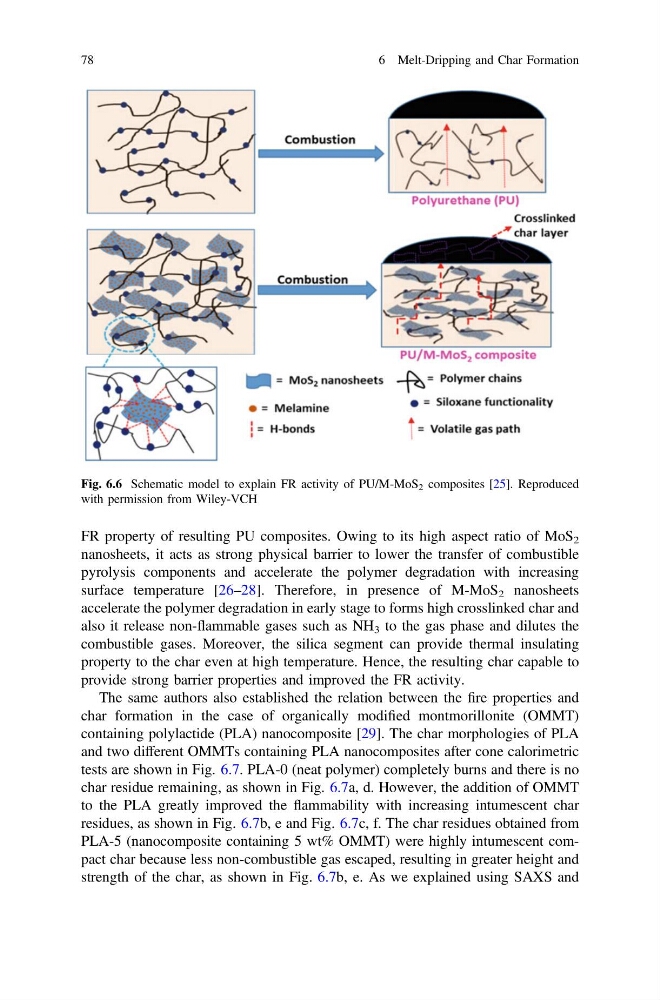
FR property of resulting PU composites. Owing to its high aspect ratio of MoS 2
nanosheets, it acts as strong physical barrier to lower the transfer of combustible
pyrolysis components and accelerate the polymer degradation with increasing
surface temperature [26–28]. Therefore, in presence of M-MoS 2 nanosheets
accelerate the polymer degradation in early stage to forms high crosslinked char and
also it release non-flammable gases such as NH 3 to the gas phase and dilutes the
combustible gases. Moreover, the silica segment can provide thermal insulating
property to the char even at high temperature. Hence, the resulting char capable to
provide strong barrier properties and improved the FR activity.
The same authors also established the relation between the fire properties and
char formation in the case of organically modified montmorillonite (OMMT)
containing polylactide (PLA) nanocomposite [29]. The char morphologies of PLA
and two different OMMTs containing PLA nanocomposites after cone calorimetric
tests are shown in Fig. 6.7. PLA-0 (neat polymer) completely burns and there is no
char residue remaining, as shown in Fig. 6.7a, d. However, the addition of OMMT
to the PLA greatly improved the flammability with increasing intumescent char
residues, as shown in Fig. 6.7b, e and Fig. 6.7c, f. The char residues obtained from
PLA-5 (nanocomposite containing 5 wt% OMMT) were highly intumescent compact char because less non-combustible gas escaped, resulting in greater height and
strength of the char, as shown in Fig. 6.7b, e. As we explained using SAXS and
Fig. 6.6 Schematic model to explain FR activity of PU/M-MoS 2 composites [25]. Reproduced
with permission from Wiley-VCH
78
6 Melt-Dripping and Char Formation
nanosheets, it acts as strong physical barrier to lower the transfer of combustible
pyrolysis components and accelerate the polymer degradation with increasing
surface temperature [26–28]. Therefore, in presence of M-MoS 2 nanosheets
accelerate the polymer degradation in early stage to forms high crosslinked char and
also it release non-flammable gases such as NH 3 to the gas phase and dilutes the
combustible gases. Moreover, the silica segment can provide thermal insulating
property to the char even at high temperature. Hence, the resulting char capable to
provide strong barrier properties and improved the FR activity.
The same authors also established the relation between the fire properties and
char formation in the case of organically modified montmorillonite (OMMT)
containing polylactide (PLA) nanocomposite [29]. The char morphologies of PLA
and two different OMMTs containing PLA nanocomposites after cone calorimetric
tests are shown in Fig. 6.7. PLA-0 (neat polymer) completely burns and there is no
char residue remaining, as shown in Fig. 6.7a, d. However, the addition of OMMT
to the PLA greatly improved the flammability with increasing intumescent char
residues, as shown in Fig. 6.7b, e and Fig. 6.7c, f. The char residues obtained from
PLA-5 (nanocomposite containing 5 wt% OMMT) were highly intumescent compact char because less non-combustible gas escaped, resulting in greater height and
strength of the char, as shown in Fig. 6.7b, e. As we explained using SAXS and
Fig. 6.6 Schematic model to explain FR activity of PU/M-MoS 2 composites [25]. Reproduced
with permission from Wiley-VCH
78
6 Melt-Dripping and Char Formation