

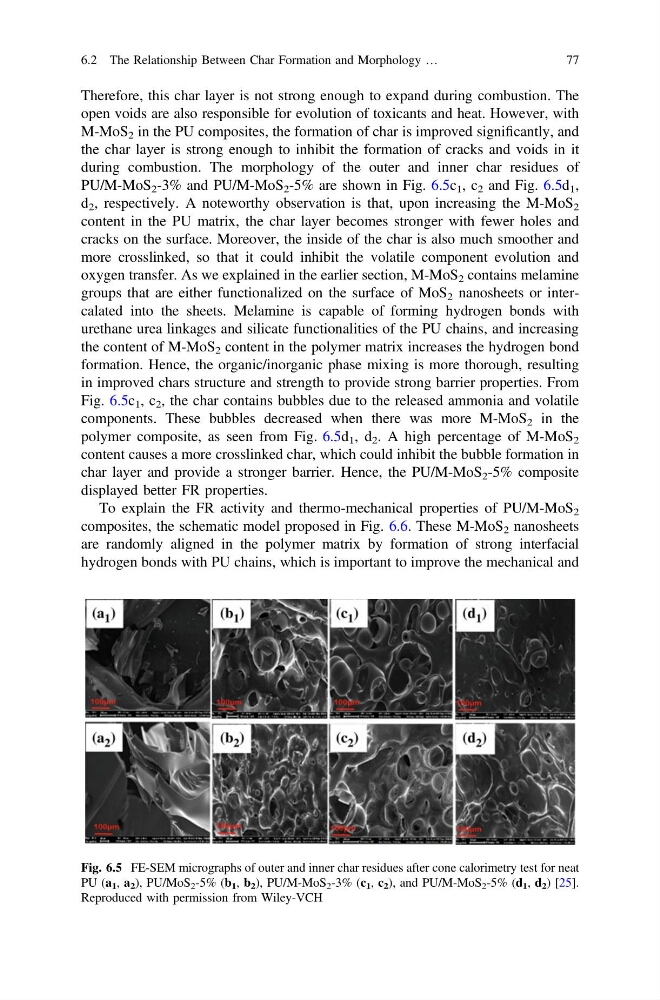
Therefore, this char layer is not strong enough to expand during combustion. The
open voids are also responsible for evolution of toxicants and heat. However, with
M-MoS 2 in the PU composites, the formation of char is improved significantly, and
the char layer is strong enough to inhibit the formation of cracks and voids in it
during combustion. The morphology of the outer and inner char residues of
PU/M-MoS 2 -3% and PU/M-MoS 2 -5% are shown in Fig. 6.5c 1 , c 2 and Fig. 6.5d 1 ,
d 2 , respectively. A noteworthy observation is that, upon increasing the M-MoS 2
content in the PU matrix, the char layer becomes stronger with fewer holes and
cracks on the surface. Moreover, the inside of the char is also much smoother and
more crosslinked, so that it could inhibit the volatile component evolution and
oxygen transfer. As we explained in the earlier section, M-MoS 2 contains melamine
groups that are either functionalized on the surface of MoS 2 nanosheets or intercalated into the sheets. Melamine is capable of forming hydrogen bonds with
urethane urea linkages and silicate functionalities of the PU chains, and increasing
the content of M-MoS 2 content in the polymer matrix increases the hydrogen bond
formation. Hence, the organic/inorganic phase mixing is more thorough, resulting
in improved chars structure and strength to provide strong barrier properties. From
Fig. 6.5c 1 , c 2 , the char contains bubbles due to the released ammonia and volatile
components. These bubbles decreased when there was more M-MoS 2 in the
polymer composite, as seen from Fig. 6.5d 1 , d 2 . A high percentage of M-MoS 2
content causes a more crosslinked char, which could inhibit the bubble formation in
char layer and provide a stronger barrier. Hence, the PU/M-MoS 2 -5% composite
displayed better FR properties.
To explain the FR activity and thermo-mechanical properties of PU/M-MoS 2
composites, the schematic model proposed in Fig. 6.6. These M-MoS 2 nanosheets
are randomly aligned in the polymer matrix by formation of strong interfacial
hydrogen bonds with PU chains, which is important to improve the mechanical and
Fig. 6.5 FE-SEM micrographs of outer and inner char residues after cone calorimetry test for neat
PU (a 1 , a 2 ), PU/MoS 2 -5% (b 1 , b 2 ), PU/M-MoS 2 -3% (c 1 , c 2 ), and PU/M-MoS 2 -5% (d 1 , d 2 ) [25].
Reproduced with permission from Wiley-VCH
6.2 The Relationship Between Char Formation and Morphology …
77
open voids are also responsible for evolution of toxicants and heat. However, with
M-MoS 2 in the PU composites, the formation of char is improved significantly, and
the char layer is strong enough to inhibit the formation of cracks and voids in it
during combustion. The morphology of the outer and inner char residues of
PU/M-MoS 2 -3% and PU/M-MoS 2 -5% are shown in Fig. 6.5c 1 , c 2 and Fig. 6.5d 1 ,
d 2 , respectively. A noteworthy observation is that, upon increasing the M-MoS 2
content in the PU matrix, the char layer becomes stronger with fewer holes and
cracks on the surface. Moreover, the inside of the char is also much smoother and
more crosslinked, so that it could inhibit the volatile component evolution and
oxygen transfer. As we explained in the earlier section, M-MoS 2 contains melamine
groups that are either functionalized on the surface of MoS 2 nanosheets or intercalated into the sheets. Melamine is capable of forming hydrogen bonds with
urethane urea linkages and silicate functionalities of the PU chains, and increasing
the content of M-MoS 2 content in the polymer matrix increases the hydrogen bond
formation. Hence, the organic/inorganic phase mixing is more thorough, resulting
in improved chars structure and strength to provide strong barrier properties. From
Fig. 6.5c 1 , c 2 , the char contains bubbles due to the released ammonia and volatile
components. These bubbles decreased when there was more M-MoS 2 in the
polymer composite, as seen from Fig. 6.5d 1 , d 2 . A high percentage of M-MoS 2
content causes a more crosslinked char, which could inhibit the bubble formation in
char layer and provide a stronger barrier. Hence, the PU/M-MoS 2 -5% composite
displayed better FR properties.
To explain the FR activity and thermo-mechanical properties of PU/M-MoS 2
composites, the schematic model proposed in Fig. 6.6. These M-MoS 2 nanosheets
are randomly aligned in the polymer matrix by formation of strong interfacial
hydrogen bonds with PU chains, which is important to improve the mechanical and
Fig. 6.5 FE-SEM micrographs of outer and inner char residues after cone calorimetry test for neat
PU (a 1 , a 2 ), PU/MoS 2 -5% (b 1 , b 2 ), PU/M-MoS 2 -3% (c 1 , c 2 ), and PU/M-MoS 2 -5% (d 1 , d 2 ) [25].
Reproduced with permission from Wiley-VCH
6.2 The Relationship Between Char Formation and Morphology …
77