

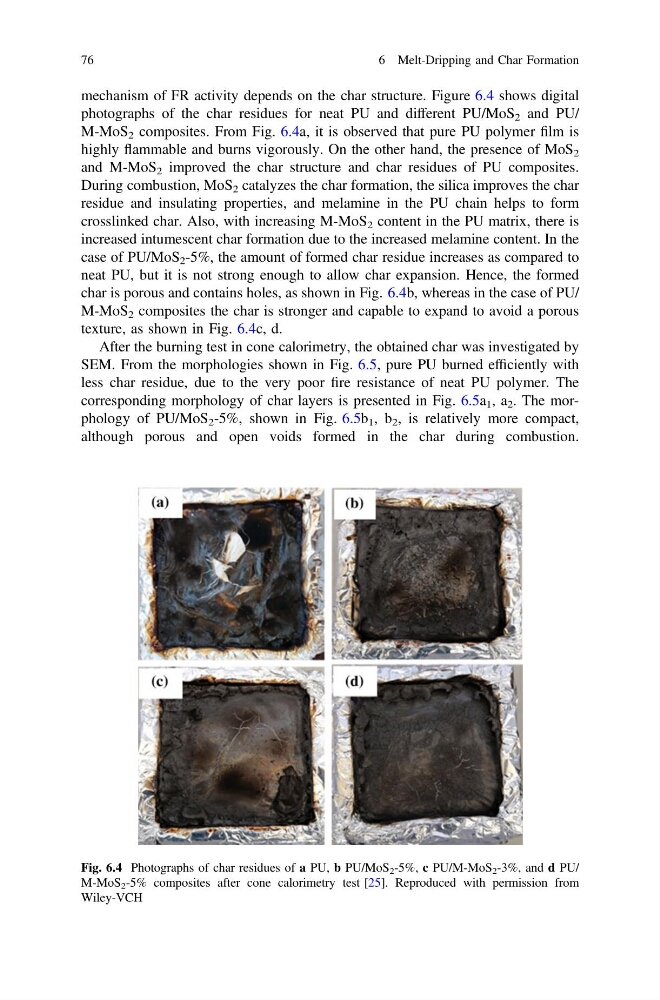
mechanism of FR activity depends on the char structure. Figure 6.4 shows digital
photographs of the char residues for neat PU and different PU/MoS 2 and PU/
M-MoS 2 composites. From Fig. 6.4a, it is observed that pure PU polymer film is
highly flammable and burns vigorously. On the other hand, the presence of MoS 2
and M-MoS 2 improved the char structure and char residues of PU composites.
During combustion, MoS 2 catalyzes the char formation, the silica improves the char
residue and insulating properties, and melamine in the PU chain helps to form
crosslinked char. Also, with increasing M-MoS 2 content in the PU matrix, there is
increased intumescent char formation due to the increased melamine content. In the
case of PU/MoS 2 -5%, the amount of formed char residue increases as compared to
neat PU, but it is not strong enough to allow char expansion. Hence, the formed
char is porous and contains holes, as shown in Fig. 6.4b, whereas in the case of PU/
M-MoS 2 composites the char is stronger and capable to expand to avoid a porous
texture, as shown in Fig. 6.4c, d.
After the burning test in cone calorimetry, the obtained char was investigated by
SEM. From the morphologies shown in Fig. 6.5, pure PU burned efficiently with
less char residue, due to the very poor fire resistance of neat PU polymer. The
corresponding morphology of char layers is presented in Fig. 6.5a 1 , a 2 . The morphology of PU/MoS 2 -5%, shown in Fig. 6.5b 1 , b 2 , is relatively more compact,
although porous and open voids formed in the char during combustion.
Fig. 6.4 Photographs of char residues of a PU, b PU/MoS 2 -5%, c PU/M-MoS 2 -3%, and d PU/
M-MoS 2 -5% composites after cone calorimetry test [25]. Reproduced with permission from
Wiley-VCH
76
6 Melt-Dripping and Char Formation
photographs of the char residues for neat PU and different PU/MoS 2 and PU/
M-MoS 2 composites. From Fig. 6.4a, it is observed that pure PU polymer film is
highly flammable and burns vigorously. On the other hand, the presence of MoS 2
and M-MoS 2 improved the char structure and char residues of PU composites.
During combustion, MoS 2 catalyzes the char formation, the silica improves the char
residue and insulating properties, and melamine in the PU chain helps to form
crosslinked char. Also, with increasing M-MoS 2 content in the PU matrix, there is
increased intumescent char formation due to the increased melamine content. In the
case of PU/MoS 2 -5%, the amount of formed char residue increases as compared to
neat PU, but it is not strong enough to allow char expansion. Hence, the formed
char is porous and contains holes, as shown in Fig. 6.4b, whereas in the case of PU/
M-MoS 2 composites the char is stronger and capable to expand to avoid a porous
texture, as shown in Fig. 6.4c, d.
After the burning test in cone calorimetry, the obtained char was investigated by
SEM. From the morphologies shown in Fig. 6.5, pure PU burned efficiently with
less char residue, due to the very poor fire resistance of neat PU polymer. The
corresponding morphology of char layers is presented in Fig. 6.5a 1 , a 2 . The morphology of PU/MoS 2 -5%, shown in Fig. 6.5b 1 , b 2 , is relatively more compact,
although porous and open voids formed in the char during combustion.
Fig. 6.4 Photographs of char residues of a PU, b PU/MoS 2 -5%, c PU/M-MoS 2 -3%, and d PU/
M-MoS 2 -5% composites after cone calorimetry test [25]. Reproduced with permission from
Wiley-VCH
76
6 Melt-Dripping and Char Formation